
UK Research Peptides: A Complete Guide to Peptide Science, Quality and Metabolic Research
What Are UK Research Peptides?
UK research peptides are peptide compounds supplied for scientific and laboratory investigation, allowing researchers to explore molecular structures, biological signalling pathways, receptor interactions, and other biochemical processes.
Peptides themselves are relatively short chains of amino acids connected by chemical bonds known as peptide bonds. Amino acids are also the building blocks of proteins, but peptides generally contain shorter sequences and can perform highly specific biological functions. UK Research Peptides
Some peptides occur naturally within biological systems, while others can be produced synthetically for controlled laboratory research. Their structural diversity and ability to interact with specific biological targets have made peptides an important area of investigation across biotechnology, molecular biology, metabolic science, endocrinology, and pharmaceutical research.
How Are Peptides Different From Proteins?
Both peptides and proteins are constructed from amino acids, but they generally differ in size and structural complexity.
Peptides typically consist of shorter amino-acid chains, while proteins are usually larger molecules that can fold into complex three-dimensional structures.
There is no single universally applied chain-length boundary separating every peptide from every protein, so the distinction is not simply a matter of counting amino acids. Molecular structure, biological function, and scientific context can also influence terminology.
Despite their relatively small size,Quality/COA peptides can have significant biological activity.
Many naturally occurring peptides function as signalling molecules, allowing different cells and tissues to communicate. Others participate in processes involving hormones, metabolism, immune signalling, appetite regulation, glucose control, and numerous other biological functions. v
Naturally Occurring Peptides
The body naturally produces many peptides as part of normal physiological processes.
One example is GLP-1 (glucagon-like peptide-1), an incretin hormone released primarily from the intestine following food intake. GLP-1 participates in appetite, glucose regulation, insulin signalling, and digestive processes. UK Research Peptides
Another is GIP (glucose-dependent insulinotropic polypeptide), which also participates in metabolic signalling following nutrient intake.
Studying naturally occurring peptide pathways helps researchers understand how biological systems communicate and regulate complex physiological functions. UK Research Peptides
This knowledge can subsequently contribute to the development of synthetic compounds designed to interact with particular receptors or reproduce certain aspects of naturally occurring peptide signalling.
What Are Synthetic Research Peptides?
Researchers are not limited to studying peptides extracted directly from biological systems.
Peptides can also be synthesised under controlled conditions, allowing scientists to investigate specific amino-acid sequences and molecular characteristics. UK Research Peptides
Synthetic peptides may be designed to resemble naturally occurring molecules, contain structural modifications, or interact with particular biological targets.
This makes them valuable experimental tools.
Researchers can investigate questions such as how changing a peptide’s molecular structure affects receptor affinity, biological activity, stability, or other measurable properties.
The ability to examine individual compounds under controlled experimental conditions is one reason UK research peptides are used across a diverse range of scientific disciplines.
What Are Research Peptides Used to Study?
The applications of peptide research depend heavily on the individual compound and the scientific question being investigated.
Research areas can include:
- receptor binding and activation;
- cellular signalling;
- molecular interactions;
- metabolic pathways;
- endocrine signalling;
- glucose regulation;
- appetite and satiety pathways;
- immune signalling;
- peptide stability;
- structure-activity relationships; and
- pharmaceutical discovery and development.
A peptide’s relevance to one research area does not mean that it will behave similarly to another peptide associated with the same general category.
Small changes in amino-acid sequence or molecular structure can substantially alter receptor interactions and biological behaviour. UK Research Peptides
For this reason, researchers should evaluate individual research peptides in the UK according to their specific molecular characteristics and intended experimental application.
Why Are UK Research Peptides Becoming More Widely Studied?
Interest in peptide science has increased alongside advances in biotechnology, analytical chemistry, molecular biology, and pharmaceutical research.
Metabolic science provides one particularly prominent example.
Research into incretin hormones such as GLP-1 and GIP has contributed to a greater understanding of appetite regulation, glucose homeostasis, insulin signalling, digestion, and energy balance.
This research eventually contributed to the pharmaceutical development of compounds such as semaglutide, liraglutide, and tirzepatide.
However, peptide research extends far beyond these well-known compounds. Researchers continue to investigate numerous peptide structures and signalling pathways to better understand their molecular characteristics and potential biological significance. UK Research Peptides
Research Peptides Are Not Automatically Medicines
One of the most important distinctions when discussing UK research peptides is the difference between a compound intended for laboratory investigation and a regulated pharmaceutical medicine.
A research peptide is supplied according to its stated research purpose.
A prescription medicine, by contrast, is a specific pharmaceutical product developed and manufactured within a regulatory framework that evaluates areas such as formulation, manufacturing controls, quality, safety, effectiveness, approved indications, and prescribing information.
This distinction remains important even when the same compound name appears in both categories.
For example, semaglutide and tirzepatide are active compounds associated with regulated pharmaceutical medicines. Clinical evidence supporting those medicines relates to specific pharmaceutical formulations evaluated under controlled clinical conditions. UK Research Peptides
A laboratory research product carrying the same compound name should not automatically be assumed to have equivalent formulation, manufacturing standards, sterility, safety, effectiveness, or regulatory approval.
Why “Research Use Only” Matters
When a peptide is designated for research use only, that classification establishes an important boundary around its intended purpose.
Research materials are intended for controlled scientific or laboratory investigation according to appropriate research procedures. They should not be presented as substitutes for approved prescription medicines or assumed to be suitable for human administration. UK Research Peptides
This distinction also affects how scientific evidence should be interpreted.
Researchers can use published clinical studies to understand the biological significance of a particular compound or pathway. However, clinical results obtained using a regulated pharmaceutical formulation should not automatically be attributed to a separate research-use product.
Understanding this distinction provides an essential foundation for evaluating UK research peptides responsibly.
It also leads to the next important question: why have peptides become such valuable tools across modern scientific research?
Why Are Peptides Studied in Scientific Research?
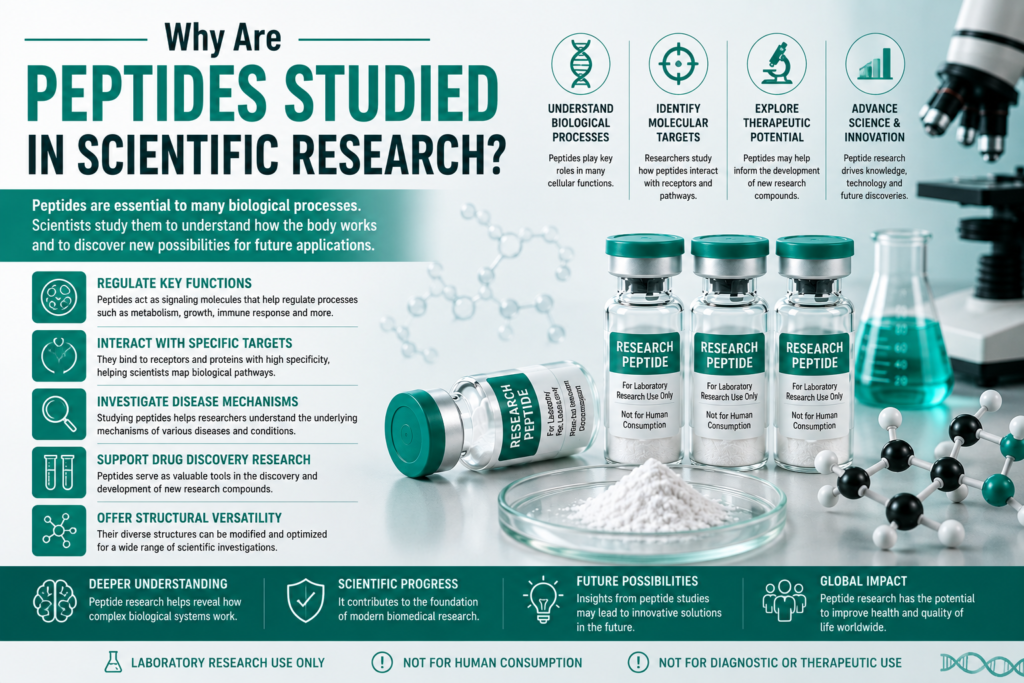
Peptides have become valuable tools in modern scientific research because of their ability to participate in highly specific biological processes. Their relatively small molecular size, structural diversity, and interactions with particular receptors make them useful for investigating how cells communicate and how biological pathways are regulated. UK Research Peptides
For researchers exploring UK research peptides, this means individual compounds can provide opportunities to investigate specific molecular mechanisms rather than treating complex biological systems as a single process.
Peptide research now spans areas including molecular biology, biotechnology, endocrinology, metabolic science, immunology, neuroscience, and pharmaceutical development.
Understanding Receptor Signalling
One of the most important areas of peptide research involves receptor signalling.
Many peptides exert biological effects by interacting with receptors located on the surface of cells or within biological systems. A receptor can recognise particular molecular structures, and when an appropriate molecule binds to it, a sequence of cellular events may be initiated. UK Research Peptides
Researchers study these interactions to understand questions such as:
- Which receptors does a peptide interact with?
- How strongly does it bind?
- Does it activate or inhibit the receptor?
- What cellular signals occur after receptor activation?
- How long does the resulting biological activity persist?
Understanding receptor interactions can provide valuable information about the role of a peptide within a particular biological pathway.
Studying Cellular Communication
Cells must constantly communicate to coordinate biological activity.
Peptides are involved in many of these communication systems and can function as molecular messengers between cells, tissues, and organs.
Researchers may use UK research peptides to investigate how these signals are transmitted and how cells respond when particular signalling pathways are activated or modified. UK Research Peptides
This can help scientists better understand normal biological processes as well as situations in which signalling pathways behave differently.
Metabolic Peptide Research
Metabolism has become one of the most prominent areas of peptide research.
Researchers investigate peptide-related pathways involved in glucose regulation, insulin signalling, appetite, satiety, digestion, and energy balance.
GLP-1 provides a well-known example.
Glucagon-like peptide-1 (GLP-1) is a naturally occurring incretin hormone involved in the body’s response to food. It participates in glucose-dependent insulin secretion and other processes associated with metabolic regulation. UK Research Peptides
Research into this pathway eventually contributed to the development of GLP-1 receptor agonists used in regulated pharmaceutical medicines.
Another important pathway involves GIP (glucose-dependent insulinotropic polypeptide). Research examining the interaction between GIP and GLP-1 signalling has contributed to the development of dual-receptor compounds such as tirzepatide.
These developments demonstrate how fundamental peptide research can contribute to a deeper understanding of biological mechanisms and eventually support pharmaceutical discovery. UK Research Peptides
Endocrine and Hormonal Research
Many peptides are closely connected with the endocrine system. UK Research Peptides
The endocrine system uses hormones and other signalling molecules to coordinate processes throughout the body. Some of these hormones are themselves peptides or proteins.
Researchers may therefore investigate peptide signalling to better understand hormone production, receptor activity, feedback mechanisms, and interactions between different endocrine pathways. UK Research Peptides
Because these systems are interconnected, studying a specific peptide can sometimes provide insight into broader biological networks.
Structure-Activity Relationships
Another important research area is the relationship between a peptide’s molecular structure and its biological activity.
Changing even a small part of an amino-acid sequence can potentially influence how a peptide interacts with receptors, how stable it is, or how it behaves under experimental conditions. UK Research Peptides
Scientists can compare related peptide structures to investigate which molecular features are responsible for particular interactions.
This field is often described as structure-activity relationship (SAR) research.
Understanding these relationships can be especially valuable during early-stage pharmaceutical research, where scientists may investigate how molecular modifications affect the characteristics of a candidate compound. UK Research Peptides
Peptide Stability Research
Peptides can also be studied to understand their stability under different conditions. UK Research Peptides
Factors such as temperature, moisture, light, pH, oxidation, and storage duration can potentially influence peptide stability depending on the compound.
Researchers may investigate how peptide materials change under controlled conditions and which molecular characteristics influence degradation.
This information can contribute to experimental design, analytical research, formulation science, and pharmaceutical development.
Pharmaceutical Discovery and Development
Peptide research has contributed to the development of numerous pharmaceutical compounds.
The process typically begins long before a medicine reaches clinical use. UK Research Peptides
Researchers first investigate biological pathways and molecular targets. Promising compounds may then undergo extensive preclinical evaluation before progressing to human clinical trials. Regulatory assessment and manufacturing requirements add further stages before a product can become an approved medicine.
The development of GLP-1 receptor agonists provides a useful example of this progression.
Scientific investigation of incretin biology contributed to compounds designed to activate GLP-1 receptors for longer periods than naturally occurring GLP-1. Subsequent pharmaceutical development and clinical research established specific formulations for defined medical indications. UK Research Peptides
This illustrates why UK research peptides and regulated medicines should be understood as different stages and categories within a much broader scientific landscape.
Research Findings Do Not Automatically Establish Clinical Use
Scientific research can reveal that a peptide interacts with a particular receptor or influences a biological pathway. That finding does not automatically mean the compound has been proven safe or effective as a medical treatment. UK Research Peptides
Laboratory findings, animal studies, early human research, randomised clinical trials, and regulatory approval represent different levels of evidence. UK Research Peptides
Researchers should therefore consider both what a study demonstrates and what it does not demonstrate.
This distinction is especially important when discussing peptides associated with popular areas such as weight management, where laboratory findings and clinical evidence are sometimes presented together without sufficient context.
For UK research peptides, maintaining this evidence-based distinction helps separate genuine scientific findings from unsupported claims.
Understanding why peptides are studied also raises a more detailed scientific question: how do research peptides actually interact with receptors and biological pathways at the molecular level?
How UK Research Peptides Work at the Molecular Level
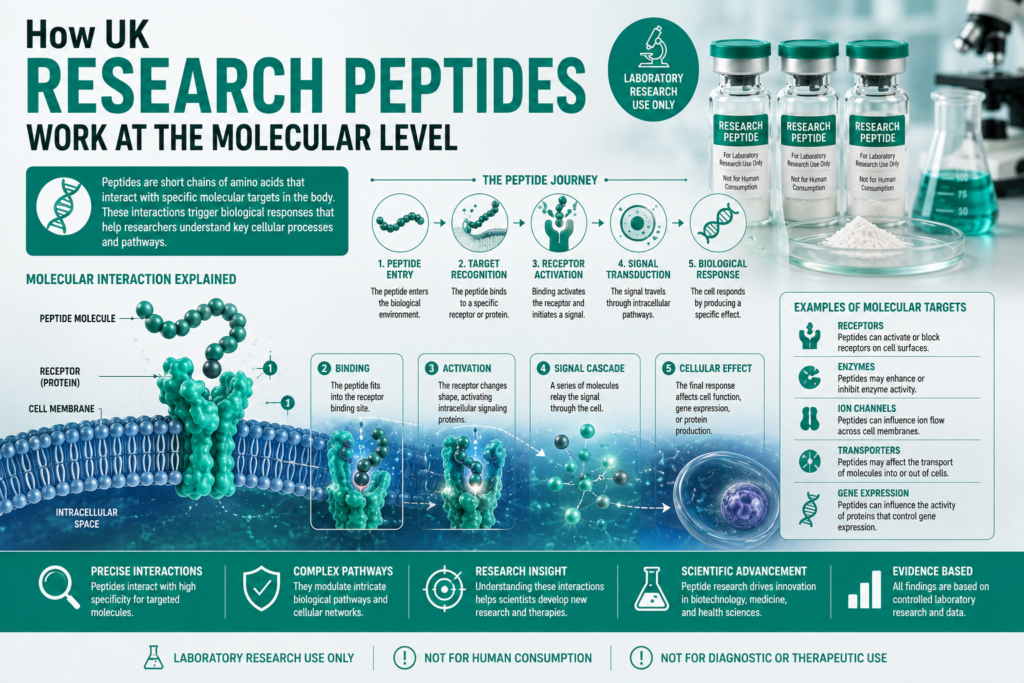
Understanding UK research peptides requires looking beyond the name of an individual compound and examining how peptides interact with biological systems at the molecular level. UK Research Peptides
Many peptides function as signalling molecules. Rather than acting independently throughout the body, they can interact with specific molecular targets—particularly receptors—and influence signalling pathways that regulate cellular activity.
The precise response depends on several factors, including the peptide’s amino-acid sequence, three-dimensional structure, receptor affinity, concentration, stability, and the biological system being studied.
This specificity is one of the characteristics that makes peptides valuable tools for laboratory research.
Peptide-Receptor Interactions
A receptor is a specialised protein capable of recognising particular molecules.
When an appropriate peptide interacts with a receptor, the binding event can change the receptor’s activity and trigger signalling processes within the cell.
This relationship is sometimes described using a lock-and-key analogy, where the peptide acts as the key and the receptor represents the lock. In reality, molecular interactions are considerably more complex, but the analogy helps illustrate why one peptide may interact strongly with a particular receptor while another does not.
Researchers studying UK research peptides may examine which receptors a compound interacts with, how strongly it binds, and what happens after that interaction occurs.
What Is Receptor Selectivity?
Peptides can differ in their receptor selectivity.
Some compounds primarily interact with one receptor, while others may influence multiple receptor systems.
This distinction can significantly affect biological activity. UK Research Peptides
Semaglutide and tirzepatide provide a useful example from metabolic research. Semaglutide primarily acts as a GLP-1 receptor agonist, whereas tirzepatide activates both GIP and GLP-1 receptors.
Although both compounds are associated with incretin and metabolic research, their receptor profiles are not identical.
Understanding receptor selectivity helps researchers investigate why related compounds may produce different experimental or pharmacological responses. UK Research Peptides
What Is a Peptide Agonist?
An agonist is a molecule that binds to a receptor and activates it.
Some research peptides are investigated because they act as agonists of specific biological receptors.
When an agonist binds successfully, it can cause the receptor to change its configuration and initiate intracellular signalling. UK Research Peptides
For example, GLP-1 receptor agonists are designed to activate the same receptor pathway influenced by naturally occurring GLP-1.
However, synthetic agonists may have structural modifications that alter properties such as stability, receptor affinity, or duration of activity. UK Research Peptides
Researchers can study these differences to better understand how molecular design influences biological function.
From Receptor Activation to Cellular Signalling
Receptor binding is only the beginning of the process. UK Research Peptides
Once a receptor is activated, the signal may be transmitted through a series of molecular events inside the cell. These processes are often described collectively as signal transduction.
Depending on the receptor and biological pathway, signalling may influence enzyme activity, gene expression, ion movement, secretion of other molecules, cellular metabolism, or numerous other functions.
Researchers may examine individual stages of these signalling pathways to understand how an initial peptide-receptor interaction eventually produces a measurable biological response. UK Research Peptides
This allows peptide research to move beyond simply asking whether a compound binds to a receptor and toward understanding what happens after binding occurs.
Why Amino-Acid Sequence Matters
The biological behaviour of a peptide is closely connected to its amino-acid sequence. UK Research Peptides
Each amino acid contributes particular chemical characteristics to the molecule. Changing one or more positions within the sequence can potentially affect the peptide’s shape, charge, stability, receptor affinity, or susceptibility to degradation.
As a result, two peptides that appear structurally similar may behave differently within the same experimental system. UK Research Peptides
Researchers can deliberately compare related peptide sequences to investigate these structure-activity relationships and determine which molecular features contribute to particular biological interactions.
Why Peptide Stability Matters
A peptide must remain sufficiently stable under the relevant experimental conditions for researchers to investigate its properties accurately.
Peptides can potentially undergo degradation or structural changes depending on the compound and environmental conditions.
Factors that may influence stability include temperature, moisture, light exposure, pH, oxidation, and storage duration. UK Research Peptides
Molecular modifications can also influence stability.
One challenge with naturally occurring signalling peptides is that some are rapidly degraded by biological enzymes. Pharmaceutical researchers may therefore investigate structural modifications designed to extend the duration of receptor activity.
This principle played an important role in the development of several peptide-based medicines.
Small Molecular Changes Can Produce Major Differences
One of the most important lessons from peptide science is that similar compounds should not automatically be treated as interchangeable. UK Research Peptides
A relatively small structural modification can potentially change:
- receptor affinity;
- receptor selectivity;
- molecular stability;
- biological activity;
- duration of activity;
- degradation characteristics; and
- experimental behaviour.
This is why researchers evaluating UK research peptides should consider the exact identity and molecular characteristics of each compound rather than relying solely on broad categories such as “metabolic peptides” or “weight-loss peptides.”
Concentration Is Not the Same as Biological Potency
Another important distinction is the difference between the amount of a compound and its biological activity.
Two different peptides supplied in identical milligram quantities should not be assumed to have equivalent potency. UK Research Peptides
Molecular weight, receptor affinity, receptor selectivity, experimental conditions, and many other factors can influence the response observed in a research model.
For the same reason, dosage information associated with one peptide cannot simply be transferred to another compound. UK Research Peptides
Researchers should evaluate each material according to its individual characteristics and the requirements of the experimental model being used.
Why Molecular Mechanisms Matter in Peptide Research
Understanding molecular mechanisms allows researchers to connect a peptide’s structure with its biological behaviour. UK Research Peptides
Rather than simply observing that a particular effect occurs, researchers can investigate the sequence of events responsible for that response:
Peptide structure → receptor interaction → receptor activation → intracellular signalling → measurable biological response
This framework is fundamental to modern peptide research. UK Research Peptides
It also helps explain why some of the most significant developments in metabolic science have emerged from studying specific hormone-receptor systems.
Among the most prominent examples are GLP-1 and GIP, two incretin pathways that have become major areas of metabolic research and pharmaceutical development.
UK Research Peptides and Metabolic Science
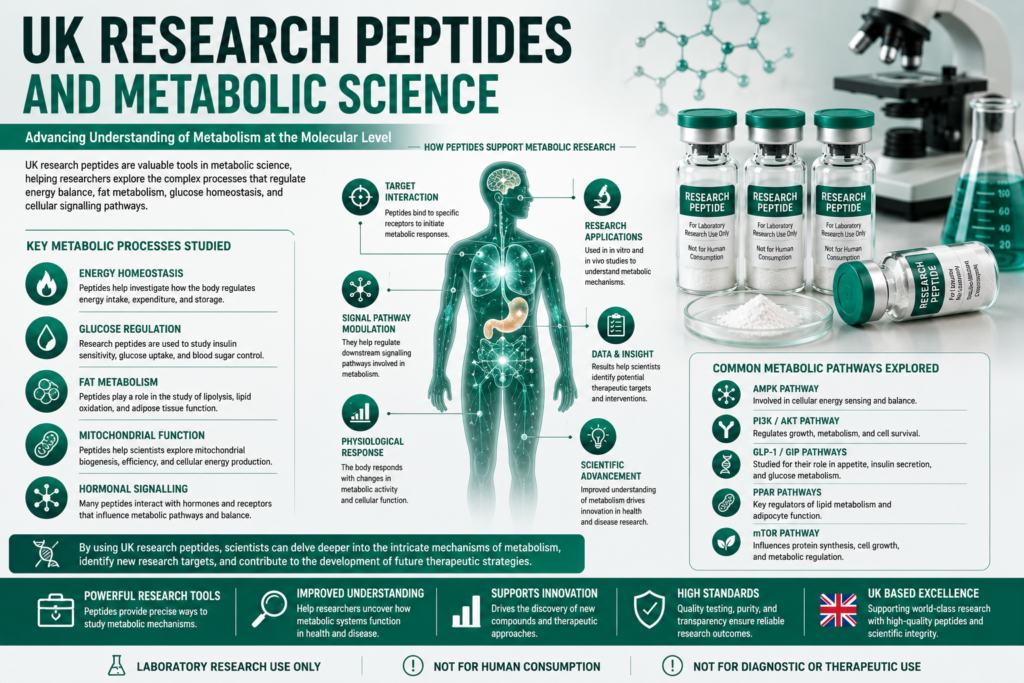
Metabolic science has become one of the most prominent areas associated with modern peptide research. Scientists continue to investigate the complex signalling systems responsible for regulating appetite, glucose levels, insulin secretion, digestion, nutrient processing, and overall energy balance. UK Research Peptides
For researchers exploring UK research peptides, metabolic pathways provide an important example of how peptide signalling can influence multiple biological processes at the same time.
Much of the current scientific attention centres on incretin hormones, particularly GLP-1 and GIP. Research into these naturally occurring signalling molecules has substantially expanded our understanding of metabolic regulation and contributed to the development of several important pharmaceutical compounds. UK Research Peptides
What Is Metabolic Peptide Research?
Metabolism refers broadly to the chemical processes through which living organisms obtain, transform, store, and use energy. UK Research Peptides
These processes require communication between multiple organs and tissues, including the digestive system, pancreas, liver, adipose tissue, skeletal muscle, and brain.
Peptide hormones can participate in this communication. UK Research Peptides
Researchers studying metabolic peptides may investigate how particular signalling molecules influence:
- appetite and food intake;
- satiety after eating;
- insulin secretion;
- glucagon activity;
- blood glucose regulation;
- gastric emptying;
- nutrient processing; and
- energy balance.
Because these mechanisms are interconnected, changing one signalling pathway can potentially influence several metabolic responses.
Appetite Regulation and Peptide Signalling
Appetite is controlled by a complex network of signals rather than a single biological switch.
The digestive system communicates information about nutrient intake to the brain and other organs through neural and hormonal pathways. Several peptide hormones participate in these processes. UK Research Peptides
GLP-1 (glucagon-like peptide-1) is one of the best-known examples.
GLP-1 is released primarily from specialised intestinal cells following nutrient intake. It can contribute to signalling associated with satiety and food intake while also participating in glucose regulation.
Research into this pathway has helped scientists better understand how gut-derived signals can influence eating behaviour and metabolic function. UK Research Peptides
Peptides and Satiety
Satiety describes the feeling of fullness and satisfaction that develops during and after eating.
Satiety signalling helps regulate when eating stops and how long it takes before hunger returns.
Certain peptide pathways can influence these signals. This has made appetite and satiety particularly important areas of metabolic peptide research.
Scientists may investigate how receptor activation alters food-intake signalling, how long these effects persist, and how different molecular structures influence the response. UK Research Peptides
These mechanisms have become especially relevant to research involving GLP-1 receptor agonists.
Glucose Homeostasis
Another major area of metabolic research is glucose homeostasis—the biological processes responsible for maintaining blood glucose within an appropriate physiological range.
After food is consumed and nutrients are absorbed, glucose levels can rise. The body responds through several coordinated mechanisms involving hormones such as insulin and glucagon. UK Research Peptides
Incretin hormones participate in this response.
GLP-1 and GIP can contribute to glucose-dependent insulin secretion, meaning their effects on insulin release are linked to glucose availability.
Studying these pathways has provided researchers with valuable insight into the relationship between the digestive system and pancreatic function.
Insulin Signalling
Insulin is a central hormone in metabolic regulation. UK Research Peptides
It allows cells in several tissues to respond to nutrient availability and plays an important role in glucose utilisation and storage.
Peptide research can help scientists examine how incretin signalling influences insulin secretion and how different receptor pathways interact within broader metabolic networks. UK Research Peptides
This does not mean every peptide associated with insulin signalling has the same biological effect.
Individual compounds may differ substantially in receptor selectivity, potency, molecular stability, and experimental behaviour.
Researchers working with UK research peptides should therefore evaluate the mechanism of each compound independently. UK Research Peptides
Gastric Emptying and Digestion
Some peptide pathways can also influence gastric emptying, the process through which food moves from the stomach into the small intestine. UK Research Peptides
Changes in gastric emptying can affect nutrient delivery, post-meal glucose responses, and sensations of fullness.
GLP-1 receptor activation is associated with effects on gastric emptying, although the magnitude and duration of these effects can vary according to the compound and experimental or clinical circumstances. UK Research Peptides
Researchers therefore consider gastric emptying as one component of a much broader metabolic signalling system rather than the sole explanation for the effects associated with GLP-1 pathways. UK Research Peptides
Energy Balance and Weight-Management Research
Body weight is influenced over time by the relationship between energy intake and energy expenditure, alongside numerous biological, behavioural, environmental, and genetic factors. UK Research Peptides
Because certain peptide pathways influence appetite and food intake, they have become important targets in weight-management research.
This does not mean peptides directly “melt” or “burn” body fat. UK Research Peptides
For clinically established GLP-1-related medicines, reductions in appetite and energy intake are important mechanisms contributing to weight reduction.
This distinction matters because terms such as “fat-burning peptide” can oversimplify considerably more complex biological processes. UK Research Peptides
Why Incretin Hormones Became Major Research Targets
The term incretin refers to gut-derived hormones that contribute to the body’s metabolic response to nutrient intake. UK Research Peptides
Two of the most important incretin hormones are:
GLP-1 — glucagon-like peptide-1
GIP — glucose-dependent insulinotropic polypeptide
Research into these hormones revealed that their receptor pathways could potentially be targeted pharmacologically. UK Research Peptides
Scientists subsequently developed compounds capable of producing longer-lasting receptor activity than the naturally occurring hormones themselves.
This research contributed to the development of medicines containing compounds such as liraglutide, semaglutide, and tirzepatide.
Semaglutide primarily targets GLP-1 receptors, while tirzepatide combines GIP and GLP-1 receptor agonism within a single molecule. UK Research Peptides
From Metabolic Research to Pharmaceutical Development
The development of incretin-based medicines demonstrates how fundamental peptide research can progress into pharmaceutical science.
Researchers first investigate naturally occurring biological pathways. Candidate molecules can then be developed and modified before undergoing preclinical testing, clinical trials, manufacturing development, and regulatory evaluation.
Only after these additional stages can specific formulations potentially become approved medicines.
For this reason, published clinical evidence involving pharmaceutical formulations should not automatically be attributed to UK research peptides carrying the same compound names. UK Research Peptides
Research materials and regulated medicines serve different purposes and should remain clearly distinguished.
Among all the metabolic pathways investigated through peptide science, GLP-1 has become one of the most extensively researched and widely recognised. Understanding how this hormone works provides important context for the development of modern metabolic peptide research.
Understanding GLP-1 Peptide Research
GLP-1 (glucagon-like peptide-1) has become one of the most extensively studied signalling pathways in modern metabolic science. Research into GLP-1 has contributed to a better understanding of the relationship between nutrient intake, appetite, insulin secretion, blood glucose regulation, digestion, and communication between the gut and brain. UK Research Peptides
For scientists exploring UK research peptides, GLP-1 provides an important example of how investigating a naturally occurring peptide hormone can eventually contribute to the development of pharmaceutical compounds designed to target the same biological pathway.
What Is GLP-1?
GLP-1 is a naturally occurring incretin hormone produced primarily by specialised enteroendocrine cells in the intestine.
Its secretion increases following nutrient intake, allowing the digestive system to communicate information about incoming food to other parts of the body. UK Research Peptides
Rather than controlling a single metabolic function, GLP-1 participates in several interconnected processes.
These include:
- glucose-dependent insulin secretion;
- regulation of glucagon activity;
- appetite signalling;
- satiety;
- gastric function; and
- broader metabolic regulation.
This combination of effects made the GLP-1 pathway particularly interesting to researchers investigating diabetes, obesity, metabolism, and energy balance. UK Research Peptides
What Is the GLP-1 Receptor?
GLP-1 produces many of its biological effects through the GLP-1 receptor (GLP-1R).
This receptor belongs to a family of cell-surface receptors involved in transmitting signals from outside a cell to its interior. UK Research Peptides
When GLP-1 or an appropriate GLP-1 receptor agonist binds to the receptor, intracellular signalling processes can be activated.
GLP-1 receptors are found in several tissues involved in metabolic regulation, which helps explain why activation of this pathway can influence more than one physiological process. UK Research Peptides
Researchers can investigate these interactions to understand how receptor activation produces downstream metabolic responses.
GLP-1 and Insulin Secretion
One of the best-established functions of GLP-1 involves glucose-dependent insulin secretion.
Following food intake, rising glucose levels stimulate insulin release from pancreatic beta cells. GLP-1 signalling can enhance this response when glucose concentrations are elevated. UK Research Peptides
The term “glucose-dependent” is important because the effect is related to prevailing glucose levels rather than representing unrestricted insulin release. UK Research Peptides
This mechanism contributed significantly to scientific interest in GLP-1 receptor agonists for metabolic research and pharmaceutical development.
GLP-1 and Glucagon
GLP-1 signalling can also influence glucagon, a pancreatic hormone that participates in maintaining blood glucose. UK Research Peptides
Insulin and glucagon perform different but interconnected roles in glucose homeostasis.
By studying how GLP-1 influences both sides of this regulatory system, researchers have gained a more detailed understanding of how incretin signalling contributes to post-meal glucose control. UK Research Peptides
These interactions demonstrate why metabolic pathways should generally be studied as interconnected networks rather than isolated mechanisms.
GLP-1 and Appetite Signalling
Another major area of GLP-1 research involves appetite. UK Research Peptides
GLP-1 receptors are associated with biological pathways involved in food intake and satiety. Activation of these pathways can increase signals associated with fullness and reduce appetite in some circumstances.
This mechanism became particularly important in the development of pharmaceutical GLP-1 receptor agonists investigated for chronic weight management. UK Research Peptides
Rather than acting as traditional stimulants or directly “burning fat,” these medicines can influence physiological appetite regulation and reduce overall energy intake.
For researchers evaluating UK research peptides, this distinction provides more accurate scientific context than simplified descriptions of GLP-1 compounds as “fat-burning peptides.”
GLP-1 and Gastric Emptying
GLP-1 signalling can also influence gastric emptying.
Gastric emptying describes the movement of stomach contents into the small intestine. Changes in this process can affect nutrient delivery, post-meal glucose responses, and sensations of fullness. UK Research Peptides
GLP-1 receptor activation can slow gastric emptying under certain circumstances.
However, this effect should not be treated as the sole explanation for the metabolic effects associated with GLP-1 receptor agonists. Appetite signalling, insulin responses, glucagon regulation, and other mechanisms also contribute. UK Research Peptides
Why Natural GLP-1 Presents a Research Challenge
Naturally occurring GLP-1 has an important limitation from a pharmaceutical-development perspective: it is rapidly broken down within the body. UK Research Peptides
An enzyme called dipeptidyl peptidase-4 (DPP-4) contributes to the rapid degradation of native GLP-1.
This means naturally occurring GLP-1 has a relatively short duration of biological activity.
Researchers therefore investigated ways to develop molecules capable of activating the GLP-1 receptor while remaining active for longer periods. UK Research Peptides
This work contributed to the development of modified GLP-1 receptor agonists.
Development of GLP-1 Receptor Agonists
Pharmaceutical researchers have developed several compounds designed to activate GLP-1 receptors while having pharmacological properties that differ from native GLP-1. UK Research Peptides
Examples include liraglutide and semaglutide.
Structural and pharmacological modifications can influence characteristics such as resistance to enzymatic degradation and duration of activity.
These developments demonstrate an important principle of peptide research: modifying molecular structure can significantly change how a compound behaves while preserving activity at a desired receptor. UK Research Peptides
This relationship between molecular structure and biological function is central to modern peptide and pharmaceutical science.
Semaglutide and GLP-1 Research
Semaglutide has become one of the most recognised GLP-1 receptor agonists. UK Research Peptides
Research involving regulated semaglutide formulations has examined areas including glucose regulation, appetite, energy intake, cardiovascular outcomes, and chronic weight management.
Large clinical trials have demonstrated substantial average weight reduction with specific semaglutide formulations in appropriate study populations. UK Research Peptides
However, these findings relate to the pharmaceutical products and protocols evaluated in those studies.
A laboratory material carrying the semaglutide name should not automatically be considered equivalent to a regulated medicine in formulation, sterility, manufacturing controls, clinical performance, or regulatory status.
This distinction remains essential when discussing UK research peptides.
Why GLP-1 Research Remains Important
GLP-1 research demonstrates how understanding a naturally occurring signalling pathway can lead from fundamental biology to pharmaceutical development. UK Research Peptides
Researchers continue to investigate GLP-1 receptor signalling, molecular modifications, metabolic responses, interactions with other pathways, and the broader biological effects associated with incretin activity.
The success of GLP-1 research has also encouraged scientists to investigate whether targeting multiple incretin pathways simultaneously could produce different metabolic responses. UK Research Peptides
That question brings us to another major area of modern peptide science: GIP and dual GIP/GLP-1 receptor research.
What Is GIP and Why Is It Researched?
GIP (glucose-dependent insulinotropic polypeptide) is another naturally occurring incretin hormone that has become increasingly important in metabolic and peptide research. Like GLP-1, GIP is released in response to nutrient intake and participates in communication between the digestive system and tissues involved in metabolic regulation. UK Research Peptides
For scientists studying UK research peptides, GIP is particularly significant because research into this pathway contributed to the development of compounds capable of targeting more than one incretin receptor simultaneously.
The best-known example is tirzepatide, a dual GIP and GLP-1 receptor agonist that has become an important subject of metabolic and weight-management research. UK Research Peptides
What Does GIP Do?
GIP is produced primarily by specialised K cells located in the small intestine.
Its release increases after nutrients are consumed, particularly in response to glucose and dietary fat.
One of GIP’s best-established functions involves supporting glucose-dependent insulin secretion. When glucose concentrations are elevated following food intake, GIP can interact with receptors on pancreatic beta cells and contribute to the insulin response. UK Research Peptides
However, GIP biology extends beyond a single mechanism.
Researchers continue to investigate its activity across tissues and its potential roles in areas including nutrient handling, energy metabolism, adipose biology, and interactions with other hormonal signalling systems.
What Is the GIP Receptor?
GIP produces its effects through the GIP receptor (GIPR).
Like the GLP-1 receptor, GIPR is a cell-surface receptor capable of initiating intracellular signalling after an appropriate molecule binds to it. UK Research Peptides
Researchers can examine GIP receptor activation to understand how the pathway influences cellular responses and how those responses differ between tissues.
This receptor has also become particularly important in pharmaceutical research because compounds can be designed to interact with GIPR while simultaneously targeting another receptor system. UK Research Peptides
GIP and Insulin Signalling
The relationship between GIP and insulin secretion is one of the reasons it is classified as an incretin hormone.
After food consumption, GIP signalling can enhance insulin secretion in a glucose-dependent manner.
GLP-1 also participates in glucose-dependent insulin signalling, but the two hormones are not identical. They bind to different receptors and can produce different physiological responses. UK Research Peptides
Studying both pathways has helped researchers develop a more complete understanding of how the digestive system communicates with the pancreas following nutrient intake. UK Research Peptides
How Is GIP Different From GLP-1?
Although GIP and GLP-1 are both incretin hormones, they should not be treated as interchangeable.
They are distinct molecules that interact with different receptors.
GLP-1 → GLP-1 receptor
GIP → GIP receptor
Both pathways participate in metabolic regulation, but their effects, receptor distribution, and biological characteristics differ. UK Research Peptides
GLP-1 research became particularly prominent because of its effects on glucose regulation, appetite, satiety, and gastric function.
GIP research has provided additional insight into nutrient-responsive insulin signalling and other aspects of metabolic biology.
The possibility of influencing both pathways simultaneously eventually became an important area of pharmaceutical investigation. UK Research Peptides
What Is Dual-Receptor Agonism?
Traditional receptor agonists may be designed primarily to activate one particular receptor.
A dual-receptor agonist is designed to interact with two receptor systems. UK Research Peptides
In metabolic peptide research, one of the most important examples is combined GIP and GLP-1 receptor agonism.
Instead of studying or pharmacologically targeting only the GLP-1 receptor, researchers investigated whether a single molecule could activate both GIP and GLP-1 receptors.
This approach resulted in compounds with a different receptor profile from traditional GLP-1-only agonists.
Tirzepatide and GIP/GLP-1 Research
Tirzepatide is the most prominent example of a dual GIP/GLP-1 receptor agonist.
Its mechanism distinguishes it from compounds such as semaglutide and liraglutide, which primarily target GLP-1 receptors.
In simplified terms:
| Compound | GLP-1 Receptor | GIP Receptor |
| Liraglutide | Yes | No |
| Semaglutide | Yes | No |
| Tirzepatide | Yes | Yes |
This dual activity has made tirzepatide particularly important in modern metabolic research.
Clinical trials involving specific regulated tirzepatide formulations have demonstrated substantial effects on glucose regulation and body weight in studied populations. UK Research Peptides
However, these clinical findings should be interpreted within the context of the pharmaceutical products and study protocols in which they were generated.
Why Has Tirzepatide Generated So Much Scientific Interest?
Tirzepatide attracted attention partly because clinical research demonstrated that simultaneous GIP and GLP-1 receptor agonism could produce substantial metabolic effects.
This raised broader scientific questions about multi-receptor peptide design.
Instead of targeting only one biological pathway, researchers can investigate whether carefully designed molecules interacting with multiple receptors produce different biological responses.
This concept has expanded beyond dual agonism, with research continuing into other multi-receptor approaches.
Such developments illustrate how peptide science can evolve from studying naturally occurring hormones to designing increasingly specialised molecules for experimental and pharmaceutical investigation.
Why Researchers Should Distinguish GIP From GLP-1
For researchers working with UK research peptides, the distinction between these pathways is important.
Simply categorising semaglutide and tirzepatide together as “weight-loss peptides” overlooks a major mechanistic difference between them. UK Research Peptides
Semaglutide primarily targets GLP-1 receptors.
Tirzepatide targets both GIP and GLP-1 receptors.
That difference can influence downstream signalling, pharmacological characteristics, and observed outcomes.
It also demonstrates why individual peptide compounds should be evaluated according to their specific molecular identity and receptor profile rather than grouped together solely according to a broad research application. UK Research Peptides
Clinical Medicines and Research Materials Remain Different
The scientific importance of GIP/GLP-1 research does not remove the distinction between regulated medicines and laboratory research materials. UK Research Peptides
Clinical findings concerning tirzepatide relate to specific pharmaceutical formulations evaluated under controlled conditions.
A research material carrying the same compound name should not automatically be assumed to have equivalent formulation, manufacturing controls, sterility, clinical safety, effectiveness, or regulatory approval. UK Research Peptides
For UK research peptides, published pharmaceutical studies can provide valuable scientific context for understanding a molecule and its receptor pathways, but they do not transform a research-use product into an approved medicine.
With the GLP-1 and GIP pathways established, the next step is to examine one of the most extensively studied GLP-1 receptor agonists individually: semaglutide and its role in peptide research.
Semaglutide in Peptide Research
Semaglutide has become one of the most extensively studied GLP-1 receptor agonists in modern metabolic science. Research involving the compound has contributed to understanding appetite regulation, glucose-dependent insulin signalling, energy intake, and the therapeutic potential of sustained GLP-1 receptor activation.
For scientists exploring UK research peptides, semaglutide is also a useful example of how researchers can modify a molecule associated with a naturally occurring peptide pathway to create longer-lasting receptor activity. UK Research Peptides
However, it remains important to distinguish scientific and clinical findings involving regulated semaglutide medicines from laboratory materials supplied specifically for research purposes.
What Is Semaglutide?
Semaglutide is a GLP-1 receptor agonist, meaning it is designed to activate the glucagon-like peptide-1 receptor. UK Research Peptides
Its activity is based on the biological pathway associated with naturally occurring GLP-1, an incretin hormone released following nutrient intake.
Native GLP-1 participates in several metabolic processes, including glucose-dependent insulin secretion, appetite signalling, glucagon regulation, and gastric function.
However, naturally occurring GLP-1 is rapidly degraded in the body.Shop
Semaglutide incorporates structural characteristics that allow it to resist rapid degradation and provide considerably longer receptor activity than native GLP-1. This extended activity has been important to its pharmaceutical development. UK Research Peptides
How Does Semaglutide Interact With GLP-1 Receptors?
Semaglutide binds to and activates GLP-1 receptors.
Following receptor activation, intracellular signalling pathways can influence several metabolic processes.
In clinical research, GLP-1 receptor agonism with semaglutide has been associated with effects involving:
- glucose-dependent insulin secretion;
- glucagon regulation;
- appetite;
- satiety;
- energy intake; and
- gastric function.
These mechanisms are interconnected rather than independent.
For example, changes in appetite and satiety can influence overall food intake, while insulin and glucagon responses participate in glucose homeostasis.
Semaglutide and Appetite Research
One of the most widely discussed areas of semaglutide research involves appetite regulation.
GLP-1 receptors participate in signalling pathways associated with food intake and satiety. Sustained activation of these pathways can reduce appetite and increase feelings of fullness in some people receiving regulated semaglutide medicines. UK Research Peptides
Reduced appetite can subsequently contribute to lower overall energy intake.
This provides a more scientifically accurate explanation for semaglutide-associated weight reduction than describing the compound as a direct “fat burner.” UK Research Peptides
The primary mechanism is related to metabolic and appetite signalling rather than directly causing stored body fat to disappear. UK Research Peptides
Semaglutide and Glucose Regulation
Semaglutide research has also focused extensively on glucose regulation.
Activation of GLP-1 receptors can enhance glucose-dependent insulin secretion, meaning the insulin response is influenced by prevailing glucose concentrations.
GLP-1 signalling can also affect glucagon activity. UK Research Peptides
Together, these mechanisms contributed to the development and investigation of GLP-1 receptor agonists in type 2 diabetes before their role in chronic weight management became widely recognised.
This history illustrates how research into a particular peptide pathway can eventually reveal applications across several related areas of metabolic medicine. UK Research Peptides
What Does the Weight-Management Evidence Show?
Semaglutide has been evaluated in large randomised clinical trials involving specific pharmaceutical formulations.
One of the landmark studies was the STEP 1 trial, which investigated once-weekly semaglutide 2.4 mg alongside lifestyle intervention in adults with overweight or obesity who did not have diabetes.
After 68 weeks, participants receiving semaglutide experienced an average body-weight reduction of approximately 14.9%, compared with approximately 2.4% among those receiving placebo.
These results provided strong evidence that the pharmaceutical formulation and treatment protocol studied could produce substantial average weight reduction in the trial population. UK Research Peptides
The findings should nevertheless be interpreted appropriately. An average result does not mean every participant experienced the same amount of weight change, and clinical outcomes depend on numerous individual and treatment-related factors.
Why the STEP Research Is Important
The STEP programme helped establish GLP-1 receptor agonism as an important approach in modern obesity medicine. UK Research Peptides
From a broader peptide-research perspective, it also demonstrated how understanding a naturally occurring signalling pathway can eventually lead to molecules with substantially modified pharmacological characteristics.
The progression can be viewed broadly as:
Natural GLP-1 biology → receptor research → molecular modification → preclinical investigation → clinical trials → regulated pharmaceutical products
This progression involves many stages of research, development, manufacturing, and regulatory evaluation.
Semaglutide Research Materials vs Semaglutide Medicines
This distinction is especially important for anyone researching UK research peptides.
Clinical studies involving semaglutide evaluate specific pharmaceutical formulations manufactured and administered under controlled conditions. UK Research Peptides
A laboratory research material carrying the semaglutide name should not automatically be assumed to have the same:
- formulation;
- manufacturing controls;
- sterility;
- excipients;
- stability profile;
- regulatory status;
- clinical safety; or
- demonstrated effectiveness.
The fact that the underlying compound has strong clinical evidence does not transform every product labelled “semaglutide” into an equivalent pharmaceutical medicine.
Does High-Purity Semaglutide Mean Pharmaceutical Grade?
Not necessarily.
Analytical purity describes a particular characteristic of the tested material. For example, HPLC can provide information about the relative chromatographic purity of a peptide sample. UK Research Peptides
A reported purity of 98%, 99%, or another percentage does not independently establish pharmaceutical quality.
It also does not establish sterility, clinical safety, suitability for human administration, or regulatory approval.
Researchers evaluating semaglutide among UK research peptides should therefore consider analytical purity within the broader context of molecular identity, testing methods, batch documentation, storage, and intended research use. UK Research Peptides
Why Semaglutide Remains Important to Peptide Research
Semaglutide represents an important case study in modern peptide science because it connects several major research themes. UK Research Peptides
It demonstrates how researchers can investigate a naturally occurring peptide pathway, identify limitations such as rapid degradation, modify molecular characteristics, and ultimately develop longer-acting receptor agonists.
Its clinical research has also expanded scientific understanding of the relationship between GLP-1 signalling, appetite, glucose regulation, energy intake, and body weight.
However, semaglutide represents only one approach to incretin-based research.
The development of tirzepatide introduced another strategy: targeting both the GIP and GLP-1 receptors within a single molecule, creating one of the most significant developments in modern metabolic peptide research.
Tirzepatide and Dual GIP/GLP-1 Research
Tirzepatide represents an important development in modern metabolic peptide research because it targets two incretin receptor pathways within a single molecule. Unlike semaglutide and liraglutide, which primarily activate the GLP-1 receptor, tirzepatide acts as a dual GIP and GLP-1 receptor agonist.
For scientists exploring UK research peptides, tirzepatide provides an important example of how peptide design can move beyond single-receptor activity and investigate the effects of influencing multiple biological pathways simultaneously.
Research into tirzepatide has contributed significantly to current scientific interest in glucose regulation, appetite, energy intake, body weight, and multi-receptor metabolic signalling. UK Research Peptides
What Is Tirzepatide?
Tirzepatide is a synthetic peptide-based compound designed to activate both the GIP receptor (GIPR) and the GLP-1 receptor (GLP-1R).
GIP and GLP-1 are naturally occurring incretin hormones released in response to nutrient intake.
Both participate in metabolic regulation, particularly glucose-dependent insulin signalling, but they are distinct molecules that interact with different receptors. UK Research Peptides
Tirzepatide combines activity at both receptor systems within a single molecule.
In simplified terms:
Tirzepatide → GIP receptor + GLP-1 receptor
This dual activity distinguishes it from traditional GLP-1 receptor agonists.
Why Is Dual-Receptor Activity Important?
Biological systems rarely operate through a single signalling pathway.
Different hormones, receptors, tissues, and feedback mechanisms interact continuously to regulate metabolism.
Researchers therefore became interested in whether simultaneously targeting two complementary receptor systems could produce metabolic responses different from those achieved through GLP-1 receptor agonism alone.
Tirzepatide provided an important opportunity to investigate this concept clinically. UK Research Peptides
Its development also contributed to wider scientific interest in multi-receptor agonists, where a single molecule is designed to influence more than one biological target.
Tirzepatide and Glucose Regulation
Both GIP and GLP-1 participate in the body’s metabolic response to food.
Activation of these incretin pathways can influence glucose-dependent insulin secretion, helping explain why tirzepatide was extensively investigated in metabolic research involving type 2 diabetes.
Its dual-receptor activity means the compound influences metabolic signalling through a different receptor profile from semaglutide. UK Research Peptides
Researchers continue to investigate how the contribution of each pathway relates to the overall pharmacological effects observed with tirzepatide.
Tirzepatide and Appetite Research
Tirzepatide has also demonstrated significant effects on appetite and energy intake in clinical research. UK Research Peptides
Its GLP-1 receptor activity contributes to pathways associated with satiety and food intake, while the precise contribution of GIP receptor activity to the compound’s overall weight-management effects remains an important area of scientific investigation.
Reduced energy intake can contribute to weight reduction over time.
As with semaglutide, it is more accurate to describe tirzepatide in terms of metabolic and appetite signalling rather than calling it a compound that directly “burns fat.”
What Does the SURMOUNT Research Show?
One of the most important clinical studies of tirzepatide for weight management was SURMOUNT-1.
The trial investigated once-weekly tirzepatide in adults with obesity, or overweight with at least one weight-related complication, who did not have diabetes. UK Research Peptides
After 72 weeks, average body-weight changes were approximately:
- 15.0% with 5 mg tirzepatide;
- 19.5% with 10 mg;
- 20.9% with 15 mg; and
- 3.1% with placebo.
These findings demonstrated substantial average weight reduction with the specific pharmaceutical tirzepatide formulations and treatment protocols evaluated in the study.
Individual results varied, and these averages should not be interpreted as guaranteed outcomes.
Why SURMOUNT-1 Was Significant
The results attracted considerable scientific attention because they demonstrated the potential of combined GIP/GLP-1 receptor agonism in chronic weight-management treatment. UK Research Peptides
From a broader peptide-research perspective, the findings also supported continued investigation into whether targeting multiple receptors could offer different effects from single-receptor approaches.
This has helped expand interest in dual and multi-receptor peptide design as an area of pharmaceutical research.
Tirzepatide vs Semaglutide Mechanisms
Although tirzepatide and semaglutide are frequently discussed together, they should not be treated as identical compounds. UK Research Peptides
Their fundamental receptor difference is:
| Compound | GLP-1 Receptor | GIP Receptor |
| Semaglutide | Yes | No |
| Tirzepatide | Yes | Yes |
This distinction can influence downstream signalling and pharmacological behaviour.
It also demonstrates why researchers working with UK research peptides should identify the exact molecular compound being investigated rather than treating all incretin-related peptides as interchangeable.
Tirzepatide Research Materials vs Pharmaceutical Tirzepatide
Clinical findings from SURMOUNT and other tirzepatide trials relate to specific pharmaceutical formulations evaluated under controlled conditions. UK Research Peptides
They should not automatically be attributed to a laboratory research material carrying the same compound name.
A research-use tirzepatide material should not be assumed to have equivalent:
- formulation;
- manufacturing controls;
- sterility;
- stability;
- clinical safety;
- pharmaceutical quality;
- effectiveness; or
- regulatory approval.
This distinction remains essential when interpreting clinical literature alongside information about UK research peptides.
Analytical Purity and Tirzepatide Research
Researchers evaluating tirzepatide material may encounter analytical information such as HPLC purity or mass spectrometry data. UK Research Peptides
These can provide useful information about characteristics of the tested sample.
However, analytical purity does not establish medical suitability.
For example, a reported high HPLC purity does not independently demonstrate sterility, safety for human administration, clinical effectiveness, or equivalence to an approved pharmaceutical product.
Research materials should therefore be assessed according to their laboratory purpose and the analytical questions relevant to the planned experiment.
Why Tirzepatide Matters to Modern Peptide Science
Tirzepatide illustrates an important evolution in peptide and pharmaceutical research: moving from targeting a single receptor pathway toward designing molecules capable of interacting with multiple complementary receptors.
Its clinical research has also increased scientific interest in the complex relationship between incretin signalling, appetite, glucose regulation, and energy balance. UK Research Peptides
For researchers, the broader lesson is that compounds associated with the same research area can have significantly different molecular mechanisms.
This makes the comparison between semaglutide and tirzepatide particularly useful for understanding how receptor selectivity can influence modern metabolic peptide research.
Semaglutide vs Tirzepatide: Research Differences
Semaglutide and tirzepatide are frequently discussed together because both have become important compounds in metabolic and weight-management research. However, they are distinct molecules with different receptor profiles and should not be treated as interchangeable. UK Research Peptides
For scientists exploring UK research peptides, comparing these compounds provides a useful example of how differences in molecular design can influence receptor activity, biological signalling, and the outcomes observed during clinical research.
The most important distinction is straightforward: semaglutide primarily activates the GLP-1 receptor, while tirzepatide activates both GIP and GLP-1 receptors.
Semaglutide vs Tirzepatide at a Glance
| Research Area | Semaglutide | Tirzepatide |
| Compound type | GLP-1 receptor agonist | Dual GIP/GLP-1 receptor agonist |
| GLP-1 receptor activity | Yes | Yes |
| GIP receptor activity | No | Yes |
| Incretin signalling | Yes | Yes |
| Glucose regulation research | Extensive | Extensive |
| Appetite research | Extensive | Extensive |
| Weight-management clinical evidence | Strong | Strong |
| Receptor profile | Single incretin receptor | Dual incretin receptors |
Although this table highlights their major similarities and differences, the mechanisms involved are more complex than simply counting the number of receptors each compound activates.
The Main Difference: Receptor Activity
Semaglutide is designed primarily to activate the GLP-1 receptor.
This pathway is involved in glucose-dependent insulin secretion, appetite signalling, satiety, glucagon regulation, and aspects of gastric function. UK Research Peptides
Tirzepatide activates the GLP-1 receptor as well, but it also activates the GIP receptor.
This gives tirzepatide a dual-receptor pharmacological profile and allows researchers to investigate how simultaneous GIP and GLP-1 receptor activity differs from GLP-1 receptor agonism alone.
For peptide research, this is an important distinction because receptor selectivity can substantially influence downstream biological signalling. UK Research Peptides
Differences in Weight-Management Research
Both compounds have demonstrated substantial average weight reduction in clinical studies involving regulated pharmaceutical formulations. UK Research Peptides
The landmark STEP 1 study reported an average body-weight reduction of approximately 14.9% after 68 weeks with semaglutide 2.4 mg, alongside lifestyle intervention.
In SURMOUNT-1, participants receiving tirzepatide experienced average reductions of approximately 15.0%, 19.5%, and 20.9% across the studied 5 mg, 10 mg, and 15 mg groups after 72 weeks. UK Research Peptides
These results generated considerable interest in whether dual GIP/GLP-1 receptor activity could produce greater average weight reduction than GLP-1 receptor agonism alone.
However, comparing percentages from separate trials has important limitations. UK Research Peptides
Different studies may involve different participants, treatment durations, protocols, eligibility requirements, lifestyle interventions, and statistical methods.
Appropriate head-to-head clinical trials provide stronger evidence for direct comparisons. UK Research Peptides
Does Tirzepatide Work the Same Way as Semaglutide?
No.
Although the compounds share GLP-1 receptor activity, tirzepatide’s additional GIP receptor activity means their mechanisms are not identical. UK Research Peptides
Both can influence metabolic processes associated with appetite, glucose regulation, and insulin signalling, but they achieve these effects through different receptor profiles.
This distinction illustrates a broader principle relevant to UK research peptides:
Similar research applications do not necessarily mean identical biological mechanisms.
Researchers should therefore examine receptor activity and molecular characteristics rather than grouping compounds together solely because they are discussed within the same research category.
Can Semaglutide and Tirzepatide Milligrams Be Compared?
No. Milligram quantities of semaglutide and tirzepatide should not be compared directly as though they represent equivalent biological potency. UK Research Peptides
For example, 5 mg of one compound does not mean the same thing biologically as 5 mg of another.
The compounds differ in molecular structure, molecular weight, receptor profile, pharmacological characteristics, and other properties. UK Research Peptides
This principle extends beyond semaglutide and tirzepatide. Researchers should not use milligram quantity alone to compare the biological activity of different peptide compounds.
Which Compound Has the Stronger Weight-Management Evidence?
Both semaglutide and tirzepatide have substantial clinical evidence from large human trials involving specific pharmaceutical formulations. UK Research Peptides
Tirzepatide has demonstrated particularly large average weight reductions in several studies, while semaglutide has an extensive clinical evidence base across metabolic, weight-management, and cardiovascular research.
Determining which treatment is appropriate for an individual patient is a medical question rather than simply a comparison of average weight-loss percentages. UK Research Peptides
Clinical decisions can depend on indication, medical history, contraindications, adverse effects, other medicines, treatment objectives, and professional assessment.
Research Products and Clinical Medicines Are Not Equivalent
The distinction between research materials and pharmaceutical products remains particularly important when discussing clinical trial results. UK Research Peptides
The evidence described above relates to specific regulated pharmaceutical formulations of semaglutide and tirzepatide.
A product supplied as a UK research peptide should not automatically be considered equivalent to the pharmaceutical formulation used in those trials.
Research products may differ in formulation, manufacturing requirements, analytical specifications, sterility controls, intended use, regulatory oversight, and other characteristics. UK Research Peptides
Therefore, clinical percentages should not be used to promise or imply equivalent outcomes from laboratory research materials.
What This Comparison Teaches Researchers
Semaglutide and tirzepatide provide an excellent example of why molecular identity matters in peptide research.
Both compounds are associated with incretin signalling and metabolic science, but one primarily targets a single incretin receptor while the other targets two.
Understanding this difference helps researchers interpret experimental and clinical literature more accurately.
It also reinforces why UK research peptides should be evaluated individually according to molecular structure, receptor activity, analytical information, and the quality of evidence associated with the specific compound.
Semaglutide and tirzepatide may currently receive much of the attention, but they are not the only GLP-1 receptor agonists with established clinical research. An earlier compound, liraglutide, played an important role in the development of this field and remains scientifically relevant today. UK Research Peptides
What About Liraglutide?
Although semaglutide and tirzepatide now receive considerable attention in metabolic and weight-management research, liraglutide remains an important compound in the development of GLP-1 receptor agonist science.
Liraglutide was investigated and introduced clinically before semaglutide became widely established for chronic weight management. Its research helped demonstrate that sustained activation of the GLP-1 receptor could influence glucose regulation, appetite, energy intake, and body weight. UK Research Peptides
For scientists exploring UK research peptides, liraglutide provides useful historical and scientific context for understanding how GLP-1 research developed into the longer-acting compounds studied today.
What Is Liraglutide?
Liraglutide is a GLP-1 receptor agonist.
It is structurally related to naturally occurring GLP-1 but incorporates modifications designed to extend its biological activity compared with the rapidly degraded native hormone. UK Research Peptides
Naturally occurring GLP-1 has a short duration of activity because it is quickly broken down within the body. Pharmaceutical researchers therefore investigated ways of modifying GLP-1-related molecules so that receptor activation could be sustained for longer periods.
Liraglutide was one of the important outcomes of this research.
How Does Liraglutide Work?
Liraglutide primarily activates the GLP-1 receptor.
Through this receptor pathway, regulated liraglutide medicines can influence several metabolic processes, including:
- glucose-dependent insulin secretion;
- glucagon regulation;
- appetite signalling;
- satiety;
- energy intake; and
- aspects of gastric function.
These mechanisms overlap substantially with those associated with semaglutide because both compounds primarily target the same receptor system.
However, this does not mean liraglutide and semaglutide are identical.
Differences in molecular structure and pharmacological characteristics influence how long each compound remains active and how pharmaceutical formulations are used clinically. UK Research Peptides
Liraglutide and Weight-Management Research
Liraglutide has been evaluated in large human clinical trials examining chronic weight management.
One important study involved adults with obesity or overweight and associated weight-related conditions. Participants receiving liraglutide alongside lifestyle intervention experienced greater average weight reduction than participants receiving placebo. UK Research Peptides
These findings helped establish sustained GLP-1 receptor activation as a viable pharmaceutical approach to chronic weight management.
The research was particularly significant because it preceded some of the later trials involving longer-acting GLP-1 receptor agonists. UK Research Peptides
How Does Liraglutide Differ From Semaglutide?
Liraglutide and semaglutide both primarily activate GLP-1 receptors, but their pharmacological profiles differ.
One of the most noticeable clinical differences is the duration of activity associated with the regulated pharmaceutical formulations.
Liraglutide formulations used clinically are generally administered once daily, whereas relevant semaglutide formulations can be administered once weekly.
This difference reflects underlying molecular and pharmacokinetic characteristics rather than simply differences in concentration.
From a research perspective, it demonstrates how modifying a peptide-related molecule can alter properties such as stability and duration of activity while retaining activity at the same receptor.
Liraglutide vs Semaglutide vs Tirzepatide
The three compounds can be broadly distinguished by their receptor profiles and pharmaceutical development:
| Compound | Primary Receptor Activity | General Development |
| Liraglutide | GLP-1 | Earlier long-acting GLP-1 agonist |
| Semaglutide | GLP-1 | Longer-acting GLP-1 agonist |
| Tirzepatide | GIP + GLP-1 | Dual incretin receptor agonist |
This progression demonstrates how metabolic peptide research has evolved.
Researchers moved from investigating naturally occurring incretin biology toward longer-acting single-receptor agonists and, more recently, compounds capable of targeting multiple receptor systems. UK Research Peptides
Does Liraglutide Produce the Same Weight Reduction?
Clinical trials involving regulated liraglutide formulations have demonstrated meaningful average weight reduction, but results have generally been more modest than those reported in major trials of semaglutide or tirzepatide. UK Research Peptides
However, comparisons between separate trials should be interpreted carefully.
Study populations, treatment durations, protocols, doses, eligibility requirements, and other factors can differ.
The scientific importance of liraglutide therefore extends beyond whether it produces the largest headline weight-loss percentage. Its development provided important evidence supporting GLP-1 receptor agonism as a metabolic and weight-management strategy. UK Research Peptides
Why Liraglutide Remains Relevant to Peptide Research
Liraglutide demonstrates how incremental molecular development can contribute to broader scientific progress.
Research into naturally occurring GLP-1 helped establish the biological pathway. Liraglutide demonstrated the potential of sustained GLP-1 receptor agonism. Later compounds such as semaglutide extended this approach, while tirzepatide introduced dual GIP/GLP-1 receptor activity. UK Research Peptides
This progression can be viewed broadly as:
Native incretin biology → sustained GLP-1 agonism → longer-acting GLP-1 agonism → dual incretin receptor agonism
For researchers studying UK research peptides, this history provides a useful example of how molecular modifications and receptor targeting can influence pharmaceutical development. UK Research Peptides
Liraglutide Research Materials vs Regulated Medicines
As with semaglutide and tirzepatide, clinical findings concerning liraglutide relate to specific pharmaceutical formulations evaluated under controlled conditions. UK Research Peptides
A laboratory research material carrying the liraglutide name should not automatically be assumed to have equivalent formulation, manufacturing controls, sterility, clinical safety, effectiveness, or regulatory approval.
Analytical information such as peptide identity and purity can be useful for laboratory research, but it does not establish equivalence to an approved pharmaceutical product.
Maintaining this distinction is essential when discussing UK research peptides responsibly. UK Research Peptides
Liraglutide, semaglutide, and tirzepatide all have substantial clinical research associated with regulated medicines. However, the wider online category of so-called “weight-loss peptides” contains many other compounds—and the evidence supporting them can be very different.
Are All “Weight-Loss Peptides” Supported by Research?
No. The term “weight-loss peptides” is used broadly online, but the scientific evidence supporting individual compounds can vary considerably.
Some peptide-based compounds have been investigated in large randomised human clinical trials and are active ingredients in regulated prescription medicines. Others may only have preliminary laboratory evidence, animal studies, limited human research, or theoretical mechanisms suggesting they could influence metabolism or body composition. UK Research Peptides
For researchers evaluating UK research peptides, understanding these differences is essential. A compound being associated with appetite, metabolism, or fat loss does not automatically mean it has been clinically demonstrated to produce meaningful weight reduction in humans.
Different Types of Scientific Evidence
Scientific evidence develops through multiple stages, and each stage answers different questions.
A compound may progress through:
Laboratory research → animal studies → early human studies → controlled clinical trials → regulatory assessment
Laboratory research can help scientists understand molecular mechanisms, receptor interactions, and cellular responses.
Animal studies may provide additional information about how a compound behaves within a complex biological system. UK Research Peptides
Human clinical trials can then investigate questions involving effectiveness, adverse effects, dosage, and clinical outcomes.
These forms of evidence should not be treated as equivalent.
Laboratory Evidence
Laboratory or in vitro research can provide important information about how a peptide behaves at the molecular or cellular level.
Researchers may examine whether a compound binds to a particular receptor, activates a signalling pathway, influences enzyme activity, or produces another measurable response in an experimental system.
These findings can be scientifically valuable.
However, demonstrating receptor activity in a laboratory does not establish that the compound will safely produce meaningful weight loss in humans. UK Research Peptides
Laboratory findings are often the beginning of a research process rather than the final evidence for a medical application.
Animal Studies
Animal research can help scientists investigate how a peptide behaves within a living biological system.
Researchers may examine metabolism, receptor activity, pharmacokinetics, toxicity, food intake, body weight, or other measurable outcomes. UK Research Peptides
However, animal biology does not perfectly reproduce human physiology.
A compound that produces a particular result in an animal model may behave differently in humans because of differences in metabolism, receptor expression, dosage, exposure, and numerous other factors.
Animal findings therefore require careful interpretation before conclusions about human effectiveness can be made.
Human Clinical Research
Human studies provide more directly relevant evidence when evaluating potential medical applications.
However, even human research varies in strength.
Small observational studies or uncontrolled experiments generally provide less reliable evidence than large randomised controlled trials (RCTs).
Well-designed RCTs can compare an intervention with a control group while reducing several sources of bias.
Semaglutide, tirzepatide, and liraglutide have substantial human clinical evidence associated with specific regulated pharmaceutical formulations. UK Research Peptides
This distinguishes them from many compounds promoted online using the broad term “weight-loss peptide.”
Clinical Evidence vs Regulatory Approval
Strong clinical research and regulatory approval are also separate stages.
A compound may produce encouraging results during clinical trials without automatically becoming an approved medicine. UK Research Peptides
Regulatory authorities evaluate specific pharmaceutical products using evidence concerning areas such as quality, safety, effectiveness, manufacturing, formulation, and the proposed medical indication.
Approval therefore relates to a particular product and use—not simply to the name of a molecule.
This distinction is particularly important when discussing UK research peptides carrying names also found in prescription medicines. UK Research Peptides
Why Mechanism Alone Is Not Enough
A common problem in online peptide marketing is assuming that a biologically interesting mechanism automatically proves a desired clinical outcome. UK Research Peptides
For example, a compound may interact with a pathway associated with metabolism, growth hormone signalling, appetite, or fat cells.
That mechanism can provide a valid reason for scientific investigation. UK Research Peptides
It does not, however, prove that the compound causes substantial or safe weight reduction in humans.
A plausible mechanism should therefore be viewed as a research hypothesis, not as guaranteed evidence of clinical effectiveness.
Be Careful With “Fat-Burning Peptide” Claims
Terms such as “fat-burning peptide,” “rapid fat-loss peptide,” or “guaranteed weight-loss peptide” can oversimplify complex metabolic biology.
Body weight is influenced by numerous interconnected factors, including energy intake, energy expenditure, appetite, metabolic regulation, genetics, behaviour, and environment. UK Research Peptides
Even clinically established peptide-based weight-management medicines do not simply cause fat to disappear.
For GLP-1 and related medicines, effects on appetite, satiety, energy intake, and metabolic signalling are important parts of the mechanisms associated with weight reduction. UK Research Peptides
Researchers should therefore approach simplified marketing terminology carefully.
Questions Researchers Should Ask About the Evidence
When evaluating claims surrounding a UK research peptide, useful questions include:
- Has the compound been studied in humans?
- Were the studies randomised and controlled?
- How many participants were included?
- How long did the research continue?
- What outcomes were actually measured?
- Were the findings statistically and clinically meaningful?
- Have results been replicated?
- What adverse effects were reported?
- Was the specific claimed outcome investigated?
- Does the evidence concern a research material or a regulated pharmaceutical formulation?
These questions can help distinguish scientific evidence from promotional claims.
Research Interest Does Not Equal Proven Treatment
A peptide can be scientifically valuable without being a proven medicine.
Researchers may investigate compounds precisely because many questions about their mechanisms, stability, receptor interactions, or biological effects remain unanswered. UK Research Peptides
That uncertainty is part of scientific research.
Describing an experimental compound accurately does not diminish its research value. Instead, clearly separating established findings from hypotheses makes scientific information more useful and credible.
Clinical Evidence Cannot Be Transferred to Every Product
Another important principle is that evidence associated with a compound cannot automatically be transferred to every product carrying its name. UK Research Peptides
For example, large clinical trials involving regulated pharmaceutical semaglutide or tirzepatide formulations provide important evidence about those specific medicines.
A laboratory research product bearing the same compound name should not automatically be assumed to share the same formulation, manufacturing controls, sterility, clinical safety, effectiveness, or regulatory status.
For researchers exploring UK research peptides, clinical literature can provide valuable scientific context while the research material itself must still be evaluated according to its identity, analytical characteristics, documentation, and intended laboratory use. UK Research Peptides
Once the strength of the scientific evidence has been considered, another question becomes equally important: how are UK research peptides actually tested to establish characteristics such as identity and purity?
How Are UK Research Peptides Tested?
Analytical testing is an important part of evaluating UK research peptides because researchers need reliable information about the materials being used in laboratory experiments. Product names and advertised purity percentages alone provide only limited information about a peptide sample.
Different analytical techniques can be used to investigate different characteristics of a peptide. Some methods help evaluate chromatographic purity, while others provide information about molecular identity, composition, or other physical and chemical properties. UK Research Peptides
For this reason, peptide testing should not be viewed as a single test that determines whether a product is simply “good” or “bad.” Instead, researchers should consider what was tested, which analytical method was used, and what the resulting data actually demonstrates.
Why Is Peptide Testing Important?
Reliable research depends partly on understanding the materials used in an experiment.
If a peptide sample contains unexpected components or does not correspond to the expected molecular identity, this may introduce additional variables into laboratory work.
Analytical testing can help researchers answer questions such as:
- Does the analysed material correspond to the expected peptide?
- What is its chromatographic purity?
- Are additional components detectable using the chosen analytical method?
- Does the measured molecular mass correspond with the expected compound?
- Can the analytical results be connected to a particular batch?
The answers to these questions can help researchers evaluate whether a material is appropriate for their intended experimental application. UK Research Peptides
HPLC Testing for Research Peptides
High-performance liquid chromatography (HPLC) is one of the most commonly referenced analytical techniques in peptide research.
HPLC separates components within a sample according to how they interact with the chromatographic system.
During analysis, the sample passes through a column containing a stationary phase while a liquid mobile phase carries the material through the system.
Different components may move through the column at different rates, allowing them to separate.
The resulting chromatogram typically displays peaks corresponding to components detected during the analysis.
What Does HPLC Purity Mean?
HPLC can be used to estimate the relative chromatographic purity of a peptide sample under defined analytical conditions. UK Research Peptides
If the primary peptide component accounts for most of the detected chromatographic signal, the laboratory may report a high percentage purity. UK Research Peptides
For example, a reported result of 99% HPLC purity generally indicates that the primary detected component represented approximately 99% of the relevant chromatographic signal under the conditions of that particular analysis.
However, this does not mean that every possible substance within the sample has been identified or excluded.
The interpretation depends on factors such as the analytical method, detector, sample preparation, chromatographic conditions, and substances the method is capable of detecting. UK Research Peptides
HPLC Does Not Confirm Everything
A common mistake is treating an HPLC purity percentage as a complete quality assessment.
HPLC can provide valuable information, but it does not independently establish:
- complete molecular identity;
- sterility;
- absence of every possible contaminant;
- endotoxin levels;
- clinical safety;
- suitability for human administration; or
- pharmaceutical regulatory compliance.
Researchers evaluating UK research peptides should therefore interpret HPLC results according to the specific analytical question the method was designed to answer. UK Research Peptides
Mass Spectrometry for Peptide Identity
Mass spectrometry (MS) provides another important analytical tool in peptide research.
Mass spectrometry measures ions according to their mass-to-charge ratio and can provide information supporting confirmation of a compound’s molecular mass.
For peptide analysis, researchers can compare the measured mass with the expected molecular characteristics of the target peptide.
If the observed results correspond with the expected molecular mass, this can provide evidence supporting the identity of the analysed material. UK Research Peptides
This makes mass spectrometry particularly useful alongside chromatographic analysis.
HPLC vs Mass Spectrometry
HPLC and mass spectrometry provide different but complementary information.
A simplified distinction is:
| Analytical Method | Main Research Question |
| HPLC | What is the chromatographic composition/purity of the sample? |
| Mass spectrometry | Does the measured molecular mass support the expected compound identity? |
Neither method should automatically be treated as a substitute for the other.
A sample could potentially show a dominant chromatographic peak without that result alone establishing the exact molecular identity of the material. UK Research Peptides
Likewise, observing an expected molecular mass does not independently provide a complete assessment of sample purity.
Using multiple appropriate analytical methods can therefore provide a more informative picture of a research material.
What Is Batch Testing?
Research peptides may be produced or supplied in individual batches or lots.
Batch testing means analytical results are associated with a particular production or product batch rather than being presented only as general information about the compound. UK Research Peptides
This can be valuable for laboratory research because researchers may receive the same peptide at different times.
Recording batch numbers allows researchers to document exactly which material was used during a particular experiment.
If differences appear between experimental results, batch records can also help researchers investigate whether different materials were involved.
Why Batch-Specific Documentation Matters
Suppose a laboratory conducts an experiment using one peptide batch and repeats it several months later using another. UK Research Peptides
If the results differ unexpectedly, researchers may need to examine possible sources of variation.
Knowing the batch numbers and having access to relevant analytical information can help determine whether material differences should be considered as part of the investigation.
For researchers purchasing UK research peptides, traceability can therefore be an important component of experimental record keeping.
What About Independent Laboratory Testing?
The source of analytical data can also be relevant when researchers evaluate product documentation.
Testing may be conducted internally by a manufacturer or supplier, or samples may be submitted to an independent analytical laboratory. UK Research Peptides
Independent testing can provide an additional level of separation between the organisation selling a product and the organisation generating the analytical result.
However, the presence of third-party testing should not eliminate the need to examine the actual documentation.
Researchers should still consider:
- what sample was tested;
- which batch was analysed;
- which analytical method was used;
- when the testing occurred; and
- what the results actually demonstrate.
The name of a laboratory alone does not replace interpretation of the analytical data.
Analytical Limitations Matter
Every analytical technique has limitations.
Results depend on the method used, instrument configuration, sample preparation, detection limits, calibration, and other experimental factors. UK Research Peptides
For this reason, responsible interpretation of UK research peptide testing involves understanding both what an analytical result demonstrates and what it does not demonstrate.
A single purity number cannot provide complete information about every characteristic of a peptide sample.
Testing Should Support Research Transparency
For researchers, the value of analytical testing ultimately comes from transparency and traceability.
Rather than simply seeing a statement such as “99% pure,” researchers benefit from understanding how the result was obtained and whether supporting analytical information is available.
A more complete assessment may consider:
Peptide identity + HPLC purity + mass spectrometry + batch information + analytical documentation + appropriate storage + intended research use
Together, these factors provide a stronger foundation for evaluating laboratory materials than a marketing claim alone. UK Research Peptides
Much of this analytical information is commonly presented through a document researchers frequently encounter when comparing UK research peptides: the Certificate of Analysis, or COA.
Understanding a Peptide Certificate of Analysis
A Certificate of Analysis (COA) is one of the most commonly referenced documents when researchers evaluate UK research peptides. It can provide analytical information associated with a particular peptide sample or batch and help researchers understand some of the characteristics of the material they are considering.
However, simply seeing the words “Certificate of Analysis” does not automatically establish peptide quality.
The usefulness of a COA depends on the information it contains, the analytical methods used, the sample that was tested, and whether the documentation can be connected to the relevant product or batch. UK Research Peptides
Researchers should therefore learn how to read a peptide COA rather than relying only on a headline purity percentage.
What Is a Peptide COA?
A peptide Certificate of Analysis is a document summarising analytical results associated with a tested material.
Depending on the laboratory, supplier, peptide, and testing performed, a COA may include information such as:
- peptide or compound name;
- batch or lot number;
- sample identification;
- testing date;
- analytical method;
- reported purity;
- HPLC results;
- chromatographic data;
- expected molecular mass;
- observed molecular mass;
- mass spectrometry results; and
- other relevant analytical observations.
Not every COA contains all of these elements.
This is why researchers should examine the actual document rather than assuming every Certificate of Analysis represents the same level of testing. UK Research Peptides
Check the Peptide Identity
One of the first things to examine is the compound name or sample identification.
The COA should make it reasonably clear which material was analysed.
Researchers should verify that the compound identified on the analytical document corresponds with the peptide product they are evaluating.
This may appear obvious, but accurate sample identification is fundamental to traceability.
A detailed analytical result provides limited value if researchers cannot determine which material the result relates to.
Look for a Batch or Lot Number
Where products are supplied in identifiable batches, the batch or lot number can be particularly useful.
A batch number helps connect the analytical document with the material used in an experiment.
For example, if a researcher purchases the same peptide on two different occasions, the products may originate from different batches. UK Research Peptides
Maintaining batch information allows the laboratory to document which material was associated with each experiment.
For UK research peptides, batch-linked analytical documentation can therefore support stronger research traceability.
Review the Testing Date
Researchers should also check when the analysis was performed. UK Research Peptides
The testing date provides context for the analytical results and may help establish when the sample was evaluated relative to production, supply, or experimental use. UK Research Peptides
A testing date alone does not determine whether a product remains unchanged indefinitely. Peptide stability can depend on the individual compound and factors such as storage conditions, temperature, moisture, light exposure, and time.
However, including the date makes the analytical record more informative.
Identify the Analytical Method
A purity percentage has limited meaning without understanding how the result was measured.
If a COA reports peptide purity, researchers should look for information about the analytical technique used.
HPLC is commonly used for chromatographic purity assessment, while mass spectrometry may provide information supporting molecular identity. UK Research Peptides
These techniques answer different analytical questions.
For example:
HPLC: How much of the detected chromatographic signal corresponds to the principal component?
Mass spectrometry: Does the measured molecular mass support the expected identity of the compound?
A COA containing both types of information can therefore provide more analytical context than a purity percentage alone.
How to Read HPLC Information on a COA
When HPLC testing has been performed, a COA may report a percentage purity and sometimes include or reference a chromatogram. UK Research Peptides
A chromatogram displays peaks detected during the analysis.
The primary peak may correspond to the intended peptide, while additional peaks can indicate other components detectable under the analytical conditions. UK Research Peptides
Researchers should remember that 99% HPLC purity does not mean “99% safe” or “99% pharmaceutical grade.”
It is a chromatographic measurement obtained under specific test conditions.
The method does not independently establish sterility, clinical effectiveness, medical suitability, or the absence of every possible contaminant. UK Research Peptides
Understanding Mass Spectrometry Results
A COA may also contain an expected molecular mass and an observed result obtained through mass spectrometry. UK Research Peptides
Researchers can compare these values to determine whether the analytical findings support the expected molecular identity.
If the observed molecular information is consistent with the expected compound, this provides useful supporting evidence. UK Research Peptides
However, molecular identity and purity remain separate analytical questions.
This is why combining appropriate chromatographic and mass-spectrometric information can provide a more complete assessment than either measurement alone.
Does a COA Prove a Peptide Is Safe?
No.
A Certificate of Analysis does not automatically establish safety for human use.
This remains true even when the COA reports very high chromatographic purity.
Depending on the tests performed, a standard peptide COA may provide information about identity and purity without establishing:
- sterility;
- endotoxin levels;
- suitability for injection;
- clinical safety;
- appropriate human dosage;
- pharmaceutical manufacturing compliance;
- therapeutic effectiveness; or
- regulatory approval.
Researchers should therefore interpret each analytical result according to what was actually tested.
Third-Party COAs
Some suppliers use independent analytical laboratories to test peptide samples.
Third-party testing can provide useful separation between the organisation selling a product and the laboratory producing the analytical data. UK Research Peptides
However, researchers should still evaluate the documentation itself.
Important questions include:
Which sample was tested?
Can it be linked to the relevant batch?
Which analytical methods were used?
When was the testing performed?
What do the results actually demonstrate?
Simply displaying the logo or name of an independent laboratory should not replace careful evaluation of the underlying information. UK Research Peptides
Warning Signs When Reviewing a Peptide COA
Researchers evaluating UK research peptides may want to examine analytical documentation more carefully when:
- no peptide or sample name is shown;
- no testing method is identified;
- a purity percentage appears without supporting context;
- the document cannot be connected to the relevant product or batch;
- analytical results are difficult to interpret or incomplete;
- the same generic document appears to be used for unrelated products; or
- the COA is used to make claims that the reported tests do not actually establish.
These issues do not necessarily prove that a product is unsuitable, but they can indicate that additional information may be required before drawing conclusions from the documentation. UK Research Peptides
What Makes a COA Useful for Researchers?
The most useful Certificate of Analysis is one that helps answer clearly defined analytical questions.
Researchers should be able to identify the material tested, understand the methods used, review the relevant results, and determine how the document relates to the product or batch being evaluated.
A useful peptide COA therefore supports transparency, interpretation, and traceability rather than functioning simply as a marketing badge.
For researchers comparing UK research peptides, this approach provides a more reliable way to assess analytical information.
It also highlights an important misconception that deserves separate attention: even when a COA reports 99% peptide purity, that does not automatically mean the material is pharmaceutical quality or suitable for human use.
Does 99% Peptide Purity Mean Pharmaceutical Quality?
No. A peptide described as 99% pure should not automatically be considered pharmaceutical grade, sterile, clinically safe, or suitable for human use.
This distinction is particularly important when evaluating UK research peptides, because purity percentages are frequently highlighted as indicators of product quality. While analytical purity can provide valuable information for laboratory research, it answers a much narrower question than whether a product meets pharmaceutical standards.
Researchers should therefore understand exactly what a reported purity percentage represents—and what it does not.
What Does 99% Peptide Purity Actually Mean?
When a peptide is advertised as having 99% purity, the percentage commonly refers to the result obtained using a particular analytical method, such as high-performance liquid chromatography (HPLC).
In simplified terms, a 99% HPLC purity result generally indicates that the principal component represented approximately 99% of the relevant chromatographic signal detected under the conditions of that analysis.
That can be useful information when assessing research materials.
However, it does not mean that a laboratory has performed every possible test or demonstrated that 99% of the entire product is universally “safe” or free from every possible impurity.
The meaning of the result depends on the analytical method used.
Analytical Purity and Molecular Identity Are Different
Purity and identity answer different questions.
Purity asks: How much of the detected material corresponds to the principal component under the analytical conditions?
Identity asks: Does the material correspond to the expected molecular compound?
HPLC can provide information about chromatographic purity, while techniques such as mass spectrometry can provide evidence supporting molecular identity.
For researchers assessing UK research peptides, considering both characteristics can provide substantially more information than looking at a purity percentage alone.
Purity Does Not Mean Sterility
Sterility and peptide purity are separate characteristics.
A peptide sample could potentially demonstrate high chromatographic purity without an HPLC analysis establishing whether viable microorganisms are present.
Sterility requires different testing procedures and appropriate manufacturing controls.
Researchers should therefore never interpret statements such as “99% HPLC purity” as equivalent to “sterile.”
The analytical methods are answering fundamentally different questions.
What About Endotoxins?
Endotoxins provide another example of why analytical purity is not a complete safety assessment.
Endotoxins are components associated with certain bacteria. Determining endotoxin levels requires appropriate testing designed specifically for that purpose.
A standard chromatographic purity result does not automatically establish acceptable endotoxin levels.
Therefore:
HPLC purity ≠ endotoxin testing
and
HPLC purity ≠ sterility testing
Each requires its own appropriate analytical approach.
What Does Pharmaceutical Quality Involve?
Pharmaceutical quality involves considerably more than demonstrating that an active compound has high analytical purity.
Regulated medicines are manufactured within quality systems covering numerous aspects of production and control.
Depending on the pharmaceutical product and applicable regulatory requirements, these can include areas such as:
- verified identity;
- purity specifications;
- controlled manufacturing;
- validated analytical methods;
- formulation;
- stability;
- consistency between batches;
- microbiological controls where applicable;
- packaging;
- storage;
- documented quality systems; and
- regulatory oversight.
For particular products, additional requirements may apply.
A single HPLC result therefore cannot establish that a research material meets the complete requirements applicable to a regulated pharmaceutical medicine.UK Research Peptides
“Pharmaceutical Grade” Should Not Be Assumed
Researchers may encounter the phrase “pharmaceutical grade peptide” in online marketing.
This terminology should be interpreted carefully.
A high reported purity percentage alone does not establish pharmaceutical-grade manufacturing or regulatory compliance.
Researchers should look beyond promotional terminology and examine what can actually be verified through available product information and analytical documentation.
For UK research peptides, accurate descriptions of testing and intended use are more informative than broad claims that are not clearly defined.
Does High Purity Mean a Peptide Is Safe for Human Use?
No.
Even if analytical testing accurately demonstrates very high peptide purity, that result does not independently establish human safety.
Medical safety depends on substantially more evidence, including the compound itself, formulation, route of administration, exposure, toxicology, clinical studies, contraindications, manufacturing controls, and regulatory evaluation.
A purity result cannot answer all of these questions.
This is why research-use products should remain within their stated laboratory context.
Does High Purity Prove Clinical Effectiveness?
No.
Purity and clinical effectiveness are separate concepts.
A peptide can have high analytical purity without having strong evidence that it produces a particular medical outcome.
Clinical effectiveness is established through appropriately designed human studies involving defined pharmaceutical products and treatment protocols.
For example, evidence concerning semaglutide and tirzepatide comes from clinical trials involving specific regulated formulations.
That evidence should not automatically be transferred to a separate laboratory material simply because it has the same compound name and a high reported purity.
Research Peptides vs Regulated Medicines
The distinction can be summarised simply:
| Characteristic | Research Peptide | Regulated Pharmaceutical Medicine |
| Analytical purity may be reported | Yes | Yes |
| Molecular identity may be tested | Yes | Yes |
| Intended for laboratory research | Yes | No |
| Evaluated as a specific medicine | Not automatically | Yes |
| Clinical effectiveness established by product-specific trials | Not automatically | Required for approved indication |
| Pharmaceutical regulatory oversight | Not automatically | Yes |
The exact requirements depend on the product and regulatory framework, but the central principle remains the same:
Analytical purity does not equal pharmaceutical approval.
Evaluating UK Research Peptides More Effectively
Rather than asking only, “Is this peptide 99% pure?”, researchers can consider a broader set of questions:
Is the compound clearly identified?
Which analytical method was used?
Is molecular identity supported?
Can the documentation be connected to a particular batch?
When was the analysis performed?
Are appropriate storage instructions provided?
Is the intended research use clearly stated?
This approach provides a more complete picture of a research material than a single percentage.
For researchers evaluating UK research peptides, purity remains important—but it should be interpreted alongside identity, documentation, traceability, storage, and the limitations of the analytical methods used.
And that leads naturally to another factor that can significantly affect research materials after testing has been completed: peptide storage and stability.
Storage and Stability of UK Research Peptides
Appropriate storage is an important consideration when working with UK research peptides. Even when a peptide has been correctly identified and analytical testing indicates high purity, environmental conditions can potentially influence its stability over time. UK Research Peptides
Peptides are molecular structures that may be sensitive to factors such as temperature, moisture, light, oxidation, pH, and repeated environmental changes. The degree of sensitivity varies considerably between individual compounds.
For researchers, this means analytical quality at the time of testing is only one part of maintaining suitable research materials. Appropriate storage, handling, documentation, and adherence to product-specific guidance can also contribute to experimental consistency. UK Research Peptides
Why Does Peptide Stability Matter?
Peptide stability refers broadly to the ability of a peptide to maintain its relevant chemical and structural characteristics over a particular period and under defined conditions. UK Research Peptides
If degradation occurs, the composition of the material may change.
This can introduce unwanted variables into laboratory experiments and potentially influence analytical or experimental results. UK Research Peptides
Researchers working with UK research peptides should therefore consider stability as part of experimental planning rather than treating storage as an afterthought.
Temperature and Peptide Stability
Temperature can influence the rate of chemical reactions and degradation processes.
However, there is no single storage temperature that should automatically be applied to every research peptide.
Different compounds and product formats can have different stability characteristics. Researchers should therefore follow the storage information supplied for the specific material and, where appropriate, relevant laboratory protocols.
Product-specific instructions are more useful than assuming that all peptides require identical conditions.
Moisture Exposure
Moisture can also affect some peptide materials.
Exposure to humidity or water may influence chemical stability depending on the compound and product format.
Laboratory procedures should therefore aim to minimise unnecessary environmental exposure and follow the handling recommendations associated with the individual research material.
Appropriate container closure and storage conditions can form part of maintaining material integrity.
Light Exposure
Certain compounds can be sensitive to light.
Prolonged exposure to particular wavelengths may contribute to photochemical changes or degradation in susceptible molecules. UK Research Peptides
Where a peptide’s documentation specifies protection from light, researchers should follow those requirements.
Again, sensitivity varies between compounds, which is why storage decisions should be based on the characteristics of the individual peptide rather than broad assumptions about research peptides as a category.
Oxidation and Chemical Degradation
Some amino-acid residues can be susceptible to oxidation or other chemical changes. UK Research Peptides
The likelihood and significance of these processes depend on factors such as peptide sequence, environmental conditions, storage duration, and product characteristics.
Researchers investigating peptide stability may use analytical techniques to determine whether changes occur over time or under different experimental conditions. UK Research Peptides
This illustrates why molecular structure is directly relevant to stability: two peptides stored under similar conditions may not necessarily degrade in the same way.
Why Repeated Environmental Changes Can Matter
Research materials may sometimes experience repeated changes in temperature or environmental conditions during storage and handling.
Depending on the peptide, repeated fluctuations can potentially contribute to degradation or other changes.
Laboratories should therefore consider how frequently materials are removed from their recommended storage environment and follow product-specific procedures designed to maintain stability. UK Research Peptides
Good laboratory planning can also reduce unnecessary handling.
Does a COA Guarantee Long-Term Stability?
No.
A Certificate of Analysis provides information about a sample at or around the time it was analysed.
If a COA reports high HPLC purity, that result describes the material tested under the analytical conditions used at that time. UK Research Peptides
It does not mean the peptide will remain chemically unchanged indefinitely regardless of storage conditions.
Stability is a separate question and may require dedicated studies over defined periods. UK Research Peptides
This is another reason researchers should consider analytical documentation and storage guidance together.
Storage Conditions Can Differ Between Peptides
One of the most important principles for researchers is that not all peptides should automatically be stored in exactly the same way.
Individual compounds can differ in:
- amino-acid sequence;
- molecular structure;
- susceptibility to oxidation;
- sensitivity to moisture;
- light sensitivity;
- temperature stability; and
- expected storage duration.
Researchers should therefore consult the specifications and storage guidance associated with each particular product. UK Research Peptides
Keep Accurate Storage Records
Laboratory documentation can help researchers maintain consistency across experiments. UK Research Peptides
Depending on the nature of the project, useful records may include the peptide name, batch or lot number, date received, storage conditions, relevant analytical documentation, and dates associated with experimental use.
These records can become particularly valuable when an experiment is repeated.
If unexpected differences occur, researchers can examine whether materials came from different batches or experienced different storage conditions. UK Research Peptides
Storage Is Part of Research Quality
Peptide quality should not be considered solely at the point of purchase.
A research material may have appropriate analytical documentation when supplied, but maintaining suitable conditions after receipt remains an important laboratory responsibility.
For researchers working with UK research peptides, a broader quality approach can therefore include:
Identity → analytical testing → batch documentation → appropriate storage → controlled handling → experimental records
Each stage contributes different information or controls.
Follow Product-Specific Guidance
The most appropriate storage conditions depend on the individual peptide and its supplied format.
Researchers should therefore follow the manufacturer’s or supplier’s documented storage recommendations and applicable institutional laboratory procedures. UK Research Peptides
General online advice should not override product-specific stability information.
If storage requirements are unclear, obtaining clarification from the supplier before beginning experimental work can help prevent unnecessary uncertainty. UK Research Peptides
Understanding storage and stability completes another important part of evaluating peptide research materials. The next step is bringing these considerations together to determine how researchers can choose UK research peptides that are appropriate for their laboratory work.
Choosing UK Research Peptides for Laboratory Work
Selecting UK research peptides for laboratory work should begin with the requirements of the research project rather than product popularity, marketing claims, or the highest advertised purity percentage.
Different peptides have different amino-acid sequences, molecular structures, receptor profiles, stability characteristics, and research applications. Even compounds associated with the same area of science may behave differently under experimental conditions. UK Research Peptides
Researchers should therefore evaluate each peptide individually and determine whether the available information supports its intended laboratory application.
Start With the Research Objective
Before selecting a peptide, researchers should clearly define what the experiment is intended to investigate.
The appropriate compound will depend on the scientific question. UK Research Peptides
For example, a project might investigate:
- receptor binding;
- receptor activation;
- cellular signalling;
- metabolic pathways;
- molecular interactions;
- peptide stability;
- structure-activity relationships;
- biochemical characteristics; or
- another defined experimental endpoint.
Beginning with a clear research objective helps prevent selecting a compound simply because it is currently receiving attention online. UK Research Peptides
Confirm the Exact Compound
Peptide names can sometimes appear across numerous research categories, and related compounds should not automatically be considered interchangeable.
Researchers should confirm the exact molecular identity of the material required for their experimental design.
This becomes particularly important when comparing compounds such as semaglutide, tirzepatide, and liraglutide.
Although all three are associated with incretin research, they do not have identical receptor profiles. UK Research Peptides
Semaglutide and liraglutide primarily target GLP-1 receptors, while tirzepatide has dual GIP and GLP-1 receptor activity. UK Research Peptides
Selecting the correct compound therefore requires understanding the biological pathway being investigated.
Review the Product Specifications
Before ordering UK research peptides, researchers should examine the available product specifications.
Depending on the compound and supplier, useful information may include the peptide name, quantity, product format, molecular information, research classification, batch details, and storage requirements.
Clear specifications make it easier to determine whether a material corresponds with the requirements of the planned experiment. UK Research Peptides
They also provide information researchers can incorporate into laboratory documentation.
Examine Analytical Testing
Analytical information can provide additional evidence about the characteristics of a research peptide.
As discussed earlier, HPLC can provide information concerning chromatographic purity, while mass spectrometry can provide evidence supporting molecular identity. UK Research Peptides
Researchers should consider which tests were performed rather than focusing only on a headline percentage.
A statement such as “99% purity” becomes considerably more informative when the analytical method and relevant documentation are available.
Check the Certificate of Analysis
Where a Certificate of Analysis (COA) is provided, researchers should examine the document rather than simply treating its existence as proof of quality.
Useful questions include:
Does the COA identify the peptide?
Is a batch or lot number provided?
Which analytical methods were used?
When was testing performed?
Does the document include relevant HPLC or mass-spectrometry information?
Can the documentation be connected to the product or batch being evaluated?
These questions can help researchers determine how useful the COA is for their particular laboratory requirements.
Consider Batch Traceability
Batch traceability can be valuable when maintaining accurate experimental records. UK Research Peptides
If researchers use the same peptide across multiple experiments, recording the relevant batch numbers makes it easier to determine whether the same material was used throughout the project. UK Research Peptides
This becomes particularly useful when experiments are repeated or unexpected differences occur.
Researchers can then examine whether changes in materials, storage, methodology, or other experimental variables may have contributed to the result. UK Research Peptides
Check Storage Requirements Before Ordering
Storage requirements should be considered before a peptide arrives at the laboratory.
Researchers should determine whether they have suitable facilities for maintaining the conditions specified for the particular material. UK Research Peptides
Factors potentially relevant to peptide stability can include temperature, moisture, light, oxidation, and storage duration.
Because stability varies between compounds, researchers should follow product-specific information rather than assuming every peptide requires identical conditions. UK Research Peptides
Distinguish Research Evidence From Marketing Claims
Researchers may encounter promotional phrases such as:
“highest purity peptides,”
“premium research peptides,”
“pharmaceutical grade,” or
“best research peptides in the UK.”
These statements should not replace verifiable information. UK Research Peptides
Instead, researchers can evaluate factors that can actually be examined, such as molecular identity, analytical methods, documentation, batch information, storage guidance, and intended use.
Evidence-based information provides a stronger foundation for research purchasing decisions than promotional terminology alone. UK Research Peptides
Consider the Strength of Published Research
The amount and quality of published evidence associated with different peptides can vary substantially.
Some compounds have extensive laboratory, preclinical, and clinical research. Others remain at much earlier stages of investigation. UK Research Peptides
Researchers should distinguish between:
mechanistic evidence → laboratory studies → animal research → human studies → controlled clinical trials → regulatory assessment
The existence of a theoretical mechanism does not automatically establish a clinical outcome.
Likewise, clinical evidence associated with a regulated pharmaceutical formulation should not automatically be transferred to a separate research-use material.
Confirm the Intended Use
Researchers should check how the product is classified and what purpose it is supplied for.
A product designated for laboratory research should remain within that intended context.
This distinction is especially important for UK research peptides such as semaglutide or tirzepatide, where the compound names are also associated with regulated prescription medicines. UK Research Peptides
A research material should not be assumed to have equivalent formulation, sterility, manufacturing controls, clinical safety, effectiveness, or regulatory status simply because the same underlying compound has been studied medically.
Evaluate the Complete Research Material
Rather than relying on one characteristic, researchers can evaluate several factors together:
Research objective + compound identity + product specifications + analytical testing + COA + batch traceability + storage requirements + intended use
This provides a more complete framework for selecting research materials. UK Research Peptides
A high purity percentage can certainly be relevant, but it becomes more meaningful when supported by appropriate analytical and product information.
Choosing Research Materials With Confidence
The objective is not simply to find the peptide with the largest purity number or lowest price. UK Research Peptides
Researchers should look for materials that align with the scientific requirements of their experiments and provide enough information to support informed laboratory decisions.
For those exploring UK research peptides, careful evaluation before purchasing can also make subsequent experimental documentation and interpretation considerably easier. UK Research Peptides
Once the required peptide has been identified, the next consideration is equally important: how do you evaluate and choose a UK research peptide supplier?
How to Choose a UK Research Peptide Supplier
Choosing a UK research peptide supplier involves more than finding a website with the compounds you need. Researchers should consider the quality of the product information, analytical documentation, batch traceability, storage guidance, shipping policies, and overall transparency provided by the supplier. UK Research Peptides
This becomes particularly important when searching for UK research peptides online, where products may appear similar while the supporting information available for them can vary considerably.
A research-focused supplier should make it easier for customers to understand what they are purchasing and determine whether a particular material is appropriate for their laboratory requirements. UK Research Peptides
Look for Clear Product Identification
Every research peptide should be clearly identified.
Product pages should make it straightforward to determine exactly which compound is being offered rather than relying on vague categories or promotional terminology. UK Research Peptides
Depending on the peptide, useful information may include:
- compound name;
- quantity;
- product format;
- molecular information where relevant;
- batch or lot information;
- recommended storage conditions; and
- intended research-use classification.
Clear product information helps researchers compare compounds and maintain more accurate laboratory records.
Check for Analytical Testing
A supplier making specific claims about peptide identity or purity should ideally provide information explaining how those characteristics were assessed.
Two commonly encountered analytical techniques are HPLC and mass spectrometry.
HPLC can provide information about chromatographic purity, while mass spectrometry can provide evidence supporting molecular identity.
These techniques answer different questions.
Researchers comparing research peptide suppliers in the UK should therefore look beyond a statement such as “99% pure” and determine what analytical information supports the claim.
Review Certificates of Analysis
Where a Certificate of Analysis (COA) is available, researchers should review its contents carefully.
A useful COA may contain information such as the peptide identity, batch or lot number, testing date, analytical method, HPLC results, purity information, and mass-spectrometry data where applicable. UK Research Peptides
The important question is not simply:
“Does this supplier provide a COA?”
A better question is:
“What does this COA actually demonstrate about the material being evaluated?”
This distinction can help researchers separate meaningful analytical documentation from certificates used primarily as marketing material. UK Research Peptides
Consider Batch Traceability
Batch identification can be particularly valuable for research reproducibility and record keeping.
Researchers may purchase the same peptide multiple times during a long-term project. If different orders originate from different batches, recording this information makes it easier to identify which material was used in each experiment.
A transparent UK research peptide supplier should provide appropriate batch or product identification where applicable.
Where analytical documents are batch-specific, researchers can also more easily connect the reported results with the material they receive. UK Research Peptides
Look Beyond the Purity Percentage
Purity is important, but it should not be the only criterion used to compare suppliers.
A claim such as “99% peptide purity” does not independently establish pharmaceutical quality, sterility, clinical safety, or suitability for human administration. UK Research Peptides
Researchers should consider the wider information available around the product.
A more complete assessment might include:
Identity + analytical purity + testing method + COA + batch information + storage guidance + intended use
This provides substantially more context than a single headline percentage.
Check Storage Information
A research supplier should provide appropriate storage information for its products.
Peptide stability can vary according to molecular structure and environmental conditions, so researchers should avoid assuming that every compound requires identical storage. UK Research Peptides
Before ordering, laboratories should determine whether they can maintain the recommended conditions for the selected material.
Clear storage guidance also helps researchers plan how products will be handled after delivery.
Review UK Shipping Information
Researchers searching for research peptides UK may prefer a supplier that clearly explains its domestic ordering and delivery process. UK Research Peptides
Before placing an order, review information concerning:
- order processing;
- available delivery methods;
- expected shipping procedures;
- tracking where offered;
- damaged or missing parcels; and
- relevant returns policies.
Transparent delivery information allows researchers to understand the purchasing process before committing to an order.
Check Customer Support and Contact Information
Researchers may occasionally need clarification about a product, analytical document, storage requirement, or order.
Accessible customer-support information can therefore be useful when evaluating suppliers.
A research-focused website should make it reasonably straightforward to determine how to contact the business if additional product or order information is required. UK Research Peptides
Support should complement clear product documentation rather than replace it.
Be Careful With Unsupported Marketing Claims
Terms such as “best peptides UK,” “highest purity,” “pharmaceutical grade,” or “premium peptides” can sound reassuring, but researchers should ask what evidence supports those statements.
Marketing language is not an analytical method. UK Research Peptides
Researchers should prioritise information they can evaluate, including testing methodology, documentation, compound identity, batch traceability, storage information, and clearly stated intended use.
A supplier willing to communicate the limitations of its analytical information can sometimes provide more useful scientific transparency than one making absolute quality claims without context.
Confirm Research-Use Classification
The intended use of the product should be clearly stated.
This becomes especially important for compounds such as semaglutide, tirzepatide, and liraglutide, whose names are also associated with regulated prescription medicines. UK Research Peptides
A UK research peptide carrying the same compound name should not automatically be considered equivalent to an approved pharmaceutical product.
Research materials should not be presented as substitutes for prescription medicines or as products with established clinical safety simply because clinical studies exist for regulated formulations of the underlying compound. UK Research Peptides
What Makes a Reliable Research Supplier?
There is no single website feature that establishes whether a supplier is appropriate for every research project.
Instead, researchers should consider the overall level of transparency.
Useful indicators can include:
Clear product information → appropriate analytical documentation → batch traceability → storage guidance → transparent policies → accessible support → clear research-use classification
Together, these characteristics provide researchers with more information for making an informed decision.
Pure Lab Peptides and UK Research Products
Researchers exploring peptide materials can use Pure Lab Peptides to review available research products, individual product specifications, and related peptide information. UK Research Peptides
When considering any compound, researchers should evaluate the product according to the needs of their particular laboratory project and review the available analytical, storage, and research-use information before ordering.
The goal when choosing a UK research peptide supplier should ultimately be to obtain sufficient information to make a considered laboratory purchasing decision—not simply to find the lowest price or most impressive marketing claim. UK Research Peptides
Once a suitable supplier has been identified, researchers should apply the same careful approach to the ordering process itself. The next section examines what to consider when buying research peptides online in the UK.
Buying Research Peptides Online in the UK
Buying UK research peptides online gives researchers access to a wide range of compounds for laboratory investigation. However, the convenience of online ordering also makes it important to evaluate exactly what is being purchased, what analytical information supports the product, and whether the material is appropriate for the intended research application.
Searches such as “buy research peptides UK,” “research peptides UK,” and “peptides for research UK” can return many different suppliers and products. Researchers should avoid making decisions based solely on price, popularity, or an advertised purity percentage.
Instead, the purchasing process should begin with the scientific requirements of the project.
Know Which Peptide Your Research Requires
Before ordering, identify the exact compound required for the experiment.
Peptides associated with the same general research area may have significantly different molecular characteristics.
For example, semaglutide and tirzepatide are both widely investigated within metabolic science, but their receptor profiles differ:
Semaglutide → GLP-1 receptor agonist
Tirzepatide → GIP + GLP-1 receptor agonist
Selecting between them for laboratory investigation therefore depends on the biological pathway and experimental question being studied. UK Research Peptides
Researchers should not choose a compound simply because it is currently popular or frequently discussed online.
Review the Product Page Carefully
A research peptide product page should provide enough information to identify what is being supplied.
Before purchasing research peptides in the UK, look for information such as:
- compound name;
- stated quantity;
- product format;
- molecular information where relevant;
- intended research use;
- storage recommendations;
- batch information where available; and
- supporting analytical documentation.
The more clearly this information is presented, the easier it becomes to determine whether the material corresponds with the requirements of the planned research. UK Research Peptides
Check How Purity Was Determined
Statements such as “99% purity” should be interpreted within their analytical context.
Researchers should look for information about how the reported purity was determined.
If HPLC was used, the result generally relates to chromatographic purity under the conditions of that analysis.
That can provide useful research information, but it should not be interpreted as proof of sterility, pharmaceutical quality, clinical safety, or suitability for human administration. UK Research Peptides
A purity percentage becomes more meaningful when researchers can understand the analytical method behind it.
Review Available COAs
If a Certificate of Analysis is available, examine the actual document.
Look for information that can connect the analytical results to the material being evaluated, including the peptide identity, batch or lot number, testing date, analytical method, and reported results.
Where mass-spectrometry information is provided, researchers may also be able to assess whether the observed molecular information supports the expected identity of the peptide. UK Research Peptides
A COA should provide useful analytical context rather than function simply as a quality badge.
Check Batch Information
Batch traceability can help researchers maintain accurate records.
If a project requires repeated experiments over several months, different orders of the same peptide may originate from different batches. UK Research Peptides
Recording which batch was used for each experiment can help researchers investigate potential sources of variation if unexpected differences appear. UK Research Peptides
When buying UK research peptides online, researchers may therefore want to determine whether relevant product or batch identification is available.
Consider Storage Before Purchasing
Researchers should understand the storage requirements of a peptide before ordering it.
Different compounds can have different stability characteristics, and appropriate facilities should be available to maintain the recommended conditions after delivery. UK Research Peptides
Relevant factors can include temperature, moisture, light exposure, oxidation, and storage duration.
Product-specific guidance should take priority over generic assumptions about peptide storage.
Review UK Delivery Policies
Delivery should also form part of the purchasing decision. UK Research Peptides
Researchers should review the supplier’s information concerning order processing, shipping methods, tracking where available, and procedures for delayed, missing, or damaged parcels.
Clear policies make it easier to understand what happens between placing an order and receiving the research material. UK Research Peptides
For UK-based laboratories, domestic availability may also simplify certain aspects of ordering and delivery compared with sourcing materials internationally.
Review Returns and Support Information
Before placing an order, researchers should understand what happens if there is a problem. UK Research Peptides
Check whether the supplier provides clear information about returns, replacements, damaged orders, and customer support.
Researchers may also need to contact a supplier about analytical documentation, product specifications, storage information, or order details. UK Research Peptides
Accessible support can therefore be an important practical consideration when comparing UK research peptide suppliers.
Avoid Buying Based Only on Price
Price is naturally part of purchasing decisions, but the cheapest peptide is not necessarily the most appropriate research material.
Likewise, the most expensive product is not automatically the highest quality.
Researchers should consider price alongside information they can evaluate, including:
compound identity + specifications + analytical testing + documentation + batch traceability + storage information + supplier transparency
This provides a more meaningful basis for comparison. UK Research Peptides
Be Careful With Medical Claims
A website selling research peptides should clearly distinguish laboratory materials from prescription medicines.
This is particularly important for compounds such as semaglutide, tirzepatide, and liraglutide. UK Research Peptides
Clinical studies involving regulated medicines can provide important scientific information about these compounds and their biological pathways.
However, a research-use product carrying the same compound name should not automatically be assumed to have equivalent formulation, sterility, manufacturing standards, clinical effectiveness, safety, or regulatory approval. UK Research Peptides
Researchers should be cautious when a research supplier presents laboratory products as though they were interchangeable with approved medicines.
Where Can Researchers Explore UK Research Peptides?
Researchers looking to buy research peptides in the UK for laboratory investigation can explore the available research catalogue at Pure Lab Peptides. UK Research Peptides
Individual product pages can be used to review available compounds and relevant product information before selecting materials for a research project.
Purchasing decisions should always be based on the requirements of the intended experiment and the information available about the specific research material. UK Research Peptides
An Evidence-Based Approach to Buying Research Peptides
The objective when purchasing research peptides should not simply be finding a product carrying the right compound name. UK Research Peptides
Researchers should determine whether the available information allows them to make an informed laboratory decision.
Before ordering, consider:
Is this the correct compound?
What analytical testing is available?
Can the results be connected to the product or batch?
What are the storage requirements?
Is the intended research use clearly stated?
Are shipping and support policies transparent?
Taking this approach can help researchers navigate the UK research peptides market more effectively while keeping purchasing decisions grounded in scientific and analytical information.
One distinction remains especially important throughout this process: research peptides and prescription medicines are not the same type of product, even when they share the same compound name.
Research Peptides vs Prescription Medicines: What Is the Difference?
One of the most important distinctions when discussing UK research peptides is the difference between a laboratory research material and a regulated prescription medicine. UK Research Peptides
The distinction can sometimes become confusing because the same compound name may appear in scientific literature, clinical trials, pharmaceutical products, and research peptide catalogues.UK Research Peptides
Semaglutide and tirzepatide are clear examples. Both compounds have been extensively investigated in human clinical trials and are active ingredients in regulated prescription medicines. However, this does not mean every product carrying the names “semaglutide” or “tirzepatide” is equivalent to those medicines.
A research peptide and an approved pharmaceutical product should be evaluated according to their own intended use, manufacturing framework, formulation, quality controls, and regulatory status.
What Is a Research Peptide?
A research peptide is a peptide material supplied for scientific or laboratory investigation.UK Research Peptides
Depending on the compound and experimental design, researchers may investigate characteristics such as:
- molecular identity;
- receptor interactions;
- cellular signalling;
- biochemical pathways;
- structure-activity relationships;
- metabolic mechanisms;
- stability; or
- other laboratory endpoints.
A product designated for research use should remain within its stated laboratory context.
Its availability for research does not mean it has been evaluated or authorised as a medicine.
What Is a Prescription Medicine?
A prescription medicine is a specific pharmaceutical product that has undergone development and regulatory evaluation for particular medical uses. UK Research Peptides
This process can involve preclinical research, multiple phases of clinical trials, manufacturing development, quality controls, stability assessment, safety monitoring, and regulatory review.
Approval is therefore not granted simply because a particular molecule has interesting biological activity.
Regulators evaluate a defined pharmaceutical product, including its formulation, manufacturing standards, evidence base, intended indication, and other characteristics.
The Same Compound Name Does Not Mean the Same Product
This is particularly important for UK research peptides associated with well-known pharmaceutical compounds.
Consider semaglutide.
The semaglutide investigated in major clinical trials was administered as specific pharmaceutical formulations produced under defined manufacturing and quality systems.
A separate research material labelled “semaglutide” may refer to the same underlying peptide compound, but that does not establish that the product is equivalent to the regulated medicine.
The same principle applies to tirzepatide, liraglutide, and other compounds that exist within both research literature and pharmaceutical development.
Formulation Matters
A pharmaceutical medicine is more than its active compound. UK Research Peptides
The finished product may include carefully controlled excipients, delivery systems, concentrations, packaging, stability requirements, and manufacturing processes.
These characteristics can affect how a medicine is stored, delivered, and performs within its approved use.
A laboratory peptide material should therefore not be assumed to share the same formulation simply because its active compound has the same name. UK Research Peptides
Manufacturing Controls Matter
Regulated pharmaceutical manufacturing operates within extensive quality systems designed to ensure consistency and compliance with applicable standards.
Controls may address areas such as:
- raw materials;
- manufacturing processes;
- contamination controls;
- equipment;
- analytical methods;
- batch consistency;
- documentation;
- packaging;
- stability; and
- product release.
Research materials may be produced according to different specifications because they are intended for different purposes. UK Research Peptides
A high analytical purity result alone does not establish equivalence with pharmaceutical manufacturing requirements. UK Research Peptides
Purity Is Not the Same as Pharmaceutical Approval
Suppose a UK research peptide has a reported HPLC purity of 99%.
That result may provide useful information about the chromatographic composition of the tested sample.
It does not independently establish that the material has undergone the complete manufacturing, quality, clinical, and regulatory processes associated with an approved medicine.
In particular:
99% purity ≠ pharmaceutical approval
99% purity ≠ sterility
99% purity ≠ clinical safety
99% purity ≠ proven medical effectiveness
These are separate questions requiring different forms of evidence.
Clinical Trials Apply to the Products Studied
Clinical trial results should also be interpreted carefully.
For example, large trials have demonstrated substantial average weight reduction with specific regulated formulations of semaglutide and tirzepatide. UK Research Peptides
Those findings provide important scientific evidence concerning the products, doses, populations, and protocols that were actually studied.
They should not automatically be used to predict the effects of an unrelated research-use product carrying the same compound name. UK Research Peptides
This distinction helps prevent pharmaceutical evidence from being misapplied to research peptides.
Regulatory Approval Is Product-Specific
Regulatory approval generally applies to a specific medicine for defined indications and conditions of use.
The fact that a compound is present in an approved medicine does not mean every version of that compound available from every source is automatically approved. UK Research Peptides
Researchers should therefore avoid statements such as:
“Semaglutide is approved, so all semaglutide products are approved.”
That conclusion is incorrect. UK Research Peptides
Specific pharmaceutical products containing semaglutide have regulatory authorisations. A separate research product requires its own classification and should be considered according to its stated intended use.
Research Evidence Can Still Be Scientifically Valuable
Maintaining this distinction does not mean researchers should ignore clinical literature.
Clinical studies can provide valuable information about a compound’s receptor activity, pharmacology, biological pathways, and observed effects in controlled human research. UK Research Peptides
This information can help researchers understand why a particular molecule is scientifically significant.
The key is to describe the evidence accurately. UK Research Peptides
Researchers can discuss what has been demonstrated with a regulated pharmaceutical formulation without implying that every laboratory product carrying the same compound name will produce equivalent results.
Why This Distinction Protects Research Integrity
Clearly separating research materials from prescription medicines supports more accurate scientific communication.
It allows researchers to evaluate UK research peptides according to laboratory criteria such as identity, analytical characteristics, documentation, traceability, stability, and experimental suitability.
At the same time, pharmaceutical products can be evaluated according to the clinical and regulatory evidence specifically associated with them. UK Research Peptides
Keeping these categories separate helps prevent unsupported conclusions and makes it easier to understand exactly what the available evidence demonstrates.
Research Use Should Remain Research Use
When a peptide is supplied specifically for laboratory investigation, researchers should follow its stated research-use classification and applicable institutional procedures.
It should not be assumed to be appropriate for self-medication, human administration, or use as an alternative to a prescription medicine. UK Research Peptides
Questions concerning medical treatment should instead be addressed through appropriately qualified healthcare professionals and regulated healthcare channels.
For researchers, the appropriate focus remains scientific investigation.
Understanding this boundary provides the foundation for the next consideration: responsible handling, safety principles, and good research practices when working with UK research peptides.
UK Research Peptide Safety and Responsible Research
Responsible research with UK research peptides involves more than selecting the correct compound and reviewing its analytical purity. Researchers should also consider appropriate laboratory handling, storage, documentation, experimental controls, institutional procedures, and the intended use of the material.
Peptide research can provide valuable information about molecular structures, receptor interactions, cellular signalling and metabolic pathways, but reliable findings depend on carefully controlled research practices.
Maintaining a clear distinction between laboratory investigation and medical use is also essential, particularly for compounds such as semaglutide, tirzepatide and liraglutide that are associated with regulated prescription medicines. UK Research Peptides
Follow Appropriate Laboratory Procedures
Research peptides should be handled according to the procedures established for the laboratory and the particular research project.
Depending on the institution and type of experiment, this may involve documented protocols, appropriate protective equipment, controlled work areas, material labelling, risk assessments and procedures for managing laboratory waste. UK Research Peptides
Researchers should consider the characteristics of the individual compound rather than assuming every peptide presents identical handling requirements.
Product-specific documentation and institutional laboratory procedures should guide how research materials are managed. UK Research Peptides
Maintain Accurate Product Identification
Clear identification is fundamental to responsible peptide research.
Laboratories should maintain records showing which compound was used during an experiment.
Where available, useful information can include:
- peptide name;
- product identifier;
- batch or lot number;
- date received;
- supplier information;
- relevant analytical documentation;
- storage conditions; and
- dates associated with experimental use.
Accurate identification becomes especially important when several structurally related peptides are being investigated within the same laboratory.
Keep Batch Records
Batch traceability can contribute to research reproducibility.
If the same experiment is performed using peptide materials obtained at different times, researchers should record which batch was associated with each experiment. UK Research Peptides
Suppose unexpected differences appear between two experimental runs. Researchers may need to examine numerous possible variables, including equipment, methodology, environmental conditions and materials.
Batch records make it possible to determine whether different peptide lots should also be considered during that investigation.
For researchers working with UK research peptides, this information can therefore become part of a broader quality-control process.
Follow Appropriate Storage Guidance
Storage conditions can influence peptide stability.
Depending on the compound, factors such as temperature, moisture, light, oxidation and storage duration may contribute to chemical changes. UK Research Peptides
Researchers should follow the documented storage recommendations associated with the individual product and applicable institutional procedures.
There is no universal storage rule that should automatically be applied to every peptide.
Appropriate storage also helps ensure that the material used during an experiment remains as consistent as reasonably possible with the material originally evaluated.
Understand What Analytical Testing Establishes
Responsible research also requires accurate interpretation of analytical information.
For example, HPLC can provide information concerning chromatographic purity, while mass spectrometry can provide evidence supporting molecular identity. UK Research Peptides
Neither method independently establishes every characteristic of a peptide material.
Researchers should avoid interpreting a high purity percentage as proof of:
- sterility;
- clinical safety;
- pharmaceutical quality;
- suitability for human administration;
- absence of every possible contaminant; or
- medical effectiveness.
Understanding the limitations of analytical methods helps prevent conclusions that extend beyond the available evidence. UK Research Peptides
Use Appropriate Experimental Controls
Well-designed laboratory research generally requires suitable controls. UK Research Peptides
Controls allow researchers to determine whether an observed result is likely to be associated with the variable being investigated rather than an unrelated experimental factor.
The specific controls required depend on the research question and experimental model. UK Research Peptides
Researchers should design studies according to accepted scientific methodology and document experimental conditions sufficiently for results to be interpreted and, where appropriate, reproduced.
Research Reproducibility Matters
One of the foundations of scientific research is the ability to evaluate whether findings can be reproduced.
Peptide identity, batch information, storage conditions, analytical characteristics, experimental methodology and environmental variables can all potentially influence research outcomes. UK Research Peptides
Detailed documentation allows researchers to understand the conditions under which a result was produced.
For UK research peptides, maintaining this information can be especially valuable when comparing different compounds, batches or experimental conditions. UK Research Peptides
Follow Institutional Research Requirements
Universities, biotechnology companies, laboratories and other research organisations may have their own requirements concerning the handling and use of research materials.
Depending on the nature of the project, these may include:
- laboratory risk assessments;
- standard operating procedures;
- chemical or biological safety requirements;
- ethical review where applicable;
- documentation requirements;
- waste-disposal procedures; and
- research governance.
Researchers should follow the requirements relevant to their institution and experimental work.
Supplier information does not replace institutional laboratory procedures.
Avoid Extending Research Findings Beyond the Evidence
Responsible peptide research also involves careful scientific communication. UK Research Peptides
A laboratory finding demonstrating that a peptide interacts with a particular receptor does not automatically establish that it produces a meaningful clinical outcome. UK Research Peptides
Likewise:
Laboratory evidence ≠ clinical evidence
Animal evidence ≠ proven human effectiveness
Analytical purity ≠ medical safety
Research material ≠ prescription medicine
These distinctions are particularly important when communicating research involving compounds that receive significant public attention.
Maintain the Boundary Between Research and Medical Use
Compounds such as semaglutide and tirzepatide demonstrate why this boundary matters.
Specific pharmaceutical formulations containing these compounds have been investigated in controlled human clinical trials and authorised for particular medical uses. UK Research Peptides
A UK research peptide carrying the same compound name should not automatically be considered equivalent to those pharmaceutical products.
Research-use materials should not be assumed to have equivalent formulation, sterility, manufacturing controls, clinical safety, effectiveness or regulatory approval. UK Research Peptides
Their purpose remains laboratory investigation according to their stated classification.
Responsible Research Supports Better Science
Responsible peptide research ultimately depends on combining appropriate materials with sound scientific practices.
A useful framework is:
Correct compound → analytical documentation → batch traceability → appropriate storage → controlled methodology → accurate records → evidence-based interpretation
No individual component can guarantee the quality of an entire research project, but together they provide a stronger foundation for reliable experimental work.
For researchers exploring UK research peptides, this approach also makes it easier to distinguish meaningful scientific information from unsupported marketing claims. UK Research Peptides
With these principles established, researchers can move from understanding peptide science and responsible laboratory practices to exploring available UK research peptides and product information at Pure Lab Peptides.
Explore UK Research Peptides at Pure Lab Peptides
Researchers looking for UK research peptides need more than a list of popular compounds. Understanding what a peptide is, its molecular characteristics, available analytical information, storage requirements and intended research application can help laboratories make more informed purchasing decisions.
Pure Lab Peptides provides a UK-focused destination for exploring peptide research products and learning more about compounds relevant to different areas of laboratory investigation.
Whether the research involves metabolic signalling, receptor activity, molecular interactions or another area of peptide science, researchers should select materials according to the specific requirements of their experimental work. UK Research Peptides
Explore Peptides for Different Research Areas
Peptide science encompasses a broad range of research applications.
Depending on the individual compound, researchers may investigate areas including:
- receptor signalling;
- metabolic pathways;
- cellular communication;
- molecular interactions;
- endocrine signalling;
- structure-activity relationships;
- peptide stability;
- incretin biology; and
- other biochemical processes.
This diversity is one reason UK research peptides should not be treated as a single interchangeable product category. UK Research Peptides
Each compound has its own molecular structure and research characteristics.
Explore Metabolic Research Peptides
Metabolic peptide research has attracted significant scientific attention, particularly following developments involving the GLP-1 and GIP receptor pathways.
Compounds such as semaglutide, tirzepatide and liraglutide have become widely recognised because of research examining incretin signalling, appetite, glucose regulation and energy balance.
Semaglutide primarily targets the GLP-1 receptor, while tirzepatide combines GIP and GLP-1 receptor agonism.
Understanding these differences can help researchers identify compounds relevant to particular laboratory questions rather than treating all metabolic peptides as equivalent. UK Research Peptides
Review Individual Product Information
Before selecting a research peptide, researchers should review the information associated with the individual product. UK Research Peptides
Relevant details may include the compound name, quantity, product format, molecular information where applicable, storage recommendations and research-use classification.
Where analytical information is available, researchers should also consider what testing was performed and what the results demonstrate.
The objective is to understand the research material rather than relying solely on a product name or headline purity percentage.
Consider Analytical Documentation
Analytical information can contribute to a more informed evaluation of research materials.
Depending on the product and available testing, researchers may encounter information from techniques such as HPLC and mass spectrometry.
HPLC can provide information concerning chromatographic purity, while mass spectrometry can provide evidence supporting molecular identity.
Where a Certificate of Analysis (COA) is available, researchers should review the document itself and determine whether the analytical information can be connected to the relevant product or batch. UK Research Peptides
Look Beyond “99% Purity”
Purity can be an important characteristic of a research peptide, but it should not be the only factor considered.
Researchers evaluating UK research peptides may also want to consider:
Molecular identity + analytical methodology + batch information + COA documentation + storage guidance + intended research use
Together, these characteristics provide more context than an isolated purity percentage.
A high HPLC purity result does not independently establish sterility, pharmaceutical quality, clinical safety or suitability for human administration. UK Research Peptides
UK-Focused Research Peptide Ordering
Researchers purchasing laboratory materials in the UK may also consider practical factors such as product availability, order processing, delivery information and customer support.
Before ordering, researchers should review the relevant shipping, returns and product policies so they understand how orders are handled. UK Research Peptides
Clear purchasing information complements scientific product documentation and can make the overall research procurement process easier to manage. UK Research Peptides
Research Products and Medicines Remain Different
Pure Lab Peptides’ research products should be considered according to their stated laboratory purpose.
This distinction is particularly important for compounds whose names also appear in pharmaceutical medicine.
Clinical research involving regulated semaglutide, tirzepatide or liraglutide formulations can provide important scientific context about these compounds and their biological pathways. UK Research Peptides
However, those findings should not automatically be attributed to a separate research-use material carrying the same compound name.
Research materials should not be considered substitutes for regulated prescription medicines.
Find Research Materials for Your Laboratory
Selecting an appropriate peptide begins with the scientific question being investigated.
Researchers should identify the required compound, review available product and analytical information, understand its storage requirements and determine whether the material is suitable for the intended laboratory application. UK Research Peptides
For those searching for research peptides UK, UK peptide research products, or a UK research peptide supplier, Pure Lab Peptides provides a dedicated destination for exploring available compounds and related research information.
Explore UK Research Peptides
Discover the available research catalogue at Pure Lab Peptides and review individual peptide products according to the requirements of your laboratory work.
Explore UK Research Peptides at Pure Lab Peptides
Review available compounds, product information and research-focused resources to support informed laboratory purchasing decisions. UK Research Peptides
Products designated for research use are intended for laboratory research purposes only. References to clinical research, pharmaceutical products or medically studied compounds are provided for scientific and educational context and should not be interpreted as medical advice, treatment recommendations or instructions for human use. UK Research Peptides
Frequently Asked Questions About UK Research Peptides
What Are UK Research Peptides?
UK research peptides are peptide compounds supplied for scientific and laboratory investigation. Peptides are relatively short chains of amino acids connected by peptide bonds and can participate in numerous biological processes. UK Research Peptides
Researchers may investigate synthetic peptides to better understand molecular structure, receptor interactions, cellular signalling, metabolic pathways, stability, and other biochemical characteristics.
Products designated for research use should be considered according to their stated laboratory purpose rather than assumed to be medicines or products intended for human administration.
What Are Research Peptides Used For?
Research peptides can be investigated across molecular biology, biotechnology, pharmaceutical development, metabolic science, endocrinology, and other scientific fields.
Depending on the compound, researchers may study receptor binding, cellular signalling, molecular interactions, structure-activity relationships, metabolic pathways, peptide stability, or other experimental endpoints. UK Research Peptides
The appropriate peptide depends on the specific research question being investigated.
How Are Research Peptides Made?
Research peptides can be produced synthetically using established peptide-synthesis techniques.
One widely used approach is solid-phase peptide synthesis (SPPS), in which amino acids are progressively assembled into a desired sequence while the developing peptide remains attached to a solid support.
Following synthesis, additional purification and analytical procedures may be performed depending on the material and its intended research specifications. UK Research Peptides
The final peptide can then be evaluated using appropriate analytical techniques.
How Are UK Research Peptides Tested?
Different analytical methods can provide information about different characteristics of a peptide.
High-performance liquid chromatography (HPLC) is commonly used to evaluate chromatographic purity, while mass spectrometry (MS) can provide information supporting molecular identity. UK Research Peptides
Researchers should consider what testing was actually performed rather than assuming a single test provides a complete quality assessment.
What Does HPLC Testing Show?
HPLC separates components within a sample according to their interactions with the chromatographic system.
The resulting chromatogram can provide information about the relative abundance of detected components.
When a peptide is described as having 99% HPLC purity, this generally refers to the relative chromatographic signal associated with the principal component under the conditions of that analysis. UK Research Peptides
It does not mean the product has been proven 99% safe or free from every possible contaminant.
What Is Mass Spectrometry Used for in Peptide Research?
Mass spectrometry measures ions according to their mass-to-charge ratio.
In peptide analysis, it can provide information supporting confirmation of the expected molecular mass and therefore help researchers assess molecular identity. UK Research Peptides
HPLC and mass spectrometry answer different analytical questions, which is why they can complement each other when evaluating UK research peptides.
What Is a Peptide Certificate of Analysis?
A Certificate of Analysis (COA) is a document containing analytical information associated with a tested product or sample. UK Research Peptides
Depending on the testing performed, a peptide COA may include the compound name, batch number, testing date, analytical methods, reported purity, chromatographic information, and molecular-mass data.
Researchers should review the actual contents of a COA and determine whether the documentation can be connected to the relevant product or batch.
Does 99% Purity Mean a Research Peptide Is Safe for Human Use?
No.
A reported purity percentage describes an analytical characteristic of the tested sample. It does not independently establish sterility, pharmaceutical quality, an appropriate human dose, clinical safety, medical effectiveness, or regulatory approval. UK Research Peptides
Analytical purity and human safety are different questions.
Research-use products should remain within their stated laboratory context.
What Is GLP-1 Peptide Research?
GLP-1, or glucagon-like peptide-1, is a naturally occurring incretin hormone involved in metabolic signalling.
Researchers have investigated GLP-1 pathways in relation to glucose-dependent insulin secretion, glucagon regulation, appetite, satiety, gastric function, and energy intake. UK Research Peptides
This research contributed to the pharmaceutical development of GLP-1 receptor agonists such as liraglutide and semaglutide.
What Is the Difference Between Semaglutide and Tirzepatide?
The primary difference involves receptor activity. UK Research Peptides
Semaglutide primarily activates GLP-1 receptors, whereas tirzepatide activates both GIP and GLP-1 receptors.
This means tirzepatide has a dual-incretin receptor profile, while semaglutide primarily targets a single incretin receptor system.
Both compounds have substantial clinical research associated with specific regulated pharmaceutical formulations, but they should not be considered molecularly or pharmacologically interchangeable.
Are UK Research Peptides the Same as Prescription Medicines?
No.
A research peptide and a prescription medicine are different product categories even when they reference the same underlying compound.
Prescription medicines are specific pharmaceutical products manufactured and evaluated within regulatory frameworks covering areas such as formulation, quality, safety, effectiveness, manufacturing controls, and approved indications.
A UK research peptide carrying the same compound name should not automatically be assumed to have equivalent formulation, sterility, manufacturing standards, clinical effectiveness, safety, or regulatory status.
Can Clinical Research Be Applied to Research Peptides?
Clinical research can provide valuable scientific information about a compound and its biological mechanism, but the results should be interpreted within the context of the product actually studied.
For example, clinical trials involving regulated semaglutide or tirzepatide formulations provide evidence concerning those particular pharmaceutical products and study protocols.
Those results should not automatically be used to predict the effects of a separate laboratory research material carrying the same compound name.
How Should Researchers Choose a UK Research Peptide Supplier?
Researchers should look beyond price and headline purity claims.
Useful considerations can include clearly identified compounds, detailed product specifications, analytical testing, Certificates of Analysis where available, batch traceability, appropriate storage information, transparent shipping policies, accessible customer support, and clear research-use classification.
The objective should be to obtain enough information to determine whether a material is appropriate for the intended laboratory project.
How Should Research Peptides Be Stored?
Storage requirements depend on the individual peptide and its supplied format.
Factors such as temperature, moisture, light, oxidation, and storage duration can potentially influence peptide stability.
Researchers should follow the documented storage recommendations associated with the specific product and their institution’s applicable laboratory procedures rather than assuming every peptide requires identical conditions.
Where Can I Find Research Peptides in the UK?
Researchers looking for UK research peptides can explore specialist research suppliers that provide clearly identified compounds and relevant product information.
Pure Lab Peptides provides a UK-focused catalogue of peptide research products alongside individual product information for laboratory researchers.
Before selecting a product, researchers should consider the compound identity, research objective, available analytical information, storage requirements, and intended use.
Can Research Peptides Be Used for Self-Treatment?
Research-use peptides should not be treated as substitutes for prescription medicines or used on the assumption that they have been evaluated for human administration.
Where a compound is supplied specifically for laboratory research, it should remain within that stated purpose.
Questions concerning medical treatment, weight management, or prescription peptide-based medicines should be discussed with an appropriately qualified healthcare professional.
Understanding these distinctions allows researchers to approach UK research peptides from a scientific perspective—focusing on molecular identity, analytical evidence, experimental suitability, and responsible laboratory research.
Conclusion: Understanding UK Research Peptides
The field of UK research peptides continues to develop alongside advances in molecular biology, biotechnology, analytical chemistry, metabolic science, and pharmaceutical research.
From naturally occurring signalling molecules to synthetic compounds designed to interact with specific receptors, peptides provide researchers with valuable tools for investigating complex biological mechanisms.
Understanding these materials, however, requires more than recognising popular compound names.
Researchers should consider molecular identity, receptor activity, analytical testing, Certificates of Analysis, batch traceability, storage requirements, scientific evidence, and intended use when evaluating peptides for laboratory investigation.
From Molecular Science to Metabolic Research
One of the clearest examples of the importance of peptide science can be found in metabolic research.
Investigation of naturally occurring incretin hormones such as GLP-1 and GIP helped scientists better understand biological processes associated with glucose regulation, insulin secretion, appetite, satiety, digestion, and energy balance.
This fundamental research eventually contributed to the development of compounds such as liraglutide, semaglutide, and tirzepatide.
Their development also demonstrates how peptide science continues to evolve.
Liraglutide and semaglutide primarily target GLP-1 receptors, while tirzepatide introduced combined GIP and GLP-1 receptor agonism. These differences illustrate why individual peptides should be evaluated according to their specific molecular characteristics rather than grouped together under broad descriptions such as “weight-loss peptides.”
Evidence Matters in Peptide Research
Not every peptide discussed online has the same level of scientific evidence.
Laboratory experiments, animal studies, observational research, randomised controlled trials, and regulatory approval represent different stages and strengths of evidence.
Researchers should therefore ask what has actually been demonstrated for each compound.
A plausible biological mechanism can justify further scientific investigation, but it does not automatically establish clinical effectiveness.
Likewise, clinical findings involving a regulated pharmaceutical formulation should not automatically be attributed to a separate research-use product carrying the same compound name.
Quality Is More Than a Purity Percentage
Researchers evaluating UK research peptides should also avoid reducing product quality to a single advertised number.
HPLC can provide useful information about chromatographic purity, while mass spectrometry can provide evidence supporting molecular identity.
Certificates of Analysis can bring analytical information together and support research traceability where the documentation can be connected to the relevant material or batch.
However:
High purity does not automatically mean pharmaceutical quality.
Analytical purity does not establish sterility.
A COA does not automatically establish clinical safety.
Research materials are not automatically equivalent to prescription medicines.
Understanding these distinctions allows analytical information to be interpreted according to what the testing actually demonstrates.
Make Research Decisions Based on Evidence
When selecting research materials, researchers should begin with the scientific question they want to investigate.
A useful framework is:
Research objective → correct compound → molecular identity → analytical testing → COA → batch traceability → appropriate storage → controlled methodology → accurate documentation
This approach provides a stronger foundation for laboratory research than choosing materials solely according to popularity, price, or marketing claims.
The same principles can be applied when comparing a UK research peptide supplier.
Clear product specifications, meaningful analytical information, transparent policies, appropriate storage guidance, accessible support, and clearly stated intended use can all contribute to more informed purchasing decisions.
Explore UK Research Peptides at Pure Lab Peptides
For researchers looking to explore peptide compounds for laboratory investigation, Pure Lab Peptides provides a dedicated destination for discovering available research materials and reviewing individual product information.
Whether your research interests involve metabolic signalling, incretin biology, receptor interactions, molecular characteristics, peptide stability, or other areas of peptide science, selecting appropriate materials begins with understanding the compound and the requirements of your experimental work.
Explore UK Research Peptides at Pure Lab Peptides
Discover available peptide research products, review individual product information, and explore research-focused resources designed to support informed laboratory purchasing decisions.
As peptide science continues to develop, maintaining a clear focus on evidence, analytical transparency, responsible research, and accurate scientific communication will remain essential for understanding the expanding field of UK peptide research.
Products designated for research use are intended for laboratory research purposes only. References to clinical studies, pharmaceutical products, semaglutide, tirzepatide, liraglutide, or other medically studied compounds are provided for scientific and educational context. Research-use products should not be considered substitutes for regulated medicines, and the information provided should not be interpreted as medical advice, treatment recommendations, or instructions for human use.
References & Further Reading
The science surrounding UK research peptides covers peptide chemistry, incretin biology, metabolic signalling, analytical testing, and pharmaceutical development. Researchers who want to explore these subjects further should consult peer-reviewed literature and authoritative scientific and regulatory resources.
Peptide and Metabolic Research
Scientific literature concerning peptide signalling provides important background for understanding how peptide hormones participate in biological communication.
Research into GLP-1 (glucagon-like peptide-1) and GIP (glucose-dependent insulinotropic polypeptide) has been particularly influential in modern metabolic science.
These pathways have been investigated in relation to:
- glucose homeostasis;
- insulin secretion;
- glucagon regulation;
- appetite and satiety;
- gastric function;
- energy intake; and
- metabolic regulation.
Published research concerning these mechanisms provides useful context for scientists investigating metabolic peptides.
Semaglutide Research
Semaglutide is a GLP-1 receptor agonist that has been extensively investigated through laboratory and clinical research.
The STEP clinical trial programme contributed substantial evidence concerning regulated semaglutide formulations and chronic weight management.
Researchers interested in semaglutide can explore peer-reviewed studies covering GLP-1 receptor pharmacology, molecular characteristics, metabolic signalling, glucose regulation, appetite, and clinical outcomes.
Clinical findings should always be interpreted in relation to the specific pharmaceutical formulation and study protocol evaluated.
Tirzepatide Research
Tirzepatide introduced another major area of incretin research through combined GIP and GLP-1 receptor agonism.
The SURPASS and SURMOUNT clinical research programmes have investigated regulated tirzepatide formulations across metabolic and weight-management applications.
This research has also contributed to broader scientific interest in dual and multi-receptor peptide agonists.
For researchers studying UK research peptides, tirzepatide provides an important example of how molecular design can combine activity at multiple receptor systems.
Liraglutide Research
Liraglutide played an important role in establishing sustained GLP-1 receptor agonism as an area of metabolic and pharmaceutical research.
Scientific literature involving liraglutide provides useful historical context for understanding the subsequent development of longer-acting GLP-1 receptor agonists such as semaglutide.
Research involving liraglutide has examined glucose regulation, appetite, energy intake, body weight, and other aspects of metabolic biology.
Analytical Peptide Research
Researchers interested in peptide quality and characterisation can also explore scientific literature concerning analytical techniques such as:
High-performance liquid chromatography (HPLC) for chromatographic separation and purity assessment.
Mass spectrometry (MS) for molecular-mass analysis and supporting compound identification.
Additional analytical techniques may be used depending on the peptide, research objective, and characteristics being investigated.
Understanding the capabilities and limitations of each method is important when interpreting analytical documentation for UK research peptides.
Regulatory and Scientific Resources
Researchers can consult authoritative organisations and peer-reviewed databases when investigating peptide science and pharmaceutical evidence.
Useful resources include the UK Medicines and Healthcare products Regulatory Agency (MHRA) for information concerning medicines regulation in the United Kingdom, the European Medicines Agency (EMA) for European pharmaceutical information, and peer-reviewed biomedical literature indexed through PubMed.
Regulatory information can be particularly valuable when distinguishing approved pharmaceutical products from laboratory research materials.
Continue Exploring Peptide Research
Peptide science continues to evolve as researchers investigate new molecular structures, receptor combinations, analytical methods, and biological pathways.
Readers interested in UK research peptides can continue exploring Pure Lab Peptides for research-focused product information and educational resources covering peptide science.
Always evaluate scientific claims according to the quality of the underlying evidence and distinguish clearly between laboratory research materials and regulated pharmaceutical medicines.
Research-use products are intended for laboratory research purposes only. Clinical and pharmaceutical research discussed throughout this article is provided for scientific and educational context and does not establish the safety, effectiveness, or regulatory status of separate research-use products.
About This UK Research Peptides Guide
This guide has been created as an educational resource for readers interested in understanding UK research peptides, peptide science, analytical testing, metabolic research, and the differences between laboratory research materials and regulated pharmaceutical medicines.
The field of peptide research continues to evolve. New studies, analytical techniques, compounds, and regulatory developments can change how particular areas of peptide science are understood.
For this reason, information about research peptides should always be considered alongside current scientific literature and authoritative regulatory guidance.
Our Approach to Peptide Research Content
At Pure Lab Peptides, research-focused educational content is designed around several core principles:
- scientific accuracy;
- clear separation between research and medical use;
- responsible interpretation of published studies;
- transparency around analytical testing;
- appropriate discussion of Certificates of Analysis;
- avoidance of unsupported medical claims; and
- clear communication about research-use products.
When discussing compounds such as semaglutide, tirzepatide, or liraglutide, clinical studies may be referenced to explain the scientific importance of the underlying molecules and receptor pathways.
These references should not be interpreted as evidence that separate research materials are equivalent to the regulated pharmaceutical products investigated in those studies.
Research Information Can Change
Peptide science is an active research field.
New evidence may expand, refine, or challenge existing understanding of particular compounds and biological pathways.
Researchers should therefore consult current peer-reviewed literature when making decisions about experimental design or interpreting scientific findings.
Information concerning UK research peptides should similarly be reviewed alongside relevant analytical documentation for the specific material being investigated.
Research Use Only
Products identified by Pure Lab Peptides as research materials are intended for laboratory research purposes only.
They should not be considered medicines, substitutes for prescription products, or products intended for self-administration.
References to pharmaceutical compounds, clinical trials, metabolic effects, or weight-management research throughout this guide are provided solely to explain the scientific literature surrounding the compounds discussed.
Keeping This Guide Current
This guide may be periodically reviewed as new research and relevant scientific information become available.
Researchers are encouraged to verify important information using current peer-reviewed literature, analytical documentation, and authoritative scientific or regulatory sources.
By combining reliable scientific literature with careful evaluation of compound identity, analytical testing, COAs, batch traceability, storage requirements, and intended use, researchers can make more informed decisions when exploring UK research peptides.
Pure Lab Peptides — supporting informed, responsible peptide research in the UK.
UK Research Peptides Glossary: Key Terms Explained
Understanding the terminology used in peptide science can make it easier to interpret product information, Certificates of Analysis, scientific studies, and analytical results. The following glossary explains some of the most important terms researchers may encounter when exploring UK research peptides.
Amino Acid
An amino acid is an organic molecule that serves as a building block for peptides and proteins.
When amino acids are joined together through peptide bonds, they can form peptide chains with different structures and biological characteristics.
The sequence and arrangement of amino acids can significantly influence how a peptide interacts with other molecules.
Peptide
A peptide is a chain of amino acids connected by peptide bonds.
Peptides occur naturally throughout biology and participate in numerous processes, including cellular communication and hormonal signalling.
Synthetic peptides can also be produced for laboratory investigation.
Peptide Bond
A peptide bond is the chemical linkage connecting one amino acid to another within a peptide chain.
Multiple amino acids connected through these bonds form the peptide backbone.
The order of amino acids within this chain is known as the peptide sequence.
Peptide Sequence
The peptide sequence describes the specific order of amino acids within a peptide.
Sequence is important because even relatively small structural changes can potentially influence molecular behaviour, stability, receptor interactions, and other characteristics.
Researchers working with UK research peptides should therefore identify the specific compound required for their experiment rather than assuming related peptides are interchangeable.
Synthetic Peptide
A synthetic peptide is produced using controlled chemical or biotechnological processes rather than being extracted directly from a naturally occurring biological source.
One widely used production method is solid-phase peptide synthesis.
Synthetic peptides can be designed to reproduce naturally occurring sequences or incorporate structural modifications for particular research purposes.
Solid-Phase Peptide Synthesis
Solid-phase peptide synthesis (SPPS) is a commonly used method for producing peptides.
During SPPS, amino acids are progressively added to a developing peptide chain attached to a solid support.
After synthesis is complete, the peptide can undergo additional processing, purification, and analytical characterisation.
Receptor
A receptor is a biological structure—often a protein—that can interact with particular signalling molecules.
When an appropriate molecule binds to a receptor, it can initiate or modify cellular signalling.
Receptor research is particularly important when investigating peptides because many peptide hormones produce their biological effects through specific receptor systems.
Receptor Agonist
A receptor agonist is a molecule capable of binding to and activating a receptor.
Semaglutide, for example, is a GLP-1 receptor agonist.
Tirzepatide has activity at both GIP and GLP-1 receptors, making it a dual incretin receptor agonist.
Understanding receptor selectivity can help researchers distinguish between compounds associated with similar research areas.
GLP-1
GLP-1 stands for glucagon-like peptide-1.
It is a naturally occurring incretin hormone involved in metabolic signalling following nutrient intake.
GLP-1 research has examined processes including glucose-dependent insulin secretion, glucagon regulation, appetite, satiety, and gastric function.
The pathway contributed to the development of pharmaceutical GLP-1 receptor agonists such as liraglutide and semaglutide.
GIP
GIP stands for glucose-dependent insulinotropic polypeptide.
Like GLP-1, it is an incretin hormone released following nutrient intake.
GIP participates in metabolic signalling, including glucose-dependent insulin responses.
The GIP receptor has attracted significant research interest following the development of dual-receptor compounds such as tirzepatide.
Incretin
An incretin is a gut-derived hormone involved in the metabolic response to nutrient intake.
GLP-1 and GIP are the two incretin hormones most frequently discussed in modern metabolic research.
Research into these pathways has contributed substantially to understanding glucose regulation and pharmaceutical peptide development.
HPLC
HPLC stands for high-performance liquid chromatography.
It is an analytical technique used to separate components within a sample.
In peptide research, HPLC is commonly used to provide information concerning chromatographic purity.
A reported HPLC purity percentage should be interpreted according to the analytical method used rather than treated as proof of pharmaceutical quality or human safety.
Mass Spectrometry
Mass spectrometry (MS) is an analytical technique that measures ions according to their mass-to-charge ratio.
For peptide research, MS can provide evidence supporting the expected molecular identity of a compound.
Mass spectrometry and HPLC can complement one another because they provide different types of analytical information.
Molecular Mass
Molecular mass describes the mass associated with a molecule.
Researchers can compare experimentally observed molecular information with the expected value for a particular peptide.
This can form part of analytical characterisation and compound identification.
Certificate of Analysis
A Certificate of Analysis (COA) is a document summarising analytical information associated with a tested material.
Depending on the testing performed, a peptide COA may include compound identification, batch information, testing dates, HPLC results, purity data, and mass-spectrometry information.
Researchers evaluating UK research peptides should examine what the COA actually demonstrates rather than relying solely on the existence of the document.
Batch Number
A batch number or lot number identifies a particular production or product batch.
Recording batch numbers can support laboratory traceability and help researchers identify which material was used during individual experiments.
Batch-specific analytical documentation can provide additional context when evaluating research materials.
Peptide Purity
Peptide purity generally describes the proportion of the principal peptide component detected using a particular analytical method.
The meaning of a purity percentage depends on how it was measured.
For example, 99% HPLC purity should not automatically be interpreted as 99% pharmaceutical quality, 99% safety, or proof of sterility.
Research Use Only
Research Use Only (RUO) indicates that a product is supplied for laboratory or scientific investigation rather than as a medicine or product intended for human administration.
This distinction is particularly important when research materials share compound names with ingredients used in regulated pharmaceutical medicines.
Research Peptide
A research peptide is a peptide material supplied for scientific investigation.
Researchers may study molecular identity, receptor interactions, cellular signalling, stability, biochemical pathways, or other experimental characteristics depending on the compound.
Research classification should remain separate from medical or pharmaceutical use.
Why Peptide Terminology Matters
Understanding these terms helps researchers interpret scientific literature, analytical documents, and product information more accurately.
For anyone exploring UK research peptides, knowing the difference between terms such as purity, identity, HPLC, mass spectrometry, COA, receptor agonist, and research use can prevent important scientific concepts from being confused.
The same principle applies throughout peptide research: understand what the terminology actually demonstrates before drawing conclusions from it.
Key Takeaways About UK Research Peptides
The field of UK research peptides covers a wide range of compounds, biological pathways, analytical methods, and laboratory applications. While individual peptides can differ substantially in structure and function, several important principles apply when researching and evaluating these materials.
Peptides Are Important Research Tools
Peptides are short chains of amino acids that can participate in biological signalling and numerous other molecular processes.
Researchers may investigate peptides to understand receptor interactions, cellular communication, metabolic pathways, molecular structure, stability, and other biochemical mechanisms.
The appropriate peptide depends on the specific scientific question being investigated.
Not All Research Peptides Are the Same
Two peptides associated with the same research field can have significantly different molecular characteristics.
For example:
Semaglutide → primarily GLP-1 receptor agonism
Tirzepatide → combined GIP and GLP-1 receptor agonism
Understanding these differences is important when selecting UK research peptides for laboratory investigation.
Researchers should consider molecular identity and receptor activity rather than assuming compounds associated with similar applications are interchangeable.
Scientific Evidence Varies Between Compounds
Not every peptide has the same level of scientific evidence.
Some compounds have extensive laboratory, animal, and human research, while others remain at earlier stages of investigation.
Researchers should distinguish between:
Laboratory evidence → animal studies → human research → randomised clinical trials → regulatory evaluation
A scientifically interesting mechanism does not automatically establish clinical effectiveness.
Analytical Testing Matters
Analytical testing can provide important information about research materials.
HPLC can help evaluate chromatographic purity, while mass spectrometry can provide evidence supporting molecular identity.
These methods answer different analytical questions and can therefore complement one another.
Researchers should look beyond headline claims such as “99% pure” and determine how the reported result was obtained.
A COA Should Be Read, Not Just Displayed
A Certificate of Analysis (COA) can provide useful information about a tested peptide or batch.
Researchers should examine whether the document identifies the compound, includes relevant batch information, explains the analytical methods used, and presents interpretable results.
Simply having a COA does not automatically establish every aspect of product quality.
99% Purity Does Not Mean Pharmaceutical Grade
One of the most important distinctions throughout this guide is:
Analytical purity ≠ pharmaceutical quality
A high HPLC purity result does not independently establish sterility, clinical safety, therapeutic effectiveness, suitability for human administration, or regulatory approval.
These characteristics require different evidence and controls.
Storage and Traceability Matter
The condition of a peptide after testing can also influence research quality.
Researchers should follow product-specific storage guidance and maintain appropriate records concerning the materials used in experiments.
Useful documentation can include:
Compound → batch number → analytical information → storage conditions → experimental use
This supports greater traceability and can help when experiments need to be repeated or investigated.
Research Peptides and Medicines Are Different
A UK research peptide should not automatically be considered equivalent to a regulated prescription medicine simply because both products reference the same underlying compound.
Clinical trials involving pharmaceutical semaglutide, tirzepatide, or liraglutide relate to specific formulations manufactured and evaluated under controlled conditions.
Research-use products should remain within their stated laboratory purpose.
Choose Suppliers Based on Transparency
Researchers comparing UK peptide suppliers should consider more than price.
Useful factors can include:
- clear compound identification;
- analytical information;
- Certificates of Analysis where available;
- batch traceability;
- appropriate storage guidance;
- transparent ordering policies;
- accessible support; and
- clear research-use classification.
These characteristics provide a stronger basis for laboratory purchasing decisions than promotional claims alone.
Explore UK Research Peptides Responsibly
Ultimately, effective peptide research begins with a clearly defined scientific objective.
Researchers should identify the appropriate compound, understand its biological characteristics, evaluate available analytical documentation, maintain suitable storage conditions, and interpret experimental findings according to the strength of the available evidence.
For researchers looking to explore UK research peptides, Pure Lab Peptides provides access to research-focused product information and available laboratory peptide materials.
Explore Pure Lab Peptides to discover UK research peptides for laboratory investigation and learn more about the science behind individual compounds.
Research-use products are intended for laboratory research purposes only and should not be considered medicines or products intended for human administration.
Related UK Peptide Research Topics
The science surrounding UK research peptides extends far beyond a single compound or biological pathway. Researchers interested in peptide science may benefit from exploring related subjects in greater detail, particularly when designing experiments or interpreting analytical and published data.
The following topics provide natural areas for further reading and research.
What Are Research Peptides?
Understanding the fundamentals of peptide structure provides a foundation for more advanced research.
Researchers can explore how amino acids form peptide chains, how peptide sequences influence molecular characteristics, and why synthetic peptides are useful tools in laboratory science.
This topic is particularly valuable for readers who are new to research peptides in the UK and want to understand the underlying chemistry before exploring individual compounds.
Understanding GLP-1 Research
GLP-1 has become one of the most widely studied peptide-related signalling pathways in metabolic science.
Further research can explore how GLP-1 participates in glucose-dependent insulin secretion, glucagon regulation, appetite signalling, satiety, and gastric function.
Researchers may also investigate how modifications to GLP-1-related molecules contributed to longer-acting receptor agonists.
Semaglutide Research
Semaglutide provides an important case study in modern GLP-1 receptor research.
Researchers can explore its molecular structure, receptor activity, pharmacological development, and the extensive scientific literature surrounding GLP-1 signalling.
When discussing semaglutide research, it remains important to distinguish laboratory materials from the regulated pharmaceutical formulations evaluated in clinical trials.
Tirzepatide and Dual-Receptor Research
Tirzepatide has expanded scientific interest in multi-receptor peptide design.
Unlike semaglutide, tirzepatide has activity at both GIP and GLP-1 receptors.
Researchers interested in metabolic signalling can explore how dual-receptor agonism differs from traditional single-receptor approaches and why multi-target peptide compounds have become an important area of pharmaceutical investigation.
Semaglutide vs Tirzepatide
Comparing semaglutide and tirzepatide provides a useful way to understand how receptor selectivity influences peptide pharmacology.
Although both compounds are associated with incretin research, their receptor profiles differ substantially.
A dedicated comparison can examine:
GLP-1 receptor activity → GIP receptor activity → molecular structure → published research → differences in experimental context
This can help researchers avoid treating compounds associated with the same research field as interchangeable.
Understanding Peptide Purity
Purity is one of the most frequently discussed characteristics of UK research peptides.
A dedicated guide to peptide purity can explain what percentages such as 98% or 99% mean, how chromatographic purity is determined, and why a purity result should always be interpreted according to the analytical method used.
Researchers should also understand why high purity does not independently establish sterility, pharmaceutical quality, or clinical safety.
How HPLC Peptide Testing Works
HPLC deserves further exploration because it is one of the analytical methods most frequently referenced in peptide product documentation.
Researchers can learn how chromatography separates sample components, how chromatograms are interpreted, and what a reported HPLC purity percentage actually demonstrates.
Understanding the limitations of HPLC is equally important.
Mass Spectrometry for Peptide Research
Mass spectrometry provides another valuable area for further reading.
Researchers can explore how mass-to-charge measurements contribute to molecular characterisation and how MS data can provide evidence supporting the expected identity of a peptide.
Comparing mass spectrometry with HPLC can also demonstrate why different analytical methods provide complementary information.
How to Read a Peptide COA
A detailed Certificate of Analysis guide can help researchers understand the documents commonly supplied alongside research peptides.
Useful areas to explore include batch numbers, analytical methods, chromatograms, purity results, molecular-mass information, testing dates, and laboratory identification.
Learning to interpret these documents can help researchers make more informed decisions when comparing UK research peptide suppliers.
Peptide Storage and Stability
Storage represents another important area of peptide research.
Researchers can explore how temperature, moisture, oxidation, light exposure, molecular structure, and time may influence peptide stability.
Because individual compounds can behave differently, storage information should be evaluated on a product-specific basis.
Choosing a UK Research Peptide Supplier
Researchers purchasing laboratory materials can also explore the factors that distinguish peptide suppliers.
Rather than focusing exclusively on price or advertised purity, useful considerations include analytical documentation, batch traceability, clear product specifications, storage information, shipping policies, and research-use classification.
These factors can help researchers compare UK research peptide suppliers using more objective criteria.
Continue Exploring Peptide Science
Peptide science encompasses molecular chemistry, receptor biology, analytical testing, biotechnology, metabolic research, and pharmaceutical development.
Each topic provides an opportunity to explore a particular aspect of the field in greater detail.
For researchers using Pure Lab Peptides as an educational resource, these subjects can also provide pathways to dedicated guides covering individual compounds and laboratory concepts.
Continue exploring Pure Lab Peptides for educational resources covering UK research peptides, analytical testing, peptide science, and individual research compounds.
All research-product information is intended for laboratory and educational purposes. Research-use materials should not be considered prescription medicines or products intended for human administration.
UK Research Peptides: Researcher Checklist
Before selecting or ordering UK research peptides, researchers can use the following checklist to evaluate whether a material provides the information needed for their laboratory project.
This checklist brings together the key principles covered throughout this guide.
1. Define the Research Objective
Start with a clearly defined scientific question.
Consider what the experiment is intended to investigate, such as receptor activity, cellular signalling, molecular interactions, metabolic pathways, stability, or another measurable laboratory endpoint.
The research objective should determine the peptide selected—not product popularity.
2. Confirm the Exact Peptide
Verify the identity of the compound required for the experiment.
Related peptides can have substantially different receptor profiles and molecular characteristics.
For example:
Semaglutide → GLP-1 receptor agonist
Tirzepatide → dual GIP/GLP-1 receptor agonist
Researchers should not assume that compounds associated with the same research field are interchangeable.
3. Review Product Specifications
Before purchasing UK research peptides, check whether the product information clearly identifies what is being supplied.
Look for relevant details such as:
- compound name;
- quantity;
- product format;
- molecular information where applicable;
- research-use classification; and
- recommended storage conditions.
Clear specifications make laboratory planning and documentation easier.
4. Check Analytical Purity
If a purity percentage is provided, determine how it was measured.
For example, a reported 99% HPLC purity generally refers to chromatographic purity under the conditions of that particular analysis.
Do not interpret the percentage as a complete measure of product quality.
5. Look for Molecular Identity Information
Where available, review analytical information supporting the identity of the peptide.
Mass spectrometry can provide useful evidence by allowing the observed molecular information to be compared with the expected compound.
Remember:
Purity and molecular identity answer different analytical questions.
6. Review the Certificate of Analysis
If a Certificate of Analysis (COA) is available, read the document rather than relying only on the presence of a COA badge.
Check for:
- peptide identification;
- batch or lot number;
- testing date;
- analytical method;
- HPLC information;
- purity results; and
- mass-spectrometry information where available.
The document should provide enough context to understand what was actually tested.
7. Confirm Batch Traceability
Determine whether the research material can be associated with an identifiable batch or lot.
Batch traceability can help researchers maintain accurate experimental records and investigate potential sources of variation between experiments.
8. Check Storage Requirements
Review the product-specific storage information before ordering.
Make sure the laboratory can maintain the recommended conditions.
Peptide stability may be influenced by factors such as temperature, moisture, light, oxidation, and storage duration.
Avoid assuming that all research peptides have identical storage requirements.
9. Evaluate the Scientific Evidence
Consider the strength of the research associated with the compound.
Ask whether the evidence comes from:
Laboratory experiments → animal research → human studies → randomised clinical trials
These forms of evidence should not be treated as equivalent.
A theoretical mechanism or laboratory observation does not automatically establish a clinical outcome.
10. Separate Research Products From Medicines
This distinction is essential when evaluating UK research peptides associated with pharmaceutical compounds.
Clinical studies involving regulated semaglutide, tirzepatide, or liraglutide formulations provide important scientific information.
However, a separate research-use material carrying the same compound name should not automatically be considered equivalent to those pharmaceutical products.
11. Review Supplier Transparency
Before ordering, examine the overall quality of information provided by the supplier.
Useful indicators include:
Clear products → analytical documentation → batch information → storage guidance → transparent policies → accessible support → research-use classification
Avoid relying solely on promotional statements such as “premium,” “highest purity,” or “pharmaceutical grade.”
12. Review Shipping and Returns
Check the supplier’s UK ordering policies before purchasing.
Understand the available delivery methods, order-processing information, tracking options where available, and procedures for missing or damaged orders.
Researchers should also review relevant returns policies before completing an order.
13. Maintain Laboratory Records
After receiving research materials, maintain appropriate documentation.
Depending on the project, records may include:
Peptide name → supplier → batch number → analytical documentation → date received → storage conditions → experimental use
This information can contribute to research traceability and reproducibility.
14. Interpret Results Within Their Limits
Finally, avoid drawing conclusions beyond what an experiment actually demonstrates.
Remember:
Receptor activity ≠ proven treatment
Animal evidence ≠ guaranteed human outcome
99% purity ≠ pharmaceutical grade
COA ≠ proof of human safety
Research peptide ≠ prescription medicine
Accurate interpretation is just as important as appropriate material selection.
Final Pre-Purchase Check
Before ordering UK research peptides, ask:
Is this the correct compound for my experiment?
Can I identify how its purity was evaluated?
Is molecular identity supported where appropriate?
Is relevant analytical documentation available?
Can the material be traced to a batch?
Do I understand the storage requirements?
Is its research-use classification clear?
Does the supplier provide transparent ordering information?
If these questions can be answered satisfactorily, researchers are in a stronger position to make an informed laboratory purchasing decision.
Explore Pure Lab Peptides for UK research peptides, individual product information, and educational resources supporting responsible laboratory research.
Research-use products are intended for laboratory research purposes only and are not intended for human administration or use as substitutes for regulated medicines.
Common Myths About UK Research Peptides
As interest in UK research peptides has increased, so has the amount of information available online. Unfortunately, scientific terminology, pharmaceutical research, laboratory products, and marketing claims are sometimes mixed together in ways that can create confusion.
Understanding some of the most common misconceptions can help researchers evaluate peptide information more accurately.
Myth 1: All Peptides Do the Same Thing
Peptides are not a single group of compounds with identical biological effects.
Different peptides have different amino-acid sequences, molecular structures, receptor affinities, and research applications.
Even compounds associated with the same research area can work through different mechanisms.
For example, semaglutide primarily targets the GLP-1 receptor, whereas tirzepatide targets both GIP and GLP-1 receptors.
Researchers should therefore evaluate individual compounds rather than treating all UK research peptides as interchangeable.
Myth 2: 99% Purity Means 99% Safe
A reported purity percentage should not be interpreted as a measurement of human safety.
If a peptide is reported as 99% pure by HPLC, the percentage generally relates to chromatographic analysis performed under specific testing conditions.
It does not mean the material has been demonstrated to be 99% safe.
Safety requires entirely different forms of evidence.
Myth 3: High Purity Means Pharmaceutical Grade
High analytical purity does not automatically establish pharmaceutical quality.
Regulated pharmaceutical manufacturing involves extensive controls beyond chromatographic purity, potentially including manufacturing systems, validated processes, stability requirements, microbiological controls, formulation specifications, documentation, and regulatory oversight.
Therefore:
99% HPLC purity ≠ pharmaceutical grade
Researchers should be cautious when these terms are presented as though they mean the same thing.
Myth 4: A COA Proves Everything About a Peptide
A Certificate of Analysis can provide useful analytical information, but its significance depends on what was actually tested.
A COA may provide information about identity, chromatographic purity, molecular mass, or other characteristics.
It does not automatically establish sterility, human safety, pharmaceutical equivalence, or clinical effectiveness.
Researchers should read the analytical document and determine what each result actually demonstrates.
Myth 5: Every Research Peptide Has Been Tested in Humans
Many peptides have not undergone extensive human clinical research.
The evidence supporting different compounds can range from laboratory experiments and animal studies to large randomised controlled human trials.
Researchers should therefore distinguish between different levels of evidence.
A compound being scientifically interesting does not mean it has been established as an effective medical treatment.
Myth 6: Laboratory Results Automatically Apply to Humans
Laboratory research can reveal important information about receptor activity, molecular interactions, or cellular signalling.
However, biological systems are considerably more complex than isolated laboratory models.
An effect observed in vitro does not automatically mean the same outcome will occur in humans.
Similarly, findings from animal research cannot automatically be translated directly into human outcomes.
Each stage of research provides different information.
Myth 7: Semaglutide and Tirzepatide Are Basically the Same
Although both compounds are associated with incretin and metabolic research, their mechanisms differ.
Semaglutide primarily targets GLP-1 receptors.
Tirzepatide targets GIP and GLP-1 receptors.
This distinction is fundamental to understanding the compounds.
Researchers investigating UK research peptides should consider receptor profiles and molecular characteristics rather than grouping compounds together simply because they are discussed within similar research areas.
Myth 8: Milligrams Can Be Compared Across Different Peptides
A milligram is a measurement of mass, not a universal measurement of biological potency.
Therefore, a particular milligram quantity of one peptide cannot automatically be considered equivalent to the same milligram quantity of another compound.
Different peptides can vary in molecular mass, receptor activity, potency, stability, and other pharmacological characteristics.
Direct comparisons require considerably more information than product quantity alone.
Myth 9: Clinical Trial Results Apply to Every Product With the Same Compound Name
Clinical trials evaluate specific products under defined experimental protocols.
For example, clinical research involving regulated pharmaceutical formulations of semaglutide or tirzepatide provides evidence concerning those particular formulations and study conditions.
A separate laboratory research material carrying the same compound name should not automatically be assumed to produce equivalent outcomes.
This is one of the most important distinctions when discussing UK research peptides associated with pharmaceutical research.
Myth 10: Research Peptides Are the Same as Prescription Medicines
Research materials and prescription medicines are different product categories.
A regulated medicine has undergone pharmaceutical development, manufacturing controls, clinical evaluation, and regulatory assessment for specific indications.
A research peptide is supplied for laboratory investigation.
Sharing the same underlying compound name does not make the two products equivalent.
Myth 11: The Cheapest Research Peptide Is the Best Value
Price alone provides very little information about the suitability of a peptide for laboratory work.
Researchers should also consider compound identity, analytical testing, documentation, batch traceability, storage information, supplier transparency, and the requirements of their experiment.
Likewise, a higher price does not automatically guarantee superior analytical quality.
Research purchasing decisions should be based on verifiable information rather than price alone.
Myth 12: The Supplier With the Highest Purity Claim Is Automatically Best
A headline purity percentage is only one piece of information.
Researchers comparing UK research peptide suppliers should ask how the purity was determined and whether supporting analytical documentation is available.
A more informative evaluation considers:
Identity + analytical method + purity + COA + batch traceability + storage guidance + research-use classification
This provides substantially more context than comparing percentages alone.
Myth 13: Research Peptides Are “Fat Burners”
This description can be misleading, particularly when discussing compounds associated with metabolic research.
For clinically studied GLP-1-related medicines, mechanisms associated with weight reduction include appetite regulation, satiety, energy intake, and metabolic signalling.
Describing these compounds simply as substances that “burn fat” removes much of the underlying biological complexity.
Researchers should use terminology that accurately reflects the mechanisms being investigated.
Myth 14: Popularity Equals Scientific Evidence
A compound may become widely discussed online before substantial scientific evidence is available.
Popularity, search volume, social-media attention, and scientific evidence are different things.
Researchers should prioritise peer-reviewed evidence and appropriate analytical information rather than assuming a frequently discussed peptide is necessarily well established.
Separating Peptide Science From Marketing
Many misconceptions surrounding UK research peptides arise when scientific terminology is simplified for marketing.
Researchers can reduce this confusion by asking straightforward questions:
What is the compound?
What receptor or pathway is involved?
What evidence supports the claim?
Which analytical method was used?
What does the result actually demonstrate?
Is the product a research material or regulated medicine?
These questions encourage a more evidence-based approach to peptide research.
Ultimately, understanding UK research peptides requires separating molecular science, analytical evidence, clinical research, and product marketing. Keeping those categories distinct allows researchers to evaluate both scientific literature and research materials more accurately.
Research-use products are intended for laboratory research purposes only and should not be considered medicines or products intended for human administration.
The Future of UK Research Peptides
The field of UK research peptides continues to evolve as advances in molecular biology, analytical chemistry, biotechnology, and pharmaceutical science create new opportunities to investigate peptide structure and biological signalling.
Modern peptide research is increasingly moving beyond the study of individual naturally occurring molecules. Researchers are investigating modified peptides, longer-acting analogues, multi-receptor compounds, improved analytical methods, and new approaches to understanding how molecular structure influences biological activity.
These developments suggest that peptide science will remain an important area of laboratory and pharmaceutical research.
Multi-Receptor Peptide Research
One particularly important area is the development of compounds capable of interacting with more than one receptor system.
Tirzepatide provides a prominent example through its combined GIP and GLP-1 receptor activity.
This dual-receptor approach has contributed to wider scientific interest in whether carefully designed molecules can target multiple complementary biological pathways.
Researchers are also investigating broader multi-agonist concepts involving combinations of metabolic receptor systems.
These approaches demonstrate how peptide design is becoming increasingly sophisticated.
Structure-Activity Relationship Research
Understanding the relationship between molecular structure and biological activity will continue to be central to peptide science.
Researchers can modify aspects of a peptide and investigate how those changes influence characteristics such as:
- receptor affinity;
- receptor selectivity;
- molecular stability;
- resistance to enzymatic degradation;
- duration of activity; and
- other experimental properties.
This type of structure-activity relationship (SAR) research can help scientists understand which molecular characteristics contribute to particular biological responses.
Longer-Acting Peptide Analogues
Naturally occurring peptides can sometimes have relatively short biological lifetimes because enzymes rapidly degrade them.
This has encouraged researchers to investigate structural modifications that can increase molecular stability or extend biological activity.
The progression from native GLP-1 biology to compounds such as liraglutide and semaglutide illustrates how molecular modifications can substantially change pharmacological characteristics while maintaining activity at a target receptor.
Future peptide research is likely to continue exploring similar strategies.
Improved Peptide Analytical Technologies
Advances in analytical technology will also influence how UK research peptides are characterised.
HPLC and mass spectrometry already provide valuable information concerning chromatographic composition and molecular identity.
Continuing improvements in analytical instrumentation can allow researchers to examine peptide materials with increasing sensitivity and detail.
More sophisticated analytical approaches may provide greater insight into impurities, degradation products, structural characteristics, and peptide stability.
Greater Focus on Research Traceability
As analytical capabilities improve, researchers may increasingly expect clearer connections between research materials and their supporting documentation.
Batch identification, analytical records, testing dates, and appropriate Certificates of Analysis can contribute to better research traceability.
This can be particularly valuable for reproducibility.
When laboratories can document exactly which material was used, researchers have more information available when comparing experimental results across different studies or time periods.
Peptide Stability Research
Stability will remain another important area of investigation.
Different peptide sequences can respond differently to temperature, moisture, oxidation, light, and other environmental factors.
Understanding these processes can help researchers determine how molecular structure influences degradation and how research materials can be characterised over time.
Dedicated stability research can also provide more meaningful information than assuming a peptide remains unchanged simply because it initially demonstrated high analytical purity.
Computational Peptide Research
Computational methods are becoming increasingly important across molecular science.
Researchers can use computational modelling to investigate potential peptide structures, receptor interactions, molecular dynamics, and candidate sequences before or alongside laboratory experimentation.
These approaches can help researchers narrow large numbers of possible molecular designs into more focused candidates for experimental investigation.
Computational research does not replace laboratory validation, but it can complement experimental peptide science.
Artificial Intelligence and Peptide Discovery
Artificial intelligence and machine-learning approaches are also being explored across drug discovery and molecular design.
These technologies can analyse large datasets and potentially identify patterns that assist researchers in investigating peptide sequences, structures, receptor interactions, and candidate molecules.
The results still require appropriate experimental validation.
However, the combination of computational prediction and laboratory testing could influence how future peptide candidates are identified and investigated.
More Sophisticated Metabolic Peptides
The progression from single-receptor GLP-1 agonists to dual-receptor compounds illustrates a broader trend in metabolic research.
Researchers continue to investigate whether different combinations of biological pathways can produce distinct metabolic responses.
This means the future of metabolic peptide research may increasingly involve compounds designed around multiple complementary signalling systems rather than one receptor alone.
Such research may also provide scientists with additional insight into how appetite, glucose regulation, nutrient signalling, and energy balance interact.
Scientific Evidence Will Remain Essential
New compounds and technologies can generate significant excitement, but the fundamental principles of scientific evidence will remain unchanged.
Promising molecular mechanisms require experimental validation.
Laboratory findings require further investigation before conclusions about complex organisms can be drawn.
Animal findings do not automatically establish human outcomes.
And pharmaceutical applications require extensive development and clinical evaluation.
Researchers exploring emerging UK research peptides should therefore distinguish between exciting preliminary science and well-established evidence.
The Importance of Responsible Research
As peptide science develops, responsible research practices will become even more important.
Accurate compound identification, appropriate analytical testing, transparent documentation, controlled storage, experimental methodology, and careful interpretation all contribute to reliable science.
Researchers should also maintain the distinction between laboratory materials and regulated medicines.
Scientific progress depends not only on discovering new molecules but also on producing evidence that can be evaluated, reproduced, and interpreted accurately.
Looking Ahead
The future of UK research peptides is likely to involve increasingly sophisticated molecular designs, improved analytical technologies, computational modelling, multi-receptor research, and greater understanding of peptide signalling.
For laboratories, this creates opportunities to investigate both established compounds and emerging areas of peptide science.
Pure Lab Peptides will continue to provide research-focused information and access to available peptide materials for laboratory investigation as the field develops.
Explore UK research peptides and continue discovering the evolving science of peptide research with Pure Lab Peptides.
Research-use products are intended for laboratory research purposes only. Emerging scientific research should not be interpreted as evidence of clinical safety or effectiveness, and research materials should not be considered substitutes for regulated medicines.
Questions to Ask Before Ordering UK Research Peptides
Before ordering UK research peptides, researchers should evaluate more than the compound name, price, or advertised purity. Asking the right questions can help determine whether the available product information is sufficient for the requirements of a laboratory project.
The following questions provide a practical framework for evaluating research peptide products before purchasing.
1. Is This the Correct Peptide for My Research?
Begin with the scientific objective.
Researchers should understand why a particular peptide has been selected and which biological pathway, receptor, molecular interaction, or experimental endpoint is being investigated.
Compounds associated with similar areas of research may have different mechanisms.
For example, semaglutide primarily targets the GLP-1 receptor, whereas tirzepatide has activity at both GIP and GLP-1 receptors.
The correct choice depends on the experiment rather than which compound is currently receiving the most attention.
2. Is the Compound Clearly Identified?
Product information should clearly identify the peptide being supplied.
Depending on the material, researchers may also look for relevant molecular information and product specifications.
Ambiguous product descriptions can make experimental documentation and comparison more difficult.
Clear identification should therefore be one of the first considerations when comparing UK research peptides.
3. What Does the Advertised Purity Actually Mean?
If a supplier states that a peptide is 98%, 99%, or another percentage pure, researchers should determine how that figure was obtained.
Was the result generated using HPLC?
Does the supplier provide supporting analytical information?
A percentage without an analytical method provides substantially less information than a documented result.
4. Has Molecular Identity Been Evaluated?
Purity and identity are different analytical questions.
HPLC can provide information about chromatographic composition, while techniques such as mass spectrometry can provide evidence supporting the expected molecular identity.
Where relevant analytical information is available, researchers should consider both rather than relying on purity alone.
5. Is a Certificate of Analysis Available?
A Certificate of Analysis (COA) can provide useful analytical information, but researchers should examine the actual document.
Ask:
Which peptide was tested?
Which analytical methods were used?
When was it tested?
Is a batch number shown?
What do the reported results demonstrate?
The existence of a COA should not replace evaluation of its contents.
6. Can the Testing Be Linked to the Product Batch?
Batch-specific information can improve research traceability.
If analytical documentation contains a batch or lot identifier, researchers can compare that information with the material received.
This can make laboratory record keeping more useful, particularly for experiments repeated over time.
7. What Are the Storage Requirements?
Researchers should understand how the material should be stored before placing an order.
Different peptides can have different stability characteristics.
Product-specific guidance may address factors such as temperature, moisture, light exposure, and other environmental conditions.
The laboratory should have appropriate facilities for maintaining the recommended conditions.
8. Is the Product Clearly Classified for Research Use?
The intended use should be clearly stated.
This is particularly important for UK research peptides whose compound names are also associated with regulated medicines.
Research materials should not be presented as though they are automatically equivalent to pharmaceutical products simply because they contain or reference the same underlying molecule.
9. Are Clinical Claims Being Used Appropriately?
Researchers should examine how clinical research is presented.
Clinical studies involving regulated semaglutide, tirzepatide, or liraglutide formulations can provide valuable scientific information about those compounds.
However, those findings should not automatically be used to claim that a separate research-use product will produce identical results.
Responsible scientific information should clearly distinguish the research material from the pharmaceutical product evaluated clinically.
10. Does the Supplier Explain Its Testing?
Statements such as “independently tested” or “laboratory tested” can sound reassuring, but researchers should look for additional context.
Useful information can include:
- the analytical technique;
- the sample or compound tested;
- the batch where applicable;
- the testing date; and
- the actual analytical result.
Transparency about testing provides more useful information than a badge or slogan alone.
11. Are the Supplier’s Policies Clear?
Researchers should review the practical side of ordering as well.
Before purchasing, check whether information is available concerning:
- order processing;
- UK delivery;
- tracking where offered;
- damaged shipments;
- returns;
- customer support; and
- relevant product policies.
Clear policies can make the procurement process easier if an issue occurs.
12. Can I Contact the Supplier?
Accessible support can be useful when researchers require clarification about product information, analytical documentation, storage, or an order.
A supplier should provide a clear method for customers to make legitimate product and order enquiries.
13. Am I Choosing Based on Evidence or Marketing?
Researchers should distinguish verifiable information from promotional language.
Terms such as:
“premium,”
“ultra pure,”
“best UK peptides,”
or
“pharmaceutical grade”
should not replace analytical evidence.
The more useful question is what information can actually be verified about the research material.
14. Can I Document What I Receive?
Before beginning an experiment, researchers should be able to record relevant information about the material.
Depending on the project, this might include:
Compound name → product identifier → supplier → batch number → analytical documentation → date received → storage conditions
Good documentation can contribute to research traceability and reproducibility.
Make an Informed Research Decision
The best purchasing question is not simply:
“Where can I buy UK research peptides?”
A more useful question is:
“Which supplier provides enough clear, relevant information for me to evaluate the material required for my research?”
Researchers can then compare products using scientific and practical criteria rather than relying solely on price or marketing.
For those exploring UK research peptides, Pure Lab Peptides provides a dedicated catalogue of research products alongside product information to support laboratory purchasing decisions.
Explore Pure Lab Peptides to discover available UK research peptides and research-focused product information.
Products designated for research use are intended for laboratory research purposes only and are not intended for human administration or use as substitutes for regulated prescription medicines.
Peptide Research Terms That Should Not Be Confused
When evaluating UK research peptides, several scientific and commercial terms can appear similar while describing very different characteristics. Confusing these terms can lead to incorrect assumptions about peptide identity, analytical quality, pharmaceutical status, or scientific evidence.
Understanding these distinctions can help researchers interpret product information and laboratory documentation more accurately.
Purity vs Identity
Purity and identity are related but separate analytical concepts.
Purity asks how much of the detected material corresponds to the principal component under a particular analytical method.
Identity asks whether the material corresponds to the expected compound.
For example, HPLC may provide information about chromatographic purity, while mass spectrometry can provide evidence supporting molecular identity.
A sample showing a dominant chromatographic peak does not, from that result alone, establish every aspect of molecular identity.
Purity vs Sterility
These terms should never be treated as interchangeable.
Peptide purity concerns the composition of a sample as assessed using a particular analytical method.
Sterility concerns the absence of viable microorganisms according to appropriate microbiological testing.
Therefore:
99% HPLC purity ≠ sterile
A chromatographic purity result does not independently establish sterility.
Research Grade vs Pharmaceutical Grade
A material supplied for laboratory investigation and a regulated pharmaceutical product belong to different contexts.
The term research grade generally indicates a material intended for experimental or analytical work according to the supplier’s stated specifications.
Pharmaceutical products are manufactured within specific regulatory and quality frameworks applicable to medicines.
Researchers evaluating UK research peptides should not assume that high analytical purity transforms a research material into a pharmaceutical medicine.
Research Peptide vs Prescription Medicine
A research peptide is supplied for scientific investigation.
A prescription medicine is a regulated pharmaceutical product authorised for defined medical uses.
The distinction remains even when the products reference the same underlying compound.
For example, a research material labelled semaglutide should not automatically be considered equivalent to a regulated semaglutide medicine.
Compound vs Finished Pharmaceutical Product
A compound refers to the particular chemical or molecular substance being investigated.
A finished pharmaceutical product includes considerably more than the active compound alone.
It can involve a defined formulation, excipients, manufacturing processes, packaging, stability specifications, quality controls, and regulatory requirements.
This distinction helps explain why clinical evidence concerning a finished medicine cannot automatically be transferred to every research material containing or referencing the same compound.
HPLC vs Mass Spectrometry
Both techniques are commonly discussed when evaluating UK research peptides, but they provide different information.
HPLC separates sample components and can provide information about chromatographic purity.
Mass spectrometry measures ions according to mass-to-charge ratio and can provide evidence supporting molecular identity.
Using both techniques can provide more analytical context than relying on either result alone.
COA vs Independent Verification
A Certificate of Analysis is a document presenting analytical results associated with a tested sample.
It does not automatically mean the results were generated by an independent third-party laboratory.
Researchers should check who performed the testing, which methods were used, and whether the results can be connected to the relevant material or batch.
Batch Number vs Product Name
A product name identifies the type of compound being supplied.
A batch or lot number identifies a particular production or product batch.
Two containers carrying the same peptide name may originate from different batches.
Recording batch information can therefore provide greater traceability than recording the product name alone.
Laboratory Evidence vs Clinical Evidence
Laboratory research can investigate receptor interactions, molecular behaviour, cellular responses, and biochemical mechanisms.
Clinical research investigates outcomes in humans under defined study conditions.
Evidence from one level should not automatically be presented as though it establishes another.
An interesting laboratory finding can justify further research without proving a clinical effect.
Association vs Causation
Researchers should also distinguish between association and causation.
An observed relationship between two variables does not necessarily demonstrate that one directly caused the other.
Well-designed experimental studies and appropriate controls are required to investigate causal relationships.
This principle extends far beyond peptide research and is fundamental to scientific interpretation.
Statistical Significance vs Clinical Significance
A statistically significant research result does not necessarily mean the observed effect is large or clinically meaningful.
Statistical significance relates to the probability of observing particular data under assumptions of the statistical analysis.
Clinical significance concerns whether an effect has meaningful practical or medical importance.
The two concepts answer different questions.
Mechanism vs Proven Outcome
A peptide may interact with a biological pathway that appears relevant to a particular outcome.
That mechanism can provide a strong scientific reason for investigation.
However:
Plausible mechanism ≠ proven outcome
Additional experimental evidence is required to establish what actually occurs within increasingly complex biological systems.
Weight-Loss Research vs “Fat Burning”
These terms are also frequently confused in online discussions.
Research involving metabolic peptides can examine appetite, satiety, glucose regulation, energy intake, and other biological mechanisms associated with body-weight regulation.
Describing these mechanisms simply as “fat burning” can be scientifically misleading.
Researchers should use terminology that accurately reflects the biological pathways being investigated.
Scientific Interest vs Scientific Proof
A compound can receive considerable scientific attention without having definitive evidence for every claim associated with it.
Emerging UK research peptides may have promising preliminary data while substantial questions remain unanswered.
Scientific interest should therefore encourage further investigation rather than be interpreted as proof.
Why These Distinctions Matter
Accurate terminology supports accurate research.
Researchers should continually distinguish between:
Purity and identity
Purity and sterility
Research materials and medicines
HPLC and mass spectrometry
Laboratory and clinical evidence
Mechanisms and demonstrated outcomes
Scientific interest and established evidence
Understanding these differences makes it easier to evaluate UK research peptides, interpret Certificates of Analysis, assess scientific literature, and communicate research findings without extending conclusions beyond the available evidence.
Research-use materials are intended for laboratory research purposes only and should not be considered medicines or products intended for human administration.
Why Reproducibility Matters in UK Peptide Research
Reproducibility is one of the foundations of reliable scientific research. In simple terms, researchers should be able to repeat an experiment under comparable conditions and determine whether similar findings can be observed.
For laboratories working with UK research peptides, reproducibility can be influenced by numerous factors, including peptide identity, analytical characteristics, batch variation, storage conditions, experimental design, equipment, sample preparation, and data interpretation.
Carefully documenting these variables helps researchers understand whether an observed result reflects the biological process being investigated or differences in experimental conditions.
What Is Research Reproducibility?
Research reproducibility broadly concerns whether scientific findings can be obtained again when an experiment or analysis is repeated using appropriately documented methods.
Reproducibility is important because a single experimental result may be influenced by numerous variables.
Repeated observations under controlled conditions can provide stronger evidence that a finding is associated with the phenomenon being investigated rather than an unidentified experimental factor.
Why Peptide Identity Matters
Before comparing experimental results, researchers need confidence that they are investigating the intended compound.
Two peptides associated with the same research field may have substantially different molecular structures and receptor profiles.
Even compounds frequently discussed together should not automatically be treated as interchangeable.
Accurate product identification and appropriate analytical characterisation therefore provide an important starting point for reproducible peptide research.
Batch-to-Batch Variation
Researchers may purchase the same peptide at different times and receive materials originating from different production batches.
Recording batch or lot numbers allows researchers to determine exactly which material was used during each experiment.
Consider a study repeated several months after the original experiment.
If the second experiment produces an unexpected result, researchers can examine whether the peptide came from the same batch.
Without batch records, this potential variable becomes much harder to investigate.
Analytical Documentation Supports Reproducibility
Analytical information can provide additional context about the materials used during research.
For example:
HPLC → chromatographic information
Mass spectrometry → molecular identity information
COA → documented analytical results
These records can help laboratories document characteristics associated with the UK research peptides used during particular experiments.
The analytical methods and their limitations should still be interpreted appropriately.
Storage Conditions Can Influence Experimental Consistency
Peptide materials can have different stability characteristics.
If one sample is stored according to the documented conditions while another experiences substantially different environmental exposure, researchers may introduce an additional experimental variable.
Relevant factors can include temperature, moisture, light, oxidation, and storage duration.
Researchers should therefore document storage conditions where they may be relevant to experimental reproducibility.
Experimental Conditions Should Be Recorded
The peptide itself is only one component of an experiment.
Researchers should document relevant methodological conditions sufficiently for the work to be understood and, where appropriate, repeated.
Depending on the experiment, relevant information may include:
- research material identification;
- batch information;
- experimental model;
- sample preparation;
- equipment;
- analytical methods;
- environmental conditions;
- controls;
- timing; and
- data-analysis procedures.
The precise information required depends on the research question.
Why Experimental Controls Matter
Controls help researchers determine whether an observed response is associated with the experimental variable being investigated.
Without appropriate controls, interpreting results becomes considerably more difficult.
The design of suitable controls depends on the specific experimental system.
Researchers working with UK research peptides should therefore develop controls according to accepted methodology for their particular field rather than applying one universal experimental design.
Document Unexpected Results
Unexpected findings are not automatically failed experiments.
They can reveal methodological problems, material differences, previously unidentified variables, or potentially interesting scientific observations.
Researchers should document unexpected results rather than simply removing them because they do not match expectations.
The next step is to investigate potential explanations systematically.
Accurate records concerning peptide batches, storage, analytical information, and experimental conditions can be particularly valuable during this process.
Repetition Strengthens Evidence
A single result can provide useful preliminary information.
However, repeated experiments can help researchers determine whether an observation is consistent.
If similar findings occur repeatedly under appropriately controlled conditions, confidence in the observation may increase.
If results vary substantially, researchers can investigate possible sources of variation.
This process is central to scientific research.
Reproducibility Between Laboratories
Scientific evidence becomes particularly valuable when findings can be investigated independently by different laboratories.
This requires sufficiently clear reporting of materials and methods.
For peptide studies, researchers may need to describe the compound investigated and other characteristics relevant to reproducing the work.
Transparent reporting allows other scientists to understand what was studied rather than attempting to reproduce an experiment using poorly defined materials.
Negative Results Are Still Valuable
Scientific research does not require every experiment to produce a positive result.
A carefully conducted study that does not support the original hypothesis can still provide valuable information.
Negative findings can help researchers refine hypotheses, identify limitations, and avoid pursuing unsupported assumptions.
This is especially important in emerging areas of peptide research, where preliminary mechanisms can sometimes receive more attention than contradictory or inconclusive evidence.
Avoid Selecting Only the Results You Expect
Research integrity requires evaluating the complete body of experimental evidence rather than selecting only results that support a preferred conclusion.
Unexpected, neutral, or negative findings should be considered alongside positive observations.
This helps reduce bias and supports more accurate scientific interpretation.
The principle is particularly important when investigating compounds surrounded by strong commercial or public interest.
Building Reproducible UK Peptide Research
A practical reproducibility framework can be summarised as:
Correct compound → analytical documentation → batch identification → appropriate storage → controlled experiment → accurate methodology → complete records → repeat testing → evidence-based interpretation
Each component contributes to understanding how an experimental result was produced.
For researchers using UK research peptides, maintaining these records can help improve experimental consistency and make subsequent findings easier to evaluate.
Ultimately, reproducibility transforms isolated observations into more meaningful scientific evidence. Combining clearly identified research materials with transparent methodology, appropriate controls, and careful documentation provides a stronger foundation for reliable peptide research.
Research-use peptides are intended for laboratory investigation only. Research findings should be interpreted according to the experimental evidence and should not be treated as instructions or claims concerning human use.
How to Evaluate Scientific Studies About UK Research Peptides
Scientific studies are one of the most important sources of information for understanding UK research peptides, but not every publication provides the same strength of evidence.
Researchers may encounter laboratory experiments, animal studies, observational research, randomised controlled trials, systematic reviews, and other forms of scientific literature. Each type of study can answer different questions and has different limitations.
Learning how to evaluate this evidence can help researchers distinguish well-supported findings from preliminary hypotheses or exaggerated online claims.
Start With the Research Question
Before focusing on the results, identify what the researchers were actually trying to investigate.
A study might examine:
- molecular structure;
- receptor binding;
- cellular signalling;
- peptide stability;
- metabolic pathways;
- pharmacological characteristics;
- animal responses;
- human outcomes; or
- another specific endpoint.
The conclusions should be interpreted according to the question the study was designed to answer.
A laboratory experiment investigating receptor activation, for example, should not automatically be treated as proof of a clinical outcome.
Identify the Type of Study
Different study designs provide different forms of evidence.
In vitro studies investigate biological processes outside a whole living organism, such as within cultured cells or biochemical systems.
Animal studies allow researchers to investigate biological effects within living experimental models.
Observational human studies examine associations without necessarily assigning participants randomly to interventions.
Randomised controlled trials (RCTs) compare interventions under controlled conditions and can provide stronger evidence for particular clinical questions.
Systematic reviews and meta-analyses may combine evidence from multiple studies using predefined methodologies.
Researchers evaluating claims associated with UK research peptides should identify which level of evidence actually supports the claim.
Look at What Was Actually Studied
The exact material or intervention used matters.
If a clinical study investigated a particular regulated pharmaceutical formulation of semaglutide, the results apply most directly to the product, population, dose, and protocol evaluated.
They should not automatically be attributed to every research material carrying the semaglutide name.
Similarly, results involving one peptide should not automatically be transferred to another compound simply because both interact with related biological pathways.
Examine the Study Population
For human research, consider who participated.
Relevant characteristics can include age, health status, inclusion and exclusion criteria, and the number of participants.
Results observed in one carefully defined population may not necessarily apply to every other group.
This is one reason scientific conclusions should remain consistent with the actual scope of the research.
Consider Sample Size
Sample size can influence how confidently researchers interpret results.
Very small studies may provide useful preliminary information but can be more vulnerable to random variation and may have limited ability to detect certain effects.
Larger studies can sometimes provide more precise estimates, although sample size alone does not determine study quality.
Research design, methodology, controls, data quality, and statistical analysis remain important.
Check Whether There Was a Control Group
Control groups provide a reference against which researchers can compare experimental observations.
Depending on the research design, a control might involve placebo, standard treatment, an untreated experimental condition, or another appropriate comparator.
Without an appropriate comparison, it can be difficult to determine whether an observed change was actually associated with the intervention being investigated.
Look at the Duration
Research duration matters, particularly when interpreting biological or clinical outcomes.
A short study may answer questions about immediate responses but provide limited information about longer-term effects.
Longer studies may provide additional information concerning durability, safety observations, or changes over time.
Researchers should therefore avoid comparing studies solely by headline results without considering how long each experiment lasted.
Examine the Endpoint
An endpoint is the outcome a study measures.
This might include receptor activity, a laboratory biomarker, body weight, glucose levels, molecular stability, or another predefined variable.
Researchers should distinguish between direct outcomes and surrogate endpoints.
A change in a laboratory marker does not automatically demonstrate a meaningful clinical outcome unless evidence supports that relationship.
Relative and Absolute Effects Are Different
Scientific results can sometimes appear more impressive depending on how they are presented.
Relative changes describe proportional differences, while absolute changes describe the actual difference between groups or measurements.
Where both are relevant, researchers should consider both rather than relying solely on the statistic producing the largest headline.
Statistical Significance Is Not Everything
A statistically significant result indicates something about the data under the statistical model used, but it does not automatically mean the effect is large, important, or clinically meaningful.
Researchers should also examine:
- effect size;
- confidence intervals;
- consistency;
- practical significance; and
- relevance to the original research question.
Statistical significance should therefore be interpreted as one part of the evidence.
Look for Limitations
Well-written scientific papers usually discuss limitations.
These may involve sample size, study duration, experimental design, measurement techniques, participant selection, missing data, or other methodological considerations.
Limitations do not automatically invalidate research.
Instead, they help readers understand how confidently the results can be interpreted and where additional investigation may be required.
Check for Conflicts of Interest and Funding
Funding sources and potential conflicts of interest should also be reviewed.
Industry-funded research is not automatically unreliable, just as independently funded research is not automatically correct.
The important question is whether the study was conducted transparently using appropriate methodology and whether potential conflicts were disclosed.
Researchers should evaluate the scientific methods and evidence rather than making conclusions based solely on funding.
Has the Finding Been Replicated?
A single study rarely provides the final answer to a complex scientific question.
Confidence generally increases when findings are reproduced through additional well-designed studies and, ideally, investigated by independent research groups.
Researchers evaluating emerging UK research peptides should therefore be particularly cautious when strong claims depend on only one preliminary study.
Peer Review Does Not Mean a Study Is Perfect
Peer review provides an important scientific quality-control process, but publication does not guarantee that every conclusion is correct.
Studies can still contain limitations, methodological weaknesses, or findings that later research refines or challenges.
Scientific knowledge develops as evidence accumulates.
Researchers should therefore evaluate the complete body of evidence rather than treating one publication as unquestionable proof.
Read Beyond the Abstract
Abstracts provide useful summaries but necessarily leave out substantial methodological detail.
When a study is important to a research decision, examine the full publication where possible.
Pay particular attention to:
Methods → participants or experimental model → intervention → controls → endpoints → results → limitations → conclusions
This provides much more context than relying on a headline or social-media summary.
Be Careful With Online Interpretations
Scientific findings can become distorted when they move from academic publications to news articles, social media, forums, or product marketing.
A study showing activity at a receptor may become described online as proving a particular treatment effect.
An animal experiment may be presented as though it were a human clinical trial.
Researchers should trace important claims back to the original scientific evidence whenever possible.
Build an Evidence-Based Picture
Rather than asking whether one study “proves” a claim, researchers can consider the broader evidence.
A useful approach is:
Mechanistic evidence → laboratory studies → animal research → human studies → controlled trials → replication → systematic evidence
Not every research question requires every stage, but understanding where the available evidence sits within this progression helps prevent overinterpretation.
For researchers exploring UK research peptides, learning to evaluate scientific literature is just as important as understanding HPLC results, COAs, molecular identity, or batch traceability.
The quality of peptide research ultimately depends not only on the materials used but also on the quality of the evidence used to interpret them.
Scientific and clinical research discussed in this guide is provided for educational context. Research-use products are intended for laboratory investigation and should not be considered regulated medicines or products intended for human administration.
How to Spot Misleading Claims About UK Research Peptides
As interest in UK research peptides grows, researchers may encounter product pages, articles, social-media posts, forums, and advertisements making strong claims about particular compounds.
Some information may accurately reflect published research. Other content may simplify preliminary findings, remove important scientific context, or present research materials as though they were equivalent to regulated medicines.
Knowing what to look for can help researchers distinguish evidence-based information from unsupported peptide marketing.
Be Cautious With “Guaranteed” Results
Scientific research rarely supports absolute guarantees.
Statements suggesting that a peptide is guaranteed to produce a particular biological or clinical outcome should therefore be treated cautiously.
Research findings depend on the compound, experimental model, methodology, population, conditions, and endpoints investigated.
Reliable scientific communication reflects these limitations rather than promising universal results.
Watch for “Clinically Proven” Without a Study
The phrase “clinically proven” can sound authoritative, but researchers should ask what evidence supports it.
Questions worth asking include:
Which clinical trial?
Which product was studied?
How many participants were included?
What outcome was measured?
Was the study peer reviewed?
Does the claim accurately reflect the results?
Without supporting evidence, “clinically proven” is simply a marketing statement.
Check Whether Research and Pharmaceutical Products Are Being Confused
This is especially important for UK research peptides associated with compounds such as semaglutide and tirzepatide.
Specific pharmaceutical formulations containing these compounds have been investigated in extensive clinical programmes.
However, a separate research-use product carrying the same compound name should not automatically be presented as though it were the regulated medicine used in those studies.
The compound name alone does not establish product equivalence.
Question “Pharmaceutical Grade” Claims
Researchers may encounter research materials described as “pharmaceutical grade.”
This phrase should not be accepted solely because a product has high reported purity.
Pharmaceutical quality involves considerably more than chromatographic purity and can include defined manufacturing controls, formulation requirements, validated processes, stability specifications, documentation, and regulatory oversight.
A statement such as “99% HPLC purity” does not independently demonstrate pharmaceutical-grade status.
Don’t Confuse “Lab Tested” With Complete Testing
The phrase “lab tested” provides very little information without additional context.
Researchers should ask:
What was tested?
Which analytical method was used?
Who performed the analysis?
Which batch was tested?
What were the results?
A peptide might have undergone HPLC analysis, for example, without that test establishing sterility, endotoxin levels, pharmaceutical quality, or every possible contaminant.
The analytical method determines what conclusions can reasonably be drawn.
Look Closely at Purity Claims
Statements such as “99% pure” are common in the research peptide market.
Researchers should determine whether the supplier explains how that percentage was measured.
If the figure comes from HPLC analysis, it should be understood as an analytical result obtained under specific chromatographic conditions.
Researchers should be cautious when a purity percentage is used to imply conclusions about characteristics that were not actually tested.
Beware of Claims That One Peptide Is “Best”
Terms such as “best peptide,” “strongest peptide,” or “most powerful peptide” are usually too broad to have meaningful scientific value without context.
Best for what experimental question?
Which biological pathway?
Which endpoint?
Compared with which compound?
Under what conditions?
Scientific comparisons require clearly defined criteria.
Check Whether Animal Research Is Presented as Human Evidence
Animal models can provide valuable information about biological mechanisms and potential effects.
However, animal findings do not automatically predict identical outcomes in humans.
A common warning sign is content that discusses an animal study but describes the result as though it were established human evidence.
Researchers should always identify the experimental model used.
Be Careful With Before-and-After Claims
Before-and-after images, testimonials, and individual anecdotes are not substitutes for controlled scientific evidence.
They usually provide insufficient information about confounding variables, methodology, product identity, participant selection, or other factors necessary for scientific interpretation.
Researchers evaluating UK research peptides should prioritise appropriately designed studies over testimonials.
Look for Missing Sources
Strong scientific claims should be supported by appropriate evidence.
If an article repeatedly states that research has “shown” or “proven” something without identifying the underlying studies, researchers should investigate further.
Where sources are provided, check whether they actually support the statement being made.
A citation appearing next to a claim does not necessarily mean the cited study reached that conclusion.
Check the Date of the Evidence
Peptide science can develop quickly.
Older research may remain valuable, but newer studies may provide additional information, identify limitations, or challenge earlier conclusions.
Researchers should consider both the publication date and the broader body of evidence rather than relying on one convenient study.
Watch for Selective Use of Evidence
Marketing content may highlight studies reporting favourable results while ignoring contradictory, neutral, or inconclusive findings.
This can create a distorted impression of scientific certainty.
A more reliable evaluation considers the broader evidence, including study limitations and findings that do not support the preferred conclusion.
Distinguish Mechanism From Outcome
A peptide interacting with a receptor associated with a particular biological pathway can provide a plausible mechanism for further research.
But:
Receptor interaction ≠ guaranteed biological outcome
and
Biological mechanism ≠ proven clinical effectiveness
Multiple additional factors influence what ultimately occurs within complex biological systems.
Check Whether the Language Matches the Evidence
Scientific language should reflect the strength of the available evidence.
For example:
“May influence” communicates something different from “has been proven to cause.”
“Observed in an animal model” communicates something different from “works in humans.”
“Associated with” is different from “causes.”
Responsible research communication preserves these distinctions.
Red Flags to Remember
When researching UK research peptides, caution is warranted when you encounter claims involving:
Guaranteed outcomes
Unqualified “pharmaceutical grade” claims
“Clinically proven” without supporting clinical research
HPLC purity presented as proof of human safety
Animal studies presented as human evidence
Research materials presented as prescription medicines
Testimonials presented as scientific evidence
Claims without identifiable sources
Absolute statements unsupported by the available research
None of these automatically determines everything about a supplier or product, but they should encourage researchers to examine the evidence more carefully.
Evidence Before Marketing
A useful principle when exploring peptide information online is:
Follow the evidence, not the strongest claim.
Researchers should determine what compound was studied, which analytical or experimental methods were used, what the results actually demonstrated, and whether the conclusion remains within the limits of that evidence.
Applying this approach makes it easier to navigate information about UK research peptides while maintaining the scientific standards required for responsible laboratory research.
Research-use products are intended for laboratory research purposes only. Scientific information concerning pharmaceutical or clinical research should not be interpreted as establishing the safety, effectiveness, or suitability for human use of separate research materials.
Quality Control in UK Research Peptides
Quality control is an important part of laboratory research because experimental results can only be interpreted properly when researchers understand the materials being investigated.
For UK research peptides, quality control can involve several separate considerations, including compound identification, analytical purity, molecular characterisation, batch traceability, documentation, storage, and stability.
No single test provides a complete picture of a peptide material. Instead, researchers should consider multiple sources of information together.
What Does Peptide Quality Control Mean?
In a research context, quality control involves evaluating whether a material meets the specifications relevant to its intended laboratory application.
This can involve questions such as:
Is the compound correctly identified?
What does analytical testing show?
Can the material be traced to a particular batch?
Are relevant analytical documents available?
Have appropriate storage conditions been specified?
Different research projects may require different levels or types of characterisation.
Confirming Peptide Identity
Identity is one of the first characteristics researchers may want to establish.
A container labelled with a particular peptide name does not itself constitute analytical confirmation of molecular identity.
Techniques such as mass spectrometry can provide information supporting whether the molecular characteristics observed are consistent with the expected compound.
Identity testing should be distinguished from purity testing because the two answer different questions.
Assessing Analytical Purity
Purity is another commonly evaluated characteristic of UK research peptides.
High-performance liquid chromatography, or HPLC, is frequently used to separate components within a sample and provide information concerning chromatographic purity.
A result such as 99% HPLC purity can be useful within this analytical context.
However, researchers should avoid extending that percentage beyond what the method demonstrates.
It does not independently establish pharmaceutical quality, sterility, human safety, or clinical effectiveness.
Combining HPLC and Mass Spectrometry
HPLC and mass spectrometry can provide complementary information.
A simplified way of understanding their roles is:
HPLC → How does the sample separate chromatographically?
Mass spectrometry → Is the observed molecular information consistent with the expected compound?
Using multiple analytical techniques can provide researchers with a more complete picture than relying on a single result.
The appropriate methods ultimately depend on the material and research requirements.
Certificates of Analysis and Quality Documentation
A Certificate of Analysis (COA) can provide a convenient summary of analytical information associated with a research material.
Depending on the product and testing performed, researchers may find information concerning:
- peptide identity;
- batch or lot number;
- testing date;
- analytical methodology;
- HPLC results;
- reported purity; and
- mass-spectrometry information.
Researchers should evaluate the actual contents of the document rather than treating the presence of a COA as a complete quality guarantee.
Why Batch-Specific Testing Matters
Batch traceability can strengthen the usefulness of analytical documentation.
Suppose a supplier has sold the same peptide for several years. A generic analytical report from an unrelated or unidentified batch may provide less information about the material currently being evaluated.
Where possible, researchers should determine whether analytical documentation can be connected to a relevant batch or lot.
This provides a clearer relationship between the material and the reported results.
Quality Control Does Not End After Testing
A peptide may meet particular analytical specifications when tested, but researchers must still consider what happens to the material afterward.
Environmental exposure and storage conditions can potentially influence stability.
Depending on the compound, relevant factors may include:
- temperature;
- moisture;
- light;
- oxidation;
- repeated environmental changes; and
- storage duration.
Quality control should therefore extend beyond initial analytical testing.
Stability Is Part of the Bigger Picture
Stability concerns whether relevant characteristics of a material remain within appropriate limits over time under defined conditions.
A high purity result obtained at one point does not establish that a peptide will remain unchanged indefinitely.
Where stability is important to an experiment, researchers should consider product-specific information and appropriate analytical approaches.
This is particularly relevant for long-term projects involving UK research peptides stored and investigated over extended periods.
Documentation Supports Quality Control
Good documentation connects the different parts of research quality.
A laboratory record might include:
Compound → supplier → batch → analytical documentation → date received → storage conditions → experimental use
This creates a traceable history of the material.
If unexpected experimental results occur, researchers have more information available for investigating potential variables.
Quality Control and Reproducibility
Research quality control is closely connected with reproducibility.
If researchers cannot identify which material, batch, or experimental conditions were used, reproducing an experiment becomes more difficult.
Clear material identification and documentation allow researchers to determine whether repeated experiments are actually using comparable research materials.
This becomes especially important when experiments are performed across different dates or laboratories.
Quality Control Is Not the Same as Pharmaceutical Approval
Researchers should also distinguish laboratory quality-control information from pharmaceutical regulatory approval.
A research peptide may have analytical documentation without being a regulated medicine.
Likewise, high chromatographic purity does not establish that a product has undergone the manufacturing, formulation, stability, clinical, and regulatory processes required for a pharmaceutical product.
The two concepts should remain separate.
Evaluating Quality as a Complete System
Rather than asking only:
“What is the purity?”
researchers can consider a broader framework:
Identity → purity → analytical methodology → documentation → batch traceability → storage → stability → experimental records
Each component contributes different information.
Together, they provide a more meaningful basis for evaluating UK research peptides for laboratory investigation.
Quality Begins With Transparency
Reliable research depends on researchers understanding the materials used in their experiments.
Clear product specifications, appropriate analytical information, traceable documentation, and accurate storage guidance can all contribute to that understanding.
When exploring UK research peptides, researchers should therefore prioritise transparent, verifiable information over broad quality claims.
Pure Lab Peptides provides research-focused product information to help laboratory researchers evaluate available peptide materials according to the requirements of their experimental work.
Explore UK research peptides at Pure Lab Peptides and review the available product and research information before selecting materials for laboratory investigation.
Research-use products are intended for laboratory research purposes only and should not be considered pharmaceutical medicines or products intended for human administration.
Third-Party Testing of UK Research Peptides
When evaluating UK research peptides, researchers may encounter terms such as “third-party tested,” “independently tested,” or “laboratory verified.” These descriptions can provide useful information, but only when researchers understand what testing was actually performed and what the results demonstrate.
Third-party testing generally means that analytical work has been carried out by a laboratory or testing organisation separate from the supplier or manufacturer. The purpose is to provide additional analytical information about a particular sample.
However, the phrase “third-party tested” should not be treated as a complete quality guarantee by itself.
What Does Third-Party Tested Mean?
In general, third-party testing involves sending a sample to an external laboratory for analysis.
Depending on the analytical request, the laboratory may investigate characteristics such as:
- chromatographic purity;
- molecular identity;
- molecular mass;
- composition; or
- other specified analytical parameters.
The usefulness of the testing depends on the methods used, the sample tested, and whether the resulting documentation can be connected to the research material being evaluated.
Why Can Independent Testing Be Useful?
Independent analytical testing can provide an additional source of information beyond a supplier’s product description.
For researchers, this can help answer questions such as:
Does chromatographic analysis support the reported purity?
Is the observed molecular information consistent with the expected peptide?
Can the analytical result be linked to a particular batch?
This information may contribute to a more complete evaluation of UK research peptides.
Which Analytical Methods Were Used?
The phrase “third-party tested” does not tell researchers which tests were performed.
This distinction is important.
If a laboratory performed only HPLC analysis, the resulting report may provide useful information about chromatographic purity.
It does not automatically establish molecular identity, sterility, endotoxin levels, pharmaceutical quality, or every possible contaminant.
Researchers should therefore ask:
What test was performed?
rather than relying solely on:
Was it third-party tested?
Third-Party HPLC Testing
High-performance liquid chromatography (HPLC) is commonly used when evaluating peptide purity.
HPLC separates components within a sample and generates a chromatogram showing detected signals under the analytical conditions used.
A dominant principal peak may support a high chromatographic purity result.
However, HPLC purity should still be interpreted according to the method and analytical conditions.
Third-party HPLC does not change the fundamental limitation that chromatographic purity is only one characteristic of the material.
Third-Party Mass Spectrometry
Mass spectrometry can provide information supporting molecular identity.
The technique measures ions according to their mass-to-charge ratio and can allow researchers to compare observed molecular information with what would be expected for a particular peptide.
When HPLC and mass-spectrometry results are both available, researchers may gain information about two separate characteristics:
HPLC → chromatographic purity
Mass spectrometry → evidence supporting molecular identity
This can provide more context than either result alone.
Does Third-Party Testing Guarantee 99% Purity?
No analytical result should be treated as an unconditional guarantee outside the scope of the test performed.
If an independent laboratory reports 99% HPLC purity, the result relates to the sample analysed using that particular methodology.
Researchers should determine whether the tested sample corresponds to the material or batch they are evaluating.
This is why traceability matters alongside independent testing.
Is the Test Batch-Specific?
One of the most useful questions researchers can ask is whether the analytical report can be connected to a particular batch or lot.
A third-party laboratory report becomes more relevant when researchers can determine:
which compound was tested → which batch was sampled → when testing occurred → which method was used → what result was obtained
Without this context, an impressive-looking analytical report may provide limited information about the specific product being purchased.
Check the Testing Date
Testing dates can provide additional context.
A report generated for a particular sample several years earlier should not automatically be assumed to describe every subsequent production batch.
Researchers comparing UK research peptide suppliers may therefore want to consider whether analytical documentation is reasonably connected to current materials.
The significance of testing frequency depends on the supplier’s production and quality-control processes.
Can the Laboratory Be Identified?
Where appropriate, analytical documentation may identify the laboratory responsible for the analysis.
Researchers can examine whether the testing organisation and methodology are clearly presented rather than relying on an unexplained “independently tested” badge.
Transparency helps researchers understand where analytical information originated.
Third-Party Testing and COAs
Third-party testing and a Certificate of Analysis are related concepts, but they are not necessarily the same thing.
A COA summarises analytical information associated with a material.
The testing presented on that COA may have been performed internally, externally, or through a combination of analytical processes.
Researchers should therefore determine who performed the relevant analysis rather than assuming every COA represents independent testing.
Independent Testing Does Not Establish Pharmaceutical Status
Even comprehensive analytical testing does not automatically transform a research material into a regulated pharmaceutical product.
Pharmaceutical quality involves broader manufacturing, formulation, quality, stability, and regulatory requirements.
Therefore:
Third-party tested ≠ pharmaceutical approval
99% HPLC purity ≠ sterility
Mass confirmation ≠ clinical safety
Research material ≠ prescription medicine
Maintaining these distinctions prevents analytical results from being interpreted beyond their intended scope.
Questions to Ask About Third-Party Testing
When a supplier states that its UK research peptides are independently tested, researchers can ask:
Which laboratory performed the analysis?
Which analytical methods were used?
What characteristics were tested?
Which batch or lot was analysed?
When was testing performed?
Can the analytical documentation be reviewed?
Does the documentation correspond to the material being considered?
These questions provide considerably more information than the phrase “lab tested” alone.
Transparency Makes Testing More Meaningful
Third-party testing is most useful when researchers can understand exactly what was tested and how the results relate to the material being evaluated.
A laboratory name, analytical method, batch identifier, testing date, and interpretable result provide more meaningful information than an unsupported testing claim.
For researchers evaluating UK research peptides, independent analysis can therefore form one part of a broader assessment that also considers product identity, COAs, batch traceability, storage guidance, scientific evidence, and intended research use.
Testing is valuable—but understanding the test is what makes the information useful.
Research-use peptides are intended for laboratory investigation only. Analytical testing does not establish suitability for human administration, clinical effectiveness, or equivalence to regulated pharmaceutical medicines.
Peptide Batch Testing and Traceability
When researchers evaluate UK research peptides, analytical testing becomes more useful when the results can be connected to the specific material being investigated.
This is where batch testing and traceability become important.
A peptide supplier may offer the same compound over an extended period, but individual production batches may be manufactured, purified, tested, and released at different times. Researchers should therefore avoid assuming that one analytical report automatically represents every batch ever supplied under the same product name.
Understanding batch information can help laboratories maintain more accurate records and evaluate research materials with greater confidence.
What Is a Peptide Batch?
A batch, sometimes called a lot, generally refers to a defined quantity of material produced or processed under a particular set of conditions.
A supplier may produce or obtain multiple batches of the same research peptide over time.
For example, two products may both be labelled with the same peptide name and quantity while originating from different production batches.
This is why the compound name alone does not provide complete traceability.
What Is a Batch Number?
A batch number or lot number is an identifier associated with a particular batch of material.
Depending on the supplier’s system, this may consist of numbers, letters, dates, or a combination of identifiers.
The purpose is to make it possible to distinguish one batch from another.
For researchers working with UK research peptides, recording the batch number can help connect experimental materials with relevant product and analytical information.
Why Does Batch Traceability Matter?
Traceability allows researchers to establish a documented connection between the material they received and the material used during an experiment.
A simple chain might look like:
Product → batch number → analytical documentation → laboratory receipt → storage record → experiment
This information can become valuable when reviewing results later.
If an experiment needs to be repeated, researchers can determine whether the original batch is still available or whether a different batch is being used.
Why Test Individual Batches?
Manufacturing and purification processes aim for consistency, but scientific quality control should not rely solely on assumptions.
Batch-specific analytical testing can provide information about the particular material sampled from a production lot.
Depending on the testing performed, this may include information about chromatographic purity or molecular characteristics.
The resulting documentation can then be associated with the relevant batch.
Generic COA vs Batch-Specific COA
Researchers may encounter both generic and batch-specific analytical documentation.
A generic COA may describe typical specifications or historical analytical information associated with a product.
A batch-specific COA relates analytical results to an identifiable batch or lot.
For research traceability, batch-specific information can provide considerably more context because researchers can determine which material the analytical results are intended to represent.
Match the Batch Number
When receiving UK research peptides, researchers can compare the batch identifier on the material with the identifier shown on available analytical documentation where applicable.
This creates a clearer relationship between the physical research material and its associated analytical information.
If the identifiers do not correspond, researchers should avoid automatically assuming that the document describes the material received.
Testing Dates Provide Additional Context
Batch documentation may also include a testing date.
This helps establish when the analytical assessment was performed relative to production, supply, or experimental use.
The date does not by itself establish current stability, but it provides useful context for understanding the history of the material.
Researchers should distinguish between analytical testing at a particular point in time and dedicated stability information covering a defined storage period.
Traceability Helps Investigate Unexpected Results
Suppose a laboratory performs an experiment using one batch of a peptide and obtains a particular result.
Several months later, the experiment is repeated using a newly ordered batch and the results differ.
This does not automatically mean the peptide batch caused the difference.
Numerous variables may be involved, including experimental conditions, equipment, sample preparation, environmental factors, or methodology.
However, batch records allow researchers to include material differences among the variables that can be systematically investigated.
Without those records, this information may be impossible to reconstruct.
Traceability Supports Reproducibility
Good traceability also contributes to reproducibility.
Researchers attempting to repeat an experiment should know which materials were originally used.
Depending on the project, useful records may include:
- compound name;
- supplier;
- product identifier;
- batch or lot number;
- available COA;
- analytical methods;
- testing date;
- date received;
- storage conditions; and
- experimental dates.
This information provides greater experimental context than simply recording “peptide used.”
Traceability Across Multiple Experiments
Long-term research projects may involve dozens or hundreds of experimental runs.
During that time, laboratories may receive several batches of the same peptide.
Recording when one batch was replaced by another allows researchers to determine which experimental results correspond to each material.
This can become particularly valuable during retrospective data analysis.
Traceability Does Not Mean Every Batch Is Identical
Batch identification allows researchers to distinguish materials; it does not establish that every batch has identical characteristics.
Consistency should be evaluated using appropriate specifications and analytical information.
Researchers should therefore avoid assuming that matching product names alone guarantee identical analytical characteristics across every production lot.
Keep Analytical Documents With Batch Records
Where possible, laboratories can maintain relevant analytical documentation alongside their internal material records.
For example:
Semaglutide research material
→ Product identifier
→ Batch/lot identifier
→ Associated analytical documentation
→ Date received
→ Storage record
→ Experiments using that batch
This creates a more organised research trail.
The same approach can be applied to tirzepatide and other UK research peptides.
Supplier Transparency and Batch Information
Researchers comparing suppliers may want to consider how clearly product and batch information is communicated.
Useful questions include:
Can the material be identified by batch?
Can available analytical documentation be associated with that batch?
Is the testing date provided?
Are the analytical methods identified?
Can researchers obtain clarification if documentation is unclear?
These questions focus on verifiable information rather than promotional terminology.
Building a Traceable Research Workflow
A strong research-material workflow can be summarised as:
Order material → record product → identify batch → review analytical documentation → record receipt → follow storage guidance → document experimental use → retain records
This creates continuity from purchasing through laboratory investigation.
For researchers evaluating UK research peptides, batch traceability can therefore contribute to analytical transparency, experimental documentation, quality control, and reproducibility.
The objective is not simply to know which peptide was ordered, but to understand which specific research material was used in each experiment and what documentation accompanies it.
Research-use peptides are intended for laboratory investigation only. Batch identification and analytical documentation provide research information and do not establish pharmaceutical approval, clinical safety, or suitability for human administration.
How to Compare UK Research Peptide Suppliers
When comparing UK research peptide suppliers, researchers should look beyond product price, attractive packaging, or headline claims such as “99% purity.”
The most useful comparison is based on information that can actually be evaluated: compound identification, analytical documentation, batch traceability, storage information, research-use classification, and supplier transparency.
A structured comparison can make it easier to determine which supplier provides the information required for a particular laboratory project.
Compare Product Information First
Start by examining how clearly each supplier identifies its products.
Researchers should be able to determine exactly which compound is being offered.
Depending on the material, useful information may include:
- peptide name;
- product quantity;
- product format;
- relevant molecular information;
- storage guidance; and
- research-use classification.
Clear specifications reduce ambiguity when researchers are selecting and documenting laboratory materials.
Compare Purity Claims Carefully
Two suppliers may both advertise 99% peptide purity, but those claims should not automatically be considered equivalent.
Researchers should ask how each purity result was determined.
For example:
Supplier A: “99% pure.”
Supplier B: “99% chromatographic purity by HPLC,” accompanied by relevant analytical documentation.
The second description provides more context because the researcher knows which analytical method produced the result.
The percentage itself is only part of the information.
Compare HPLC Documentation
If HPLC results are available, researchers can examine whether the supplier provides meaningful information rather than simply displaying a purity badge.
Useful documentation may identify:
- the compound analysed;
- batch or sample identification;
- testing date;
- analytical method;
- chromatographic result; and
- reported purity.
Researchers should interpret these results within the limitations of HPLC analysis.
Compare Molecular Identity Information
Purity does not independently establish molecular identity.
Where mass-spectrometry information is available, researchers may be able to compare observed molecular information with the expected characteristics of the peptide.
When comparing UK research peptides, suppliers providing both chromatographic and molecular information may offer researchers additional analytical context.
However, each test should still be interpreted according to what it actually measures.
Compare Certificates of Analysis
A Certificate of Analysis (COA) should be evaluated according to its contents.
Rather than asking only whether each supplier has a COA, compare:
Does the document identify the compound?
Is there a batch number?
Is the testing date visible?
Are the analytical methods identified?
Are the reported results understandable?
Can the document be connected to the material being evaluated?
This provides a more meaningful comparison than treating all COAs as equivalent.
Compare Batch Traceability
Batch traceability can be particularly useful for laboratories performing repeated experiments.
Researchers may want to determine whether each supplier provides a batch or lot identifier and whether analytical documentation corresponds to that batch.
A traceable chain such as:
Product → batch → analytical report → laboratory records
can provide more useful research documentation than a generic product certificate with no clear connection to the material supplied.
Compare Testing Transparency
Terms such as “lab tested” and “third-party tested” should be examined carefully.
A transparent supplier should make it reasonably clear what those terms mean.
Researchers can ask:
What was tested?
Which method was used?
Was the testing internal or independent?
Which batch was analysed?
When was the analysis performed?
A testing claim becomes more useful when these questions can be answered.
Compare Storage Information
Storage guidance is another practical consideration.
Different peptide compounds may have different stability characteristics, so researchers should look for product-specific information where available.
Clear storage instructions can help laboratories determine whether they have appropriate facilities before ordering.
A supplier providing analytical documentation but no meaningful storage information may leave researchers with unanswered questions about maintaining the material after receipt.
Compare Research-Use Classification
Suppliers should clearly communicate the intended purpose of their products.
For UK research peptides, laboratory-use classification should be distinguishable from pharmaceutical or medical products.
Researchers should be cautious where a supplier appears to blur this distinction by using clinical evidence to imply that its research materials are equivalent to regulated prescription medicines.
The existence of clinical research concerning an underlying compound does not establish pharmaceutical equivalence for every product carrying the same name.
Compare Scientific Content
Educational information can also provide insight into how a supplier communicates peptide science.
Look for content that:
- distinguishes laboratory from clinical evidence;
- cites appropriate scientific sources;
- avoids guaranteed outcomes;
- explains analytical limitations;
- distinguishes purity from sterility;
- separates research products from medicines; and
- avoids unsupported medical claims.
Accurate educational content can help researchers understand products without replacing the need to review actual analytical documentation.
Compare UK Shipping Information
Practical purchasing information matters as well.
Researchers may want to compare:
- order-processing information;
- UK delivery options;
- tracking availability;
- shipping policies;
- procedures for damaged parcels; and
- returns information.
The fastest delivery does not determine research quality, but transparent fulfilment information makes laboratory procurement easier to plan.
Compare Customer Support
Researchers may occasionally need clarification about a product, COA, batch number, storage requirement, or order.
Accessible support can therefore be useful.
The quality of support should be evaluated alongside the quality of the underlying product information rather than used as a substitute for it.
Don’t Rank Suppliers by Price Alone
A lower price does not automatically mean poor quality.
Likewise, a higher price does not automatically demonstrate superior quality.
Researchers should compare price only after evaluating whether the products meet the requirements of their laboratory work.
A useful approach is:
Scientific suitability first → analytical information second → traceability and documentation third → practical purchasing factors → price
This keeps the research requirements at the centre of the decision.
A Simple UK Research Peptide Supplier Comparison
Researchers can use a framework such as:
| What to Compare | Questions to Ask |
| Product identity | Is the compound clearly identified? |
| Purity | How was the percentage determined? |
| HPLC | Is chromatographic information available? |
| Mass spectrometry | Is molecular identity supported? |
| COA | What does the certificate actually show? |
| Batch traceability | Can testing be connected to the supplied batch? |
| Testing | Who performed it and when? |
| Storage | Are appropriate instructions provided? |
| Intended use | Is laboratory research classification clear? |
| Scientific content | Are claims supported and appropriately qualified? |
| UK delivery | Are processing and shipping policies transparent? |
| Support | Can researchers obtain clarification when necessary? |
What Should Researchers Prioritise?
There is no single characteristic that automatically identifies the best UK research peptide supplier for every laboratory.
Instead, researchers should look at the complete picture.
A useful principle is:
Transparency over slogans.
Analytical evidence over unsupported purity claims.
Batch traceability over generic certificates.
Scientific accuracy over exaggerated marketing.
Research suitability over popularity.
These principles allow researchers to compare UK research peptide suppliers using information that is relevant to laboratory work.
Pure Lab Peptides provides research-focused product information for researchers exploring available peptide materials in the UK.
Explore UK research peptides at Pure Lab Peptides and review individual product information according to the requirements of your laboratory research.
Research-use products are intended for laboratory investigation only. Supplier comparisons and analytical information do not establish pharmaceutical approval, medical effectiveness, or suitability for human administration.
Peptide Degradation and Stability Testing
When evaluating UK research peptides, initial purity and molecular identity provide important information about a material at the time of analysis. However, researchers may also need to consider whether those characteristics remain stable over time.
Peptides can undergo chemical or structural changes depending on the individual molecule and the environmental conditions to which it is exposed. These changes are broadly described as peptide degradation.
Understanding degradation and stability testing can help researchers interpret analytical results more accurately and maintain consistency throughout longer research projects.
What Is Peptide Degradation?
Peptide degradation refers to chemical or structural changes that alter the original peptide material.
The exact degradation pathways depend on the peptide’s amino-acid sequence, molecular structure, formulation, environment, and storage conditions.
Potential degradation mechanisms may include processes such as:
- oxidation;
- hydrolysis;
- deamidation;
- aggregation;
- bond cleavage;
- structural modification; and
- other compound-specific chemical changes.
Not every peptide is equally susceptible to each process.
Why Does Peptide Structure Matter?
A peptide’s amino-acid sequence can influence its chemical stability.
Certain residues or structural features may be more susceptible to particular chemical reactions than others.
This means two UK research peptides stored under apparently similar conditions may not necessarily demonstrate identical stability characteristics.
Researchers should therefore avoid assuming that stability information for one compound automatically applies to another.
Temperature and Degradation
Temperature can influence the rate of many chemical reactions.
Exposure to conditions outside those recommended for a particular material may potentially influence degradation rates.
The appropriate storage conditions depend on the individual product and available stability information.
Researchers should therefore follow documented product-specific guidance rather than applying a universal temperature rule to all research peptides.
Moisture and Hydrolysis
Water can participate in chemical reactions involving peptide materials.
Depending on the compound and its physical form, moisture exposure may potentially contribute to degradation pathways such as hydrolysis.
Laboratory storage practices should therefore consider the product’s documented sensitivity to environmental moisture.
Appropriate handling can help minimise unnecessary exposure.
Oxidation
Some peptide structures can be susceptible to oxidation.
Oxidative changes may alter particular amino-acid residues and potentially affect the molecular characteristics of the peptide.
The significance of oxidation depends on the compound and experimental context.
Researchers investigating stability may use analytical techniques to determine whether new components appear as a material ages or experiences particular environmental conditions.
Light-Induced Degradation
Some molecules can undergo chemical changes when exposed to light.
Where a research peptide is known or expected to be light sensitive, product documentation may recommend appropriate protection.
Researchers should follow those recommendations and avoid assuming that transparent laboratory storage is appropriate for every peptide.
What Is Peptide Stability Testing?
Stability testing investigates how the characteristics of a material change over time under defined environmental conditions.
Rather than measuring a peptide only once, researchers can evaluate samples at different time points.
Analytical results can then be compared to determine whether measurable changes have occurred.
Depending on the research objective, stability studies may investigate characteristics such as:
Purity over time
Appearance of degradation products
Changes in chromatographic profile
Changes in molecular characteristics
The appropriate testing strategy depends on the peptide and scientific question.
How Can HPLC Help Study Stability?
HPLC can be useful for monitoring changes in chromatographic composition.
Suppose a peptide initially produces a dominant principal peak with relatively small secondary signals.
If later analysis reveals changes in the chromatographic profile, researchers may investigate whether degradation or another chemical change has occurred.
However, chromatographic changes require appropriate interpretation.
HPLC does not automatically identify every new component that appears.
How Can Mass Spectrometry Help?
Mass spectrometry can complement chromatographic analysis by providing molecular information.
Where degradation produces molecules with altered masses, appropriate mass-spectrometric techniques may help researchers investigate those changes.
Combining analytical methods can therefore provide more information than relying solely on a change in HPLC purity.
Purity at Testing Is Not Permanent
A key concept for researchers working with UK research peptides is that an analytical purity result represents a particular sample at a particular point in time under particular analytical conditions.
For example:
99% HPLC purity at initial testing
does not mean:
99% purity forever under every storage condition.
Material characteristics can potentially change over time.
This is why testing dates and storage history can provide useful context when interpreting analytical documentation.
Stability and Expiry Are Not Identical Concepts
Researchers should also distinguish between experimental stability information and formal pharmaceutical expiry dating.
Regulated pharmaceutical expiry dates are established within defined manufacturing, formulation, quality, and regulatory frameworks.
A research material should not automatically be assigned pharmaceutical-style stability conclusions simply because an analytical result exists.
Any stated storage period or stability information should be interpreted according to the evidence and specifications provided for that particular research material.
Stability Can Affect Reproducibility
Peptide stability is closely connected with experimental reproducibility.
Imagine an experiment performed using a recently received peptide and repeated much later using material from the same container.
If the material’s characteristics have changed during storage, this could introduce another variable into the experiment.
Researchers should therefore document relevant information such as:
Date received → storage conditions → batch → analytical documentation → experimental dates
This provides additional context if results change over time.
Stability Testing and Batch Traceability
Stability information becomes particularly useful when it can be connected to an identifiable batch.
A clear research trail may look like:
Peptide → batch number → initial analytical testing → defined storage conditions → later analytical testing → experimental use
This allows researchers to understand both the identity of the material and its analytical history.
Signs That Require Further Investigation
Researchers should avoid making conclusions based solely on visual inspection.
Some chemical changes may occur without obvious visible differences, while visible changes do not necessarily identify the underlying cause.
Where material integrity is scientifically important, appropriate analytical evaluation provides considerably more information than appearance alone.
Stability Is Part of Research Quality
Evaluating UK research peptides should therefore extend beyond the purity reported when the material was initially tested.
Researchers can consider:
Initial identity → initial purity → batch documentation → storage conditions → time → stability → analytical reassessment where required
This provides a more complete picture of research-material quality throughout its laboratory lifecycle.
Ultimately, peptide stability is not simply a storage issue. It is an analytical and experimental consideration that can influence material characterisation, reproducibility, and interpretation of research findings.
Research-use peptides are intended for laboratory investigation only. Storage and stability information should be based on product-specific documentation and appropriate laboratory procedures and should not be interpreted as instructions for human use.
How to Read an HPLC Chromatogram for UK Research Peptides
When evaluating UK research peptides, researchers may encounter an HPLC chromatogram as part of a Certificate of Analysis or analytical report.
At first glance, a chromatogram can appear complicated: a horizontal axis, vertical signals, multiple peaks, retention times, and a table containing percentages or peak areas.
Understanding the basic components can help researchers determine what the document actually shows—and, equally importantly, what it does not establish.
What Is an HPLC Chromatogram?
High-performance liquid chromatography (HPLC) is an analytical technique used to separate components within a sample.
As the sample passes through the chromatographic system, different components can interact differently with the stationary and mobile phases. Under a given method, this can cause them to be detected at different times.
The resulting graphical representation is called a chromatogram.
It typically displays a series of peaks representing detector responses recorded during the analysis.
Understanding the X-Axis
The horizontal axis commonly represents retention time.
Retention time indicates when a detected component passes through the chromatographic system under the specific conditions used.
For example, one peak might appear at approximately 3 minutes while another appears later.
Retention time can provide useful analytical information, but it should not generally be treated as definitive molecular identification by itself.
Method conditions matter.
Understanding the Y-Axis
The vertical axis represents the detector response.
The exact units depend on the detector and analytical method.
A larger signal generally indicates a stronger detector response at that point in the chromatographic run.
Researchers should avoid interpreting peak height alone as a complete measure of the amount or identity of a compound.
What Does the Main Peak Represent?
A chromatogram for a peptide sample may contain one dominant peak alongside smaller secondary peaks.
The dominant peak may correspond to the principal component being analysed.
However, researchers should look at the complete analytical information rather than assuming:
largest peak = confirmed peptide identity
Chromatographic behaviour can support analytical interpretation, but molecular identity may require additional evidence.
What Are the Smaller Peaks?
Smaller peaks can represent other components detected under the analytical conditions.
Depending on the sample and method, these could potentially relate to impurities, degradation products, synthesis-related components, or other detectable substances.
The chromatogram alone does not necessarily identify what every secondary peak represents.
Additional analytical techniques may be required for identification.
What Is Peak Area?
HPLC software can calculate the area under each detected peak.
Peak area is frequently used when determining relative chromatographic composition.
For example, if the principal peak accounts for approximately 99% of the relevant integrated peak area, the sample may be reported as approximately 99% pure by HPLC under that analytical method.
This is where many peptide purity percentages originate.
What Does “99% HPLC Purity” Mean?
For UK research peptides, a statement such as 99% HPLC purity generally indicates that the principal component accounted for approximately 99% of the relevant integrated chromatographic signal according to the method and calculation used.
It does not mean:
99% clinically safe
99% sterile
99% pharmaceutical grade
or
99% free from every possible substance
The result has a specific analytical meaning.
Why Doesn’t HPLC Detect Everything?
Analytical techniques have defined capabilities and limitations.
Whether a substance is detected can depend on factors including the detector, sample preparation, chromatographic method, concentration, and chemical properties of the material.
A component that is poorly detected under a particular method may not be represented proportionally in the resulting chromatogram.
Researchers should therefore avoid treating an HPLC percentage as a universal measurement of every material present in a sample.
Retention Time Does Not Equal Complete Identity Confirmation
A compound may produce a characteristic retention behaviour under defined chromatographic conditions.
However, retention time alone generally provides less molecular information than techniques specifically designed for molecular characterisation.
This is one reason mass spectrometry is frequently discussed alongside HPLC in peptide analysis.
The two techniques can answer different questions.
HPLC and Mass Spectrometry Together
A simplified way of understanding the relationship is:
HPLC: How does the sample separate chromatographically?
Mass spectrometry: Is the observed molecular information consistent with the expected compound?
When researchers evaluate UK research peptides, having both types of information can provide a broader analytical picture.
Neither should be interpreted beyond the capabilities of the method.
Check the Sample Information
Before interpreting a chromatogram, researchers should determine what sample the document claims to represent.
Look for information such as:
- peptide name;
- sample identifier;
- batch or lot number;
- testing date; and
- relevant analytical references.
This is particularly important when the chromatogram is being used to evaluate a product from a specific batch.
Check the Testing Date
The date of analysis provides useful context.
An HPLC chromatogram represents the sample at the time it was analysed.
It does not independently demonstrate that every subsequent batch has identical characteristics or that the tested material will remain unchanged indefinitely.
This is why testing dates should be considered alongside batch information and storage history.
Check Whether the Chromatogram Matches the COA
Where an HPLC chromatogram accompanies a Certificate of Analysis, researchers can compare the information shown on both documents.
Useful details to compare include:
Compound name → batch number → sample identifier → testing date → reported purity
Consistent documentation can make it easier to understand how the analytical results relate to the research material being evaluated.
Don’t Judge a Chromatogram by Appearance Alone
A chromatogram with one visually large peak may appear impressive, but visual appearance alone is not sufficient for careful interpretation.
Researchers should examine the associated data, integration, method information, and relevant analytical context.
Likewise, screenshots of chromatograms without identifiable sample or batch information may provide less useful traceability.
Questions to Ask When Reviewing HPLC Results
When evaluating an HPLC report for UK research peptides, researchers can ask:
Which sample was analysed?
Which batch does it represent?
When was the analysis performed?
Which analytical method was used?
What does the main peak represent?
How was the reported purity calculated?
Are additional analytical methods available to support molecular identity?
These questions help turn a chromatogram from an impressive-looking graph into useful scientific information.
HPLC Is One Part of Peptide Characterisation
HPLC is an important analytical technique, but researchers should consider it within a broader quality framework:
Compound identity → HPLC analysis → molecular characterisation → COA → batch traceability → storage → stability → experimental documentation
Each element provides different information.
For researchers comparing UK research peptides, understanding how to read basic HPLC information makes it easier to evaluate purity claims and distinguish analytical evidence from marketing terminology.
The key principle is simple:
Do not ask only what purity percentage appears on the page—ask how that percentage was measured and what the analytical result actually demonstrates.
Research-use peptides are intended for laboratory investigation only. HPLC results provide analytical information and do not establish pharmaceutical approval, sterility, clinical effectiveness, or suitability for human administration.
How to Read Mass Spectrometry Results for UK Research Peptides
After reviewing HPLC purity, another important form of analytical information researchers may encounter when evaluating UK research peptides is mass spectrometry, commonly abbreviated as MS.
While HPLC can provide information about chromatographic composition and purity, mass spectrometry can help researchers investigate whether the molecular characteristics of a sample are consistent with the expected peptide.
Understanding the basic information presented in a mass spectrum can therefore make Certificates of Analysis and laboratory reports easier to evaluate.
What Is Mass Spectrometry?
Mass spectrometry is an analytical technique used to measure ions according to their mass-to-charge ratio, commonly written as m/z.
In simplified terms, molecules from a sample are converted into ions. Those ions are then separated and detected according to their mass-to-charge characteristics.
The resulting data can provide information useful for molecular identification and characterisation.
For peptide analysis, researchers can compare the observed information with values expected for the peptide being investigated.
What Is a Mass Spectrum?
A mass spectrum is the graphical representation generated from mass-spectrometric analysis.
Unlike an HPLC chromatogram, where the horizontal axis commonly represents retention time, the horizontal axis of a mass spectrum generally represents mass-to-charge ratio (m/z).
The vertical axis represents relative signal intensity or abundance.
The resulting graph may contain several peaks.
Understanding why multiple peaks can appear is important when interpreting peptide MS data.
What Does m/z Mean?
The abbreviation m/z means mass-to-charge ratio.
The m represents the mass of an ion, while z represents its charge.
If an ion carries more than one charge, its observed m/z value will differ from the molecular mass of the neutral molecule.
This is particularly relevant for peptide analysis because larger peptide molecules can produce multiple charged ions.
Researchers should therefore avoid assuming that every prominent number appearing on a mass spectrum should exactly equal the peptide’s molecular mass.
Why Can One Peptide Produce Multiple Peaks?
A peptide can produce several ion signals during mass-spectrometric analysis.
Depending on the ionisation technique and molecular characteristics, researchers may observe ions carrying different charge states.
For example, a molecule might generate signals associated with singly, doubly, or multiply charged species.
Other signals can also arise from adducts, fragments, isotopic distributions, or additional components within the sample.
This means a mass spectrum requires interpretation rather than simply locating the tallest peak.
What Is Molecular Mass?
Molecular mass refers to the mass associated with a molecule based on its chemical composition.
If the expected peptide sequence and molecular formula are known, an expected molecular mass can be calculated.
Mass-spectrometric analysis can then provide observed information that researchers compare with the expected value.
Agreement within the appropriate analytical context can provide evidence supporting the expected molecular identity.
Expected Mass vs Observed Mass
When reviewing MS documentation for UK research peptides, researchers may encounter terms such as:
Calculated mass
and
Observed mass
The calculated value is derived from the expected molecular composition.
The observed value comes from the analytical measurement and interpretation of the mass spectrum.
Researchers can examine whether the observed information is consistent with what would be expected for the stated compound.
Any acceptable analytical tolerance depends on the method and instrumentation used.
What Is an Isotopic Pattern?
Elements can occur naturally as different isotopes.
As a result, molecules may produce clusters of closely spaced signals rather than one perfectly isolated peak.
These isotopic patterns can provide additional molecular information.
The appearance and interpretation of these patterns depend on the compound, ionisation method, instrument resolution, and charge state.
For basic COA evaluation, researchers do not necessarily need to interpret every isotopic signal individually, but they should understand why a spectrum may contain multiple closely spaced peaks.
Does Mass Spectrometry Prove Peptide Purity?
Not by itself.
This is an important distinction.
Mass spectrometry can provide strong information about molecular characteristics and help support compound identification, but an MS result should not automatically be interpreted as a complete measurement of peptide purity.
That is one reason mass spectrometry and HPLC are often complementary.
A simplified distinction is:
HPLC → chromatographic purity
Mass spectrometry → molecular identity information
Both can contribute to peptide characterisation.
Does HPLC Prove Molecular Identity?
Likewise, HPLC purity alone should not automatically be treated as complete molecular confirmation.
A sample may produce a dominant chromatographic peak, but researchers still need appropriate evidence to determine what molecular species produced that signal.
Combining chromatographic and mass-spectrometric information can therefore provide a stronger analytical picture.
Why HPLC and MS Work Well Together
Suppose a sample labelled as a particular peptide produces:
A dominant HPLC peak with high relative area
and
Mass-spectrometric information consistent with the expected molecule
These two observations provide different but complementary pieces of analytical evidence.
The HPLC result provides information about chromatographic composition.
The MS result provides information supporting molecular identity.
Researchers evaluating UK research peptides can therefore gain more context when both forms of analysis are available.
What Should Researchers Look for on an MS Report?
When reviewing mass-spectrometry documentation, researchers can look for basic information such as:
- peptide or sample name;
- batch or sample identifier;
- testing date;
- analytical method;
- expected molecular information;
- observed molecular information; and
- the associated spectrum where available.
The exact format can vary between laboratories.
The objective is to determine whether the document provides enough information to understand which material was analysed and what the analysis demonstrated.
Match the MS Report to the Batch
As with HPLC documentation, traceability matters.
Researchers should determine whether the MS result can be associated with the batch or lot of the UK research peptide being evaluated.
A report from an unidentified sample provides less batch-specific information than documentation clearly connected to the material supplied.
Where applicable, compare:
Product name → batch number → sample identifier → MS report → COA
This can help establish a clearer analytical trail.
Check the Testing Date
Mass-spectrometry reports should also be interpreted within their analytical timeframe.
The testing date indicates when the particular sample was analysed.
It does not automatically establish that every future batch will have identical analytical characteristics.
Researchers should therefore consider testing dates alongside batch identification.
What Mass Spectrometry Does Not Establish
Even when MS data supports the expected molecular identity, researchers should not extend that result beyond the analytical question being addressed.
Mass spectrometry alone does not establish:
Sterility
Pharmaceutical approval
Clinical effectiveness
Suitability for human administration
Long-term stability
Absence of every possible contaminant
Different questions require different analytical or regulatory evidence.
Avoid Treating “Mass Confirmed” as a Complete Quality Statement
Researchers may encounter marketing statements such as “mass confirmed” or “MS verified.”
These can be meaningful when supported by appropriate documentation.
However, researchers should still ask:
Which sample was analysed?
Which method was used?
What was the expected molecular mass?
What was observed?
Can the result be linked to the relevant batch?
The underlying analytical information is more valuable than the marketing phrase.
Reading HPLC and MS Together
When both documents are available, researchers can evaluate them together.
A useful workflow is:
Step 1: Confirm the peptide and batch information.
Step 2: Review the reported HPLC purity.
Step 3: Examine the chromatographic documentation.
Step 4: Review the expected molecular information.
Step 5: Compare it with the MS result.
Step 6: Confirm that the documents relate to the relevant material or batch.
This creates a more structured approach to evaluating UK research peptides.
Analytical Evidence Works Best as a Complete Picture
No single number should carry the entire burden of peptide characterisation.
Instead, researchers can consider:
Product identity → HPLC → mass spectrometry → COA → batch traceability → storage information → stability → laboratory records
Each component answers a different question.
For researchers exploring UK research peptides, understanding both HPLC chromatograms and mass-spectrometry results makes it easier to evaluate analytical documentation and determine what product claims are actually supported by evidence.
The key distinction is straightforward:
HPLC helps researchers understand chromatographic composition. Mass spectrometry helps researchers investigate molecular identity. Together, they can provide a more informative analytical picture than either result alone.
Research-use peptides are intended for laboratory investigation only. Mass-spectrometry results provide analytical information and do not establish sterility, pharmaceutical approval, clinical effectiveness, or suitability for human administration.
How to Verify a Certificate of Analysis for UK Research Peptides
A Certificate of Analysis (COA) can provide useful analytical information when evaluating UK research peptides, but the presence of a certificate alone should not automatically be treated as proof of every quality characteristic.
Researchers should examine whether the document clearly identifies the material tested, which analytical methods were used, what results were obtained, and whether those results can be connected to the relevant product or batch.
A systematic review can help distinguish meaningful analytical documentation from a generic certificate or unsupported quality claim.
1. Confirm the Peptide Name
Start by checking which compound the COA identifies.
The peptide name shown on the certificate should correspond with the research material being evaluated.
This may seem obvious, but it is one of the most important checks because analytical results concerning one compound cannot automatically be applied to another.
2. Look for a Batch or Lot Number
Next, determine whether the document includes a batch number, lot number, or sample identifier.
Batch identification helps establish traceability between the analytical report and the research material.
Where a batch identifier is available on both the product and COA, researchers can compare them.
A useful traceability chain is:
Product → batch number → COA → analytical results
This provides more context than a certificate containing only a generic compound name.
3. Check the Testing Date
A COA should ideally provide information indicating when the analysis was performed.
Testing dates help researchers understand when the reported analytical characteristics were measured.
An analytical result represents a sample at a particular point in time. It does not automatically establish the characteristics of every future batch or prove indefinite stability.
Researchers evaluating UK research peptides should therefore consider the testing date alongside batch and storage information.
4. Identify the Analytical Methods
Look for information explaining which analytical techniques were used.
For peptide materials, researchers may commonly encounter:
HPLC — chromatographic analysis and purity information
Mass spectrometry — molecular information supporting identity
Other analytical methods may also appear depending on the product and research requirements.
A purity percentage becomes considerably more informative when researchers know how it was measured.
5. Review the HPLC Result
If the COA reports HPLC purity, examine the stated percentage and any accompanying chromatographic information.
For example:
Purity: 99.2% by HPLC
provides more analytical context than simply:
Purity: 99.2%
Researchers should remember that HPLC purity relates to chromatographic analysis under the conditions used.
It does not independently establish sterility, pharmaceutical quality, clinical safety, or suitability for human administration.
6. Review the HPLC Chromatogram
Where the chromatogram is available, researchers can examine whether it corresponds with the information reported on the COA.
Useful information may include:
- sample identification;
- retention times;
- detected peaks;
- integrated peak areas; and
- reported purity.
Researchers do not need to assume that a visually large peak alone confirms everything about the compound.
The chromatogram should be interpreted alongside the analytical method and other available data.
7. Review the Mass-Spectrometry Information
If mass-spectrometry data is provided, compare the expected molecular information with the observed analytical result.
The objective is to determine whether the MS information supports the expected identity of the peptide.
Remember:
HPLC purity and molecular identity are different questions.
A strong COA may provide evidence relevant to both rather than relying on one result to represent everything.
8. Check Whether the Documents Agree
Researchers should compare the information across the available documentation.
For example:
Product page: Batch PLP-24051
COA: Batch PLP-24051
HPLC report: Sample PLP-24051
MS report: Sample PLP-24051
Consistent identifiers can create a clearer analytical trail.
If the documents display unrelated identifiers, researchers may need additional information before assuming that all reports refer to the same material.
9. Identify Who Performed the Testing
Where this information is available, determine which laboratory performed the analysis.
Some testing may be conducted internally, while other analysis may be performed by an independent laboratory.
Neither description should replace evaluation of the actual analytical methods and results.
The useful questions are:
Who performed the test?
What did they test?
Which method was used?
Which sample or batch was analysed?
10. Check for Missing Information
A COA does not necessarily need to look identical across every laboratory, but researchers should consider whether important information is absent.
Potentially useful details include:
- compound identification;
- batch or sample number;
- testing date;
- analytical method;
- analytical result; and
- laboratory information where applicable.
A certificate containing only a product name and purity percentage provides less analytical context than documentation containing traceable test information.
11. Don’t Assume Every COA Test Was Performed
A COA may list only the analyses actually carried out.
If a certificate contains HPLC and MS results but does not include sterility or another specific test, researchers should not assume that the missing analysis was performed.
This principle is important:
Not listed ≠ automatically tested
Researchers should base conclusions on documented evidence.
12. Don’t Confuse a COA With Pharmaceutical Approval
A research peptide COA and pharmaceutical regulatory approval are entirely different things.
A COA may provide analytical information concerning a research material.
Pharmaceutical approval involves substantially broader evidence concerning manufacturing, formulation, quality, safety, effectiveness, stability, and regulatory requirements.
Therefore:
COA ≠ pharmaceutical approval
HPLC ≠ sterility testing
MS confirmation ≠ clinical safety
Research peptide ≠ prescription medicine
13. Be Cautious With Generic Certificates
A generic certificate may provide information about typical product specifications, but researchers should distinguish this from documentation connected to a specific batch.
If batch traceability is important to the experiment, determine whether the analytical information relates to the actual material supplied.
This is particularly relevant when comparing different UK research peptide suppliers.
14. Keep the COA With Laboratory Records
Once a research material is received, relevant analytical documentation can be retained alongside the laboratory’s material records.
A simple documentation chain might include:
Peptide name → supplier → product identifier → batch number → COA → date received → storage information → experimental use
This can make it easier to reconstruct which material was used during a particular experiment.
A Quick COA Verification Checklist
Before relying on a peptide COA, ask:
Does it identify the correct peptide?
Is there a batch or sample number?
Does that identifier correspond with the material?
Is the testing date provided?
Are the analytical methods identified?
Is HPLC purity supported by relevant data?
Is molecular identity supported where applicable?
Can the testing laboratory be identified where relevant?
Are conclusions limited to what was actually tested?
If these questions can be answered, the COA becomes considerably more useful as part of laboratory documentation.
Verify the Evidence, Not Just the Certificate
For researchers evaluating UK research peptides, the most important principle is not simply to look for a “COA available” badge.
Instead, examine what the certificate actually demonstrates.
A meaningful evaluation brings together:
Compound identity → batch traceability → testing date → HPLC → mass spectrometry → analytical results → storage information → laboratory records
This approach allows researchers to use Certificates of Analysis as scientific documents rather than marketing symbols.
A COA is most valuable when its analytical results can be understood, traced, and interpreted within the limits of the testing performed.
Research-use peptides are intended for laboratory investigation only. Certificates of Analysis and analytical results do not establish pharmaceutical approval, clinical effectiveness, or suitability for human administration.
Research Peptide Packaging, Labelling and Documentation
When evaluating UK research peptides, researchers often focus on purity, HPLC results, mass spectrometry, and Certificates of Analysis. However, the information accompanying the physical research material can also play an important role in laboratory organisation and traceability.
Clear labelling and appropriate documentation help researchers identify materials, connect them with relevant analytical records, maintain inventory, and document which materials were used during experiments.
Why Peptide Labelling Matters
A laboratory may work with several peptides simultaneously, sometimes across multiple batches of the same compound.
Clear identification reduces ambiguity.
At a minimum, researchers should be able to determine which research material a container is intended to represent.
Depending on the supplier and product, a label may contain information such as:
- peptide or compound name;
- stated quantity;
- product identifier;
- batch or lot number;
- research-use designation; and
- relevant storage information.
Not every product will present information in exactly the same format.
Compound Name
The compound name is one of the most important pieces of information.
Researchers should verify that the physical material corresponds with the product ordered and the analytical documentation supplied.
This becomes especially important when multiple UK research peptides are stored within the same laboratory.
Materials should not be identified solely by appearance because different peptide products may look visually similar.
Batch or Lot Number
Where provided, the batch or lot number helps connect the physical material to its production or analytical history.
Researchers can compare this identifier with the associated Certificate of Analysis or other analytical documentation.
A traceable relationship might look like:
Peptide label → batch number → COA → HPLC report → MS report
This provides a stronger documentation chain than relying on the product name alone.
Product Quantity
The label or accompanying product information may identify the stated quantity of research material.
Researchers should record product quantities according to their laboratory’s documentation requirements.
Quantity should not be confused with purity or biological potency.
For example, two different peptides supplied in equal milligram quantities are not necessarily equivalent in molecular or experimental characteristics.
Research-Use Classification
Research materials should have their intended use clearly communicated.
For products supplied as research-use peptides, this distinction helps separate laboratory materials from regulated pharmaceutical medicines.
This is particularly important where the underlying compound name is also associated with an approved medicine.
The presence of the same compound name does not make the products interchangeable.
Storage Information
Where applicable, product labelling or accompanying documentation may include recommended storage conditions.
Researchers should review this information when the material arrives rather than waiting until an experiment begins.
Storage requirements can vary between compounds, so a laboratory should avoid assuming that every peptide requires identical conditions.
Packaging and Material Protection
Packaging can serve several practical purposes during transport and laboratory storage.
Depending on the research material, packaging may help protect products from physical damage or environmental exposure.
However, professional-looking packaging should not be treated as analytical evidence.
A well-designed container does not demonstrate:
Peptide identity
Purity
Sterility
or
Pharmaceutical status
Those questions require appropriate evidence.
Inspect Materials When They Arrive
Laboratories can establish a simple receiving procedure for UK research peptides.
Upon arrival, researchers may document:
What was ordered?
What was received?
Is the product correctly identified?
Is the relevant batch number recorded?
Is associated analytical documentation available?
Are storage requirements understood?
This creates a clear starting point for the material’s laboratory record.
Link Physical Products to Digital Documentation
Many laboratories maintain digital research records.
Where COAs, HPLC reports, or mass-spectrometry documents are supplied electronically, researchers can record the relevant product and batch information alongside those files.
A simple folder structure could associate documentation according to:
Compound → batch → analytical documentation
The precise record-management system will depend on the laboratory.
The important principle is that researchers should be able to determine which documentation corresponds to which material.
Avoid Relying on Product Appearance
Visual appearance alone is not a reliable method for identifying a peptide.
Researchers should not assume that colour, container design, powder appearance, or packaging confirms molecular identity or analytical purity.
Different materials can appear similar, while chemical differences may not be visible.
Use documented identifiers and appropriate analytical information instead.
What If a Label and COA Don’t Match?
If the batch identifier or compound information on a research material does not correspond with the analytical documentation being relied upon, researchers should avoid simply assuming the documents belong together.
The discrepancy should be clarified before the analytical report is treated as batch-specific evidence.
This is one reason clear supplier documentation is useful when evaluating UK research peptides.
Maintain an Internal Material Record
For research projects involving multiple materials, laboratories may benefit from maintaining an internal record containing information such as:
Compound name
Supplier
Product identifier
Batch or lot number
Date received
Associated COA
Relevant analytical reports
Storage information
Experimental use
This provides continuity between procurement and laboratory research.
Packaging Is Not Proof of Quality
Premium packaging, holograms, QR codes, branded boxes, or sophisticated labels may improve presentation and traceability, but they should not replace analytical evidence.
Researchers should separate:
Presentation → how the product looks
from
Documentation → what information accompanies it
and
Analysis → what laboratory testing demonstrates
These are different considerations.
Documentation Completes the Research Trail
For researchers purchasing UK research peptides, the objective should be to maintain a clear information trail from supplier to experiment.
A useful framework is:
Product selection → order → receipt → label verification → batch recording → COA review → analytical documentation → storage → experimental use
This helps researchers understand exactly which material was used and which information supported its identification and characterisation.
Ultimately, research quality depends not on one attractive label or purity percentage, but on the combination of clear identification, analytical evidence, traceability, appropriate storage, and accurate laboratory documentation.
Research-use peptides are intended for laboratory investigation only. Packaging and labelling should not be interpreted as evidence of pharmaceutical approval, clinical effectiveness, sterility, or suitability for human administration.
Data Integrity and Record Keeping in UK Peptide Research
Reliable peptide research depends on more than selecting appropriate materials and reviewing analytical documentation. Researchers must also maintain accurate records of what was received, which batch was used, how materials were stored, what experiments were performed, and how results were generated.
For laboratories working with UK research peptides, good record keeping creates a traceable connection between the original research material and the resulting experimental data.
This principle is often described as data integrity.
What Is Data Integrity?
Data integrity refers to maintaining information so that it remains accurate, complete, consistent, and appropriately attributable throughout its lifecycle.
In peptide research, this can apply to information generated during:
- material procurement;
- sample receipt;
- analytical testing;
- storage;
- experimental preparation;
- laboratory analysis;
- data processing; and
- reporting.
The objective is to preserve enough information to understand how a research result was produced.
Record the Exact Research Material
A laboratory record should identify the actual material used rather than simply stating that a “peptide” was investigated.
Depending on the project, researchers may record:
Compound name
Supplier
Product identifier
Batch or lot number
Date received
Associated analytical documentation
This information becomes particularly valuable when the same peptide is obtained from different batches over time.
Connect the Material to Its COA
If a Certificate of Analysis is available, researchers can maintain a connection between the document and the relevant material.
For example:
Tirzepatide research material
→ Batch PLP-XXXX
→ Associated COA
→ HPLC documentation
→ Mass-spectrometry documentation
This creates a clearer analytical history than storing unrelated certificates without identifying which material they represent.
Record When Materials Are Received
The date a research material arrives can provide useful context.
Researchers can then distinguish between:
Testing date → date received → storage period → experimental date
This timeline may become relevant when evaluating stability or investigating unexpected experimental results.
Document Storage Conditions
Where storage conditions may influence the material, laboratories should maintain appropriate records.
The level of detail required depends on the research environment and experimental objective.
Researchers should follow product-specific guidance rather than assuming that all UK research peptides have identical stability requirements.
Documenting storage information can also help researchers understand whether repeated experiments used materials maintained under comparable conditions.
Record Which Batch Was Used in Each Experiment
This is particularly important when a laboratory has more than one batch of the same compound.
A simple experimental record might state:
Compound: [peptide]
Batch: [identifier]
Experiment: [project/reference]
Date: [date]
This allows researchers reviewing the project later to determine exactly which research material was involved.
Preserve Original Analytical Data
Where appropriate, laboratories should retain original experimental and analytical records rather than keeping only final conclusions.
Processed graphs and summary tables are useful, but they may not contain all the information needed to reconstruct how a result was generated.
Original records can provide additional context if data must later be reviewed or reanalysed.
Document Changes Rather Than Hiding Them
If a research record requires correction, good scientific practice generally involves maintaining transparency about what was changed.
The objective is to preserve an understandable history rather than creating uncertainty about which information was originally recorded.
Electronic laboratory systems may provide audit-trail functionality, while paper-based systems may use documented correction procedures.
The exact approach depends on the laboratory environment.
Record Unexpected Results
Unexpected findings should also be documented.
Researchers should avoid recording only results that support the original hypothesis.
An unexpected observation may indicate:
- experimental variation;
- equipment issues;
- material differences;
- methodological limitations;
- analytical problems; or
- a potentially meaningful scientific finding.
Complete records make these possibilities easier to investigate.
Avoid Selective Data Reporting
Selecting only favourable experimental results can distort the scientific picture.
Researchers should establish appropriate criteria for including, excluding, and analysing data.
Where results are excluded, the scientific reason should be documented rather than decided solely because the observation does not match expectations.
This is especially important in areas of peptide science where compounds may already be surrounded by strong commercial or public expectations.
Use Consistent Sample Identification
Clear sample identifiers can reduce confusion when multiple UK research peptides, batches, controls, or experimental conditions are being analysed.
A laboratory may develop its own structured identification system.
The exact format matters less than ensuring that researchers can reliably determine:
What is this sample?
Where did it come from?
Which experiment does it belong to?
Keep Analytical Reports Organised
COAs, chromatograms, mass spectra, stability data, and other relevant documents should be stored in a way that allows researchers to retrieve them when needed.
One possible structure is:
Compound → batch → analytical documentation → experiments
This makes it easier to follow the research trail from material receipt to experimental results.
Back Up Important Research Records
Digital laboratory information can be lost through hardware failure, accidental deletion, corruption, or other technical problems.
Appropriate backup procedures can help preserve important research records.
Laboratories should use data-management practices suitable for the importance and sensitivity of their work.
Data Integrity Supports Reproducibility
Good records allow researchers to reconstruct experiments.
If another researcher needs to repeat a study, useful documentation can answer questions such as:
Which peptide was used?
Which batch?
What analytical information accompanied it?
How was it stored?
Which experimental conditions were used?
How were the results analysed?
Without this information, reproducing the work becomes considerably more difficult.
A Simple Peptide Research Record
For UK research peptides, a useful material-to-result record might follow:
Supplier
↓
Compound
↓
Product identifier
↓
Batch number
↓
COA / HPLC / MS documentation
↓
Date received
↓
Storage record
↓
Experimental sample
↓
Experimental conditions
↓
Raw data
↓
Analysis
↓
Final interpretation
This creates continuity throughout the research process.
Good Records Strengthen Good Science
Analytical testing provides information about a research material, but those results become considerably more useful when they can be connected to the actual experiments in which the material was used.
For researchers working with UK research peptides, accurate record keeping supports:
Traceability
Quality control
Reproducibility
Data review
Experimental troubleshooting
Scientific transparency
Ultimately, good data integrity means that researchers should be able to explain not only what result they obtained, but also which material produced it, under what conditions, and how the result was generated and interpreted.
Research-use peptides are intended for laboratory investigation only. Laboratory records and analytical documentation do not establish pharmaceutical approval, clinical effectiveness, or suitability for human administration.
Responsible Scientific Communication in UK Peptide Research
Scientific research does not end when an experiment produces a result. Researchers must also decide how that result should be interpreted, described, and communicated.
For UK research peptides, responsible scientific communication is particularly important because laboratory findings, animal studies, pharmaceutical research, commercial product information, and online discussions can easily become mixed together.
Accurate communication means presenting evidence according to what the research actually demonstrates—without exaggerating findings or removing important limitations.
Separate Evidence From Interpretation
Experimental data and interpretation are related, but they are not identical.
For example, a laboratory experiment might demonstrate that a peptide interacts with a particular receptor under defined conditions.
Researchers may then develop hypotheses about what that interaction could mean biologically.
The measured receptor interaction is an observation.
The broader biological explanation is an interpretation that may require additional evidence.
Maintaining this distinction helps prevent preliminary findings from being presented as established conclusions.
Avoid Overstating Laboratory Findings
In vitro experiments can provide valuable information about molecular interactions and cellular processes.
However, findings obtained within isolated laboratory systems should not automatically be described as established effects in humans.
A responsible progression is:
Molecular hypothesis → laboratory investigation → preclinical research → human research where appropriate → replication → broader evidence
Each stage answers different scientific questions.
Animal Research Should Be Identified Clearly
Animal models can help researchers investigate complex biological processes that cannot be reproduced fully within isolated laboratory systems.
However, animal findings should be described as animal findings.
Statements such as:
“In an animal model, researchers observed…”
provide more scientific context than language implying the same result has already been demonstrated in humans.
This distinction is especially important when discussing emerging UK research peptides.
Clinical Evidence Requires Context
Human clinical research can provide stronger evidence for particular clinical questions, but researchers should still examine the study design.
Clinical findings should be interpreted according to factors such as:
- study population;
- intervention;
- comparator;
- duration;
- endpoints;
- sample size; and
- limitations.
A clinical trial does not necessarily establish that the same findings apply to every population, formulation, or research product.
Distinguish the Compound From the Product
A recurring issue in peptide communication is the failure to distinguish a molecule from a finished pharmaceutical product.
For example, clinical research involving regulated semaglutide or tirzepatide formulations provides important information about those pharmaceutical interventions.
It does not automatically establish equivalent performance for every research material carrying the same compound name.
Researchers and suppliers discussing UK research peptides should maintain this distinction clearly.
Use Precise Scientific Language
Small differences in wording can substantially change the meaning of a scientific claim.
Consider:
“The peptide has been investigated for…”
versus
“The peptide cures…”
The first describes an area of scientific investigation.
The second makes a definitive therapeutic claim requiring substantially stronger evidence and an appropriate regulatory context.
Responsible scientific writing should match the strength of the language to the strength of the evidence.
“Associated With” Does Not Mean “Causes”
Observational research may identify an association between variables.
That does not necessarily demonstrate causation.
Researchers should avoid changing:
“was associated with”
into:
“caused.”
Establishing causality generally requires stronger evidence and appropriate experimental design.
“Promising” Does Not Mean “Proven”
Emerging peptide research is frequently described as promising.
This can be reasonable when early findings justify additional investigation.
However:
Promising research ≠ established outcome
Preliminary findings can later be confirmed, refined, contradicted, or shown to apply only under particular conditions.
Scientific communication should leave room for that uncertainty.
Report Limitations
Limitations are not weaknesses that should automatically be hidden.
They help readers understand what conclusions can reasonably be drawn from an experiment.
Examples might include:
- small sample size;
- short research duration;
- limited experimental models;
- analytical constraints;
- lack of replication; or
- uncertainty about generalisability.
Transparent discussion of limitations strengthens scientific interpretation.
Avoid Cherry-Picking Research
Responsible communication considers the broader evidence rather than selecting only studies supporting a preferred conclusion.
If several studies produce different findings, those differences may themselves be scientifically important.
Researchers should examine methodology, populations, experimental models, endpoints, and other factors that might explain inconsistent results.
This provides a more accurate picture than simply citing the most favourable study.
Separate Educational Content From Product Claims
Educational information about peptide science can discuss published research concerning particular molecules.
However, researchers and suppliers should avoid presenting scientific literature in a way that implies a separate research-use product has been clinically evaluated when it has not.
Clear wording protects the distinction between:
Scientific information about a compound
and
Claims about a particular commercial product
These are not automatically the same.
Cite Original Research Where Possible
When discussing important scientific findings, researchers should ideally trace claims back to primary research or authoritative scientific sources.
Secondary articles can be useful for explanation, but they may simplify or reinterpret the original findings.
Reading the underlying study allows researchers to examine:
Methods → results → limitations → authors’ conclusions
rather than relying solely on someone else’s summary.
Correct Scientific Information When Evidence Changes
Science evolves.
A statement considered reasonable based on earlier evidence may require revision when stronger research becomes available.
Updating educational content when scientific understanding changes is part of responsible communication.
Researchers should therefore view scientific knowledge as an evolving body of evidence rather than a fixed collection of claims.
Responsible Communication Builds Research Trust
For researchers exploring UK research peptides, trustworthy scientific information should clearly communicate:
What was studied
How it was studied
What was observed
What remains uncertain
Which limitations apply
Whether the evidence is laboratory, animal, or human
Whether the discussion concerns a research material or regulated medicine
These distinctions help readers understand the actual state of the evidence.
Science Should Be More Precise Than Marketing
Peptide science is complex, and simplifying information for general readers can be useful. Simplification should not, however, change the underlying scientific meaning.
A useful principle is:
Explain clearly without exaggerating.
For UK research peptides, responsible scientific communication means allowing evidence to determine the conclusion—not allowing the desired conclusion to determine how evidence is presented.
This approach supports better research decisions, more accurate educational content, and greater transparency throughout the peptide research community.
Research-use peptides are intended for laboratory investigation only. Discussion of laboratory, preclinical, or clinical research should not be interpreted as establishing the safety, effectiveness, or suitability for human administration of separate research materials.
How Research Peptides Are Synthesised and Purified
Understanding how peptides are produced can provide useful context when evaluating UK research peptides. Before a peptide can undergo HPLC analysis, mass-spectrometry characterisation, or other quality-control procedures, its amino acids must first be assembled into the required sequence and the resulting material appropriately processed.
One widely used approach is solid-phase peptide synthesis (SPPS), although the appropriate production method depends on the peptide, its complexity, and the intended research application.
What Is Peptide Synthesis?
Peptide synthesis is the controlled process of constructing a peptide from amino-acid building blocks.
A peptide is composed of amino acids connected through peptide bonds.
The precise order of those amino acids is known as the peptide sequence.
Because molecular sequence influences peptide characteristics, producing the intended sequence accurately is fundamental to peptide research.
What Is Solid-Phase Peptide Synthesis?
Solid-phase peptide synthesis, commonly abbreviated as SPPS, is an established method for producing synthetic peptides.
The approach involves building a peptide while the growing chain remains attached to a solid support.
Rather than attempting to create the complete molecule in a single reaction, amino acids can be added through repeated synthesis cycles.
This provides researchers and manufacturers with a controlled approach to assembling defined peptide sequences.
Building the Peptide Chain
In simplified terms, SPPS involves repeated cycles in which the growing peptide is prepared for the addition of another amino acid.
The next appropriately protected amino-acid building block is then coupled to the chain.
The process is repeated according to the required sequence.
Conceptually:
Starting support → first amino acid → second amino acid → third amino acid → continued sequence → completed peptide chain
Actual peptide synthesis involves considerably more chemical detail and process control than this simplified representation.
Why Are Protecting Groups Used?
Amino acids can contain multiple chemically reactive functional groups.
During controlled peptide synthesis, researchers need particular reactions to occur at particular locations.
Protecting groups temporarily prevent selected functional groups from participating in unwanted reactions.
These groups can later be removed at appropriate stages of the synthesis process.
This controlled protection and deprotection helps support accurate peptide-chain assembly.
What Happens After the Sequence Is Complete?
Once the intended sequence has been assembled, the peptide must be separated from the solid support and appropriate protecting groups removed.
The resulting material is not necessarily ready for research immediately.
The crude product can contain the intended peptide alongside synthesis-related components or other impurities.
This is why purification becomes an important next stage.
Why Does Crude Peptide Require Purification?
Chemical synthesis is not perfectly selective at every stage.
Potential synthesis-related components may arise from factors such as incomplete reactions, modified sequences, or other chemical processes.
The objective of purification is to separate the desired peptide from unwanted components as effectively as required for the intended specification.
Researchers evaluating UK research peptides should therefore distinguish between:
Peptide synthesis → creating the molecular sequence
and
Peptide purification → separating the desired material from other components
These are related but different processes.
How Are Research Peptides Purified?
Chromatographic techniques are commonly used during peptide purification.
The specific approach depends on factors including peptide characteristics and production requirements.
Importantly, chromatography can be used both for purification and for analytical testing, but these are not necessarily the same procedure.
Preparative chromatography is designed to separate and collect material, whereas analytical chromatography is used to characterise a sample.
Purification vs HPLC Purity Testing
This distinction is important.
A peptide may undergo chromatographic purification during production and later undergo analytical HPLC to evaluate chromatographic purity.
Therefore:
Purification HPLC → helps separate and collect desired material
Analytical HPLC → helps evaluate chromatographic composition
Researchers should not assume that the phrase “HPLC purified” provides the same information as a documented analytical HPLC purity result.
Why Can’t Every Peptide Be Produced Identically?
Different peptide sequences can present different synthesis and purification challenges.
Factors may include:
- sequence length;
- amino-acid composition;
- molecular structure;
- solubility characteristics;
- aggregation tendencies;
- chemical modifications; and
- stability.
Consequently, manufacturing and purification strategies may need to be adapted for different compounds.
This is one reason researchers should evaluate individual UK research peptides rather than assuming every synthetic peptide is produced and characterised identically.
Analytical Testing After Purification
After purification, analytical techniques can be used to characterise the resulting material.
Two methods frequently encountered in peptide documentation are:
HPLC — providing information about chromatographic composition and reported purity.
Mass spectrometry — providing molecular information that can support identification of the expected peptide.
Together, these techniques can provide different forms of evidence about the final research material.
Why Can Impurities Still Exist After Synthesis?
Even carefully controlled synthesis and purification do not mean researchers should assume absolute chemical perfection.
Analytical methods are therefore used to evaluate the resulting material according to defined specifications.
When a research peptide is reported as 99% pure by HPLC, the remaining chromatographic signal may represent other detected components under the analytical conditions used.
The result should be interpreted within the scope of the method.
Synthesis Quality and Sequence Accuracy
The biological and chemical characteristics of a peptide depend strongly on its molecular structure.
Incorrect sequence assembly or unintended chemical modifications can potentially alter those characteristics.
This is why molecular characterisation can be important alongside purity analysis.
A highly dominant chromatographic peak is useful information, but researchers may also want evidence supporting whether the principal component is consistent with the expected molecule.
From Synthesis to Research Material
A simplified research-peptide production and evaluation pathway can be represented as:
Peptide design
↓
Amino-acid sequence
↓
Peptide synthesis
↓
Cleavage and processing
↓
Purification
↓
Analytical HPLC
↓
Mass-spectrometry characterisation
↓
Batch documentation
↓
Research material
Each stage contributes different information about the final material.
Why This Matters When Buying UK Research Peptides
Researchers do not necessarily need to become peptide-manufacturing specialists before purchasing laboratory materials.
However, understanding the basic process makes product claims easier to interpret.
For example:
“Synthetic peptide” describes how the peptide originates.
“HPLC purified” describes part of the purification approach.
“99% HPLC purity” describes an analytical result under particular conditions.
“MS confirmed” relates to molecular characterisation.
“Batch tested” relates analytical information to a particular production lot.
These terms should not be treated as interchangeable.
From Molecular Design to Analytical Evidence
The quality of UK research peptides cannot be understood from one percentage alone.
Researchers can instead consider the complete pathway:
Correct sequence → controlled synthesis → appropriate purification → analytical testing → molecular characterisation → batch traceability → documentation
Understanding how these stages relate provides valuable context when reviewing COAs, purity claims, HPLC chromatograms, and mass-spectrometry results.
Ultimately, analytical testing is not separate from peptide production—it is part of the process used to determine whether the material produced is consistent with the characteristics expected for laboratory research.
Research-use peptides are intended for laboratory investigation only. Discussion of peptide synthesis, purification, and analytical testing is provided for scientific education and should not be interpreted as manufacturing instructions or evidence of suitability for human administration.
Why Peptide Sequence and Molecular Structure Matter
When researchers compare UK research peptides, compounds may sometimes appear similar because they are discussed within the same area of scientific research. At the molecular level, however, differences in amino-acid sequence and structure can substantially influence how a peptide behaves.
Understanding this relationship between sequence, structure, and function is fundamental to peptide science.
What Is a Peptide Sequence?
A peptide consists of amino acids connected through peptide bonds.
The specific order of those amino acids is called the amino-acid sequence.
A simplified peptide might be represented as:
Amino acid 1 → amino acid 2 → amino acid 3 → amino acid 4 → continuing sequence
The sequence is not simply a list of ingredients. Its precise arrangement contributes to the molecular characteristics of the resulting peptide.
Why Does Amino-Acid Order Matter?
Two peptides can contain similar amino acids but behave differently if those amino acids occur in different positions.
Changing one part of a sequence may potentially influence:
- molecular shape;
- charge distribution;
- receptor interactions;
- stability;
- solubility;
- susceptibility to enzymatic degradation; and
- other biochemical characteristics.
This is one reason researchers should not assume that related UK research peptides are interchangeable.
Sequence Influences Structure
A peptide is not simply a straight molecular chain.
Interactions between different parts of the molecule and its surrounding environment can influence its three-dimensional behaviour.
Molecular structure can then affect how the peptide interacts with receptors, enzymes, membranes, and other biological molecules.
This creates an important scientific relationship:
Sequence → structure → molecular interaction → observed biological activity
Each stage can influence the next.
Small Molecular Changes Can Matter
A relatively small structural modification can sometimes produce a meaningful difference in molecular behaviour.
Researchers may investigate modifications designed to influence properties such as:
Receptor selectivity
Molecular stability
Resistance to degradation
Binding characteristics
Duration of activity
These relationships form part of structure-activity relationship research, often abbreviated as SAR.
What Is Structure-Activity Relationship Research?
Structure-activity relationship (SAR) research investigates how changes in molecular structure relate to changes in biological activity.
Researchers may compare related compounds and ask:
What changed structurally?
Did receptor interaction change?
Did stability change?
Did another measurable property change?
By examining these relationships, scientists can better understand which molecular features contribute to particular experimental observations.
Receptor Binding Depends on Molecular Compatibility
Many biologically active peptides interact with receptors.
For an interaction to occur effectively, molecular characteristics must allow the peptide and receptor to interact in an appropriate way.
Changes in peptide structure can potentially alter:
- receptor affinity;
- selectivity;
- activation;
- signalling behaviour; and
- other interaction characteristics.
This helps explain why different peptides associated with the same general pathway can produce distinct experimental profiles.
Semaglutide and Tirzepatide Illustrate the Difference
Semaglutide and tirzepatide are frequently discussed together because both are associated with incretin research.
However, they are not the same molecule.
Semaglutide is primarily a GLP-1 receptor agonist.
Tirzepatide has agonist activity at both GIP and GLP-1 receptors.
Their different molecular designs contribute to different receptor profiles.
Researchers comparing these compounds should therefore consider molecular pharmacology rather than grouping them together simply because both appear in metabolic research.
Molecular Modifications Can Influence Stability
Naturally occurring peptide hormones can sometimes be rapidly degraded within biological systems.
Scientists can investigate structural modifications intended to alter susceptibility to enzymatic degradation or other molecular processes.
This has been an important area of pharmaceutical peptide development.
For researchers studying UK research peptides, it illustrates why modified analogues can behave differently from the naturally occurring molecules that originally inspired them.
Molecular Mass Also Changes
Changes in amino-acid sequence or chemical modification can alter molecular mass.
This is one reason molecular-mass information can be useful during peptide characterisation.
Researchers may compare the expected molecular characteristics of a particular sequence with analytical observations obtained through methods such as mass spectrometry.
Agreement can provide evidence supporting the expected identity of the research material.
Similar Names Do Not Mean Identical Molecules
Researchers should be cautious when product or compound names appear closely related.
Two molecules belonging to the same scientific family may still have meaningful structural differences.
Similarly, modified versions or analogues should not automatically be assumed to behave exactly like the original molecule.
Always evaluate the specific compound rather than relying solely on the broader peptide category.
Sequence Matters for Analytical Identification
Knowing the expected sequence contributes to molecular characterisation.
The expected molecular composition can be used to calculate theoretical molecular information.
Researchers can then compare those expectations with appropriate analytical results.
This reinforces the distinction between:
Purity → how the sample appears under a particular compositional analysis
and
Identity → whether evidence supports the expected compound
Both can matter when evaluating UK research peptides.
Structure Can Influence Stability During Research
Molecular structure may also influence how a peptide responds to environmental conditions.
Different compounds can have different susceptibilities to chemical changes involving factors such as temperature, moisture, oxidation, or light.
This means storage and stability information should ideally be considered on a compound-specific basis.
A storage assumption based on one peptide may not necessarily apply to another.
Why Molecular Structure Matters When Comparing Research
Researchers comparing scientific studies should confirm whether the same compound was actually investigated.
Evidence concerning one peptide cannot automatically be transferred to another simply because both target related pathways.
Likewise, evidence concerning a modified analogue may not necessarily describe the original naturally occurring peptide.
Accurate compound identification is therefore essential when reviewing scientific literature.
From Sequence to Research Function
A useful way to understand peptide science is:
Amino-acid sequence
↓
Molecular structure
↓
Chemical characteristics
↓
Receptor or molecular interactions
↓
Experimental observations
↓
Scientific interpretation
This pathway demonstrates why molecular identity is central to peptide research.
Why This Matters for UK Research Peptides
When selecting UK research peptides, researchers should begin with the exact scientific compound required for their experimental question.
Product popularity, similar naming, or association with the same research area should not replace molecular specificity.
Researchers should consider:
What is the exact peptide?
What is its molecular structure?
Which receptors or pathways are relevant?
What analytical evidence supports its identity?
Does the published research actually concern this compound?
These questions help connect the physical research material with the underlying science.
Ultimately, peptide research begins at the molecular level. Understanding sequence and structure provides the foundation for interpreting receptor activity, analytical results, stability, and experimental findings involving UK research peptides.
Research-use peptides are intended for laboratory investigation only. Discussion of molecular structure and biological activity is provided for scientific education and does not establish clinical effectiveness or suitability for human administration.
Peptide Solubility and Experimental Consistency
When researchers evaluate UK research peptides, purity and molecular identity are only part of the scientific picture. Another property that can influence laboratory experiments is solubility.
Solubility describes the extent to which a substance can dissolve within a particular medium under defined conditions. For peptide researchers, understanding this concept is important because different peptide sequences can have substantially different physicochemical properties.
What Determines Peptide Solubility?
Peptide solubility can be influenced by several characteristics of the molecule and its environment.
These may include:
- amino-acid composition;
- molecular charge;
- hydrophobic and hydrophilic regions;
- peptide length;
- molecular structure;
- temperature;
- pH; and
- characteristics of the surrounding medium.
Because these variables differ between compounds, researchers should not assume that every peptide behaves identically.
Why Does Amino-Acid Composition Matter?
Different amino acids possess different chemical characteristics.
Some interact readily with aqueous environments, while others have more hydrophobic characteristics.
The combination and arrangement of these amino acids can influence the overall behaviour of a peptide.
This connects solubility with the broader principle discussed throughout peptide science:
Sequence → structure → physicochemical properties → experimental behaviour
What Is Hydrophobicity?
Hydrophobicity broadly describes the tendency of a molecular region to interact poorly with water.
A peptide containing substantial hydrophobic character may behave differently from one containing more hydrophilic or charged regions.
However, peptide behaviour cannot always be predicted accurately from one characteristic alone.
The complete molecular structure and experimental environment matter.
Why Does pH Matter?
Peptides can contain chemical groups capable of gaining or losing charge depending on the surrounding environment.
Changes in pH can therefore influence the overall charge state of a peptide and potentially affect its solubility and other characteristics.
This is one reason researchers should evaluate compound-specific scientific information rather than assuming that conditions appropriate for one UK research peptide automatically apply to another.
Solubility and Aggregation Are Different Concepts
Researchers should also distinguish solubility from aggregation.
Solubility concerns how a material interacts with a particular medium.
Aggregation involves molecules associating with one another to form larger assemblies.
These processes can sometimes be related, but they are not identical.
Appropriate analytical investigation may be required to understand what is occurring within a particular experimental system.
Why Solubility Can Affect Research Results
Experimental measurements depend on researchers knowing what material is actually present under the conditions being investigated.
If the physical state of a peptide differs between experiments, this may introduce an additional variable.
For reproducible research, laboratories should therefore document relevant experimental conditions rather than simply recording the name of the peptide.
Visual Appearance Is Not Enough
Researchers should avoid determining peptide solubility or material identity solely through visual inspection.
A sample appearing clear does not necessarily establish every characteristic of the material.
Likewise, visible material does not by itself identify the underlying cause.
Scientific conclusions should be based on appropriate analytical evidence rather than appearance alone.
Solubility Can Be Compound-Specific
Two peptides investigated within the same research area may have different physicochemical properties.
Semaglutide and tirzepatide, for example, are distinct molecules with different structures.
Researchers should therefore avoid transferring laboratory assumptions between compounds simply because they are associated with similar biological pathways.
Product-specific documentation and relevant scientific literature should guide experimental planning.
Solubility and Peptide Stability
Solubility and stability should also be treated as separate concepts.
A material being soluble under particular conditions does not automatically establish that it remains chemically stable under those conditions for an unlimited period.
Similarly, stability information does not necessarily describe solubility.
Researchers should evaluate each characteristic according to the scientific question being investigated.
Document Experimental Conditions
When solubility may influence an experiment, relevant conditions should be documented consistently.
This supports reproducibility and makes it easier to investigate unexpected findings.
A research record may connect:
Peptide identity → batch → analytical documentation → experimental environment → observations → analytical results
The exact information required will depend on the study.
Avoid Universal Claims About Peptide Solubility
Statements suggesting that all peptides behave identically under one set of conditions should be treated cautiously.
Peptide chemistry is compound-specific.
Differences in sequence, charge, structure, and modifications can all influence physicochemical behaviour.
Researchers working with UK research peptides should therefore consult information relevant to the specific compound being studied.
Solubility Is Part of a Larger Research Framework
Solubility should not be evaluated in isolation.
A broader laboratory framework considers:
Molecular identity
↓
Purity
↓
Physicochemical properties
↓
Solubility and stability
↓
Experimental conditions
↓
Analytical measurements
↓
Reproducibility
↓
Scientific interpretation
Each stage can influence how experimental findings are understood.
Why Solubility Matters for UK Research Peptides
Researchers selecting UK research peptides should understand that even analytically well-characterised materials can have compound-specific physicochemical behaviour.
Accurate laboratory research therefore requires more than knowing the peptide name or purity percentage.
Researchers should consider the molecular characteristics of the individual compound, consult relevant scientific documentation, maintain consistent experimental conditions, and record variables that could influence the results.
Understanding peptide solubility ultimately contributes to the same objective as analytical testing, batch traceability, and careful record keeping: producing research findings that can be interpreted accurately and reproduced reliably.
Research-use peptides are intended for controlled laboratory investigation only. This section discusses physicochemical principles for scientific education and is not a preparation, dosing, reconstitution, or human-use guide.
What Are Lyophilised UK Research Peptides?
Researchers browsing UK research peptides may frequently encounter products described as lyophilised peptides or freeze-dried peptides.
Lyophilisation is a processing technique used across scientific, biotechnology, and pharmaceutical fields to remove water from materials under controlled conditions. In peptide research, it can provide a convenient physical format for handling and storing certain laboratory materials.
Understanding what lyophilisation means—and what it does not mean—can help researchers interpret peptide product descriptions more accurately.
What Does Lyophilised Mean?
Lyophilised generally means that a material has undergone a freeze-drying process.
In simplified terms, lyophilisation involves removing water from a frozen material under reduced pressure.
Rather than relying on conventional liquid-water evaporation alone, the process allows frozen water to transition through sublimation, where ice changes directly into vapour under suitable conditions.
The resulting material contains substantially less water than the original preparation.
Why Is Lyophilisation Used?
Water can contribute to chemical or physical changes in some materials during storage.
Reducing water content can therefore be useful for particular laboratory and pharmaceutical applications.
For peptides, lyophilisation may help create a dry research format that can be stored and transported according to the requirements established for the specific material.
However, lyophilisation should not be interpreted as making every peptide indefinitely stable.
What Is Sublimation?
Sublimation describes the transition of a substance from a solid state directly into a gas without passing through the conventional liquid phase.
During freeze-drying, frozen water can be removed from a material through this process under controlled pressure and temperature conditions.
This is one of the defining principles of lyophilisation.
Does Lyophilisation Change the Peptide?
The purpose of an appropriately designed lyophilisation process is generally to produce a dried material while maintaining characteristics required for its intended application.
However, researchers should not assume that every peptide responds identically to processing.
Peptide sequence, molecular structure, formulation, and processing conditions can all influence material behaviour.
This reinforces the importance of compound-specific information when evaluating UK research peptides.
Lyophilised Does Not Mean Pure
This distinction is essential.
Lyophilisation describes a processing method—not an analytical purity measurement.
A product being freeze-dried does not establish that it is 99% pure.
Purity requires appropriate analytical evidence, such as relevant chromatographic analysis.
Therefore:
Lyophilised ≠ purity percentage
Lyophilised Does Not Mean Sterile
Likewise, lyophilisation should not automatically be interpreted as evidence of sterility.
Sterility is a separate microbiological characteristic requiring appropriate processes and evidence.
Researchers should avoid assuming:
Freeze-dried = sterile
unless relevant evidence specifically establishes that characteristic within the applicable context.
Lyophilised Does Not Mean Pharmaceutical Grade
A lyophilised research peptide is not automatically a pharmaceutical product.
Lyophilisation is used across many scientific and industrial applications.
Regulated pharmaceutical products involve broader requirements concerning manufacturing, formulation, quality controls, stability, documentation, and regulatory oversight.
Therefore:
Lyophilised research peptide ≠ regulated medicine
Why Might Researchers Encounter Lyophilised Peptides?
Lyophilised material can provide a practical format for certain research applications.
Researchers may encounter freeze-dried peptides because the format can assist with material handling, transport, or storage according to compound-specific requirements.
However, the appropriate conditions still depend on the individual peptide and its documented specifications.
Lyophilisation and Peptide Stability
Lyophilisation and stability are related topics but should not be treated as identical.
Removing water may influence particular degradation pathways, but peptide stability can still depend on factors such as:
- temperature;
- moisture exposure;
- oxygen;
- light;
- molecular structure;
- packaging;
- storage duration; and
- other compound-specific conditions.
Researchers should therefore follow relevant storage information even when a peptide is supplied in lyophilised form.
Moisture Can Still Matter
A freeze-dried material may still be sensitive to environmental moisture.
This is one reason appropriate packaging and storage conditions can remain important after lyophilisation.
Researchers should avoid assuming that a dry appearance means environmental conditions no longer matter.
Appearance Does Not Confirm Quality
Lyophilised research materials may have particular physical appearances, but visual inspection alone cannot establish molecular identity or analytical purity.
Researchers should not attempt to determine peptide quality based solely on whether a material appears as a powder, cake, film, or another physical form.
Analytical evidence provides more meaningful information.
How Is a Lyophilised Peptide Evaluated?
The analytical principles discussed elsewhere in this guide remain relevant.
Researchers may consider:
Compound identification
HPLC analysis
Mass-spectrometry information
Certificate of Analysis
Batch traceability
Testing date
Storage documentation
Lyophilisation does not replace any of these analytical considerations.
Lyophilised vs Liquid Research Materials
Researchers may encounter research materials in different physical formats.
The appropriate format depends on the compound and research application.
Neither dry nor liquid automatically means higher quality.
Instead, researchers should evaluate whether the material is appropriately characterised and suitable for the requirements of their laboratory project.
Why Batch Information Still Matters
A lyophilised peptide should still be connected to its relevant batch documentation where applicable.
A useful research trail remains:
Peptide → batch → analytical documentation → physical format → date received → storage record → experimental use
This helps laboratories maintain traceability regardless of whether the research material is supplied in dry or another form.
What Lyophilisation Tells You—and What It Doesn’t
When evaluating UK research peptides, remember:
Lyophilised tells you:
The material has undergone a freeze-drying process.
Lyophilised does not automatically tell you:
Its exact purity, molecular identity, sterility, pharmaceutical status, long-term stability, or suitability for human use.
Those characteristics require separate evidence.
Understanding the Complete Research Material
Rather than treating “lyophilised” as a quality grade, researchers should view it as one characteristic within a broader material profile:
Peptide identity → synthesis → purification → analytical testing → lyophilisation/physical format → batch documentation → storage → stability → experimental use
Understanding these distinctions allows researchers to interpret descriptions of UK research peptides more accurately and avoid confusing processing terminology with analytical evidence.
Research-use peptides are intended for laboratory investigation only. This section explains lyophilisation as a scientific processing concept and does not provide reconstitution, administration, dosing, or human-use instructions.
Peptide Reference Standards and Analytical Comparisons
When researchers analyse UK research peptides, interpreting an instrument result often requires more than simply producing a chromatogram or mass spectrum. Scientists may need appropriate reference information against which an unknown or test sample can be compared.
This is where reference standards and analytical comparisons become important.
What Is a Reference Standard?
A reference standard is a material with defined characteristics that can be used as a point of comparison during analytical work.
Depending on the scientific application, reference materials can help laboratories evaluate analytical methods, compare instrument responses, or support the identification and characterisation of test samples.
The precise requirements for a reference standard depend on the type of analysis being performed.
Why Are Reference Standards Useful?
An analytical instrument produces data, but researchers still need to interpret what that data means.
A reference can provide additional context.
For example, researchers may compare characteristics observed from a test material with appropriately established information associated with the expected compound.
This can strengthen analytical interpretation compared with relying solely on a product label.
Reference Standard vs Research Sample
Researchers should distinguish between the reference material and the sample being investigated.
The reference provides comparative analytical information.
The test sample is the material researchers are trying to characterise.
The two should not automatically be assumed to have identical properties simply because they share a compound name.
Reference Standards and HPLC
In chromatographic research, appropriate reference materials can help laboratories compare analytical behaviour under defined method conditions.
Researchers may examine characteristics such as retention behaviour and detector response.
However, chromatographic comparison should be interpreted within the specific analytical method.
A matching or similar retention time alone should not necessarily be treated as complete molecular confirmation.
Reference Standards and Mass Spectrometry
Mass spectrometry provides another form of molecular comparison.
Researchers can compare observed molecular information from a test sample with expected values associated with the peptide being investigated.
Where appropriate reference information is available, this can contribute to compound characterisation.
The result should still be interpreted according to the instrument, method, and analytical objective.
Expected Values Matter
Researchers frequently encounter the concept of expected vs observed analytical information.
A simplified approach is:
Expected value → derived from established molecular information
Observed value → generated during analysis
Researchers then determine whether the observed data are reasonably consistent with the expected characteristics under the method used.
This principle appears throughout analytical chemistry.
Analytical Comparison Does Not Mean Complete Equivalence
Suppose a test sample produces analytical information consistent with a reference in one particular method.
That does not necessarily demonstrate that the two materials are identical in every possible characteristic.
Different analytical questions require different tests.
For example:
Chromatographic similarity ≠ complete molecular equivalence
Mass consistency ≠ sterility
High purity ≠ pharmaceutical status
Researchers should limit conclusions to the evidence generated.
Why Method Conditions Matter
Analytical results depend partly on the method used.
Chromatographic behaviour, detector responses, resolution, and other characteristics can vary according to experimental conditions.
This means data produced under different methods should not always be compared as though they were generated under identical circumstances.
Researchers evaluating UK research peptides should consider the analytical context surrounding reported results.
Calibration and System Performance
Analytical laboratories also use various procedures to establish whether instruments and methods are performing appropriately.
The exact procedures depend on the technique and laboratory quality system.
This reinforces an important principle:
A scientific result depends not only on the sample but also on the reliability and suitability of the analytical process used to generate the data.
Reference Information and COAs
A Certificate of Analysis may report expected and observed analytical characteristics.
Researchers should examine how these values were generated and what they are intended to demonstrate.
A COA becomes more informative when it identifies:
The sample
The batch
The analytical method
The expected characteristic
The observed result
This provides more context than a certificate containing only a headline purity percentage.
Reference Standards Do Not Replace Batch Testing
A well-characterised reference material provides a useful analytical comparison, but it does not eliminate the need to evaluate the actual sample being investigated.
Researchers should distinguish:
What should this compound look like analytically?
from
What does this particular batch actually show?
The second question requires information about the research material itself.
Why This Matters for UK Research Peptides
Researchers comparing UK research peptides may encounter suppliers presenting HPLC, mass-spectrometry, or other analytical information.
Understanding reference standards makes it easier to ask more useful questions:
What was the sample compared against?
Which analytical method was used?
What was expected?
What was observed?
Can the result be connected to the supplied batch?
These questions move the evaluation away from marketing language and toward analytical evidence.
Analytical Confidence Comes From Multiple Pieces of Evidence
A robust research-material evaluation may combine:
Known compound information
↓
Appropriate reference data
↓
Test-sample analysis
↓
HPLC information
↓
Mass-spectrometry information
↓
Batch identification
↓
COA
↓
Laboratory records
No single component necessarily answers every analytical question.
Together, they can provide researchers with a more complete understanding of the material being investigated.
Reference, Compare, Then Interpret
The central principle is straightforward:
Measure → compare → interpret within the limits of the method.
For researchers working with UK research peptides, reference standards and appropriate analytical comparisons can contribute to better compound characterisation, stronger documentation, and more defensible scientific conclusions.
They should be viewed as part of a broader analytical framework that also includes purity testing, molecular characterisation, batch traceability, stability, and accurate record keeping.
Research-use peptides are intended for laboratory investigation only. Discussion of reference standards and analytical comparison is provided for scientific education and does not establish pharmaceutical approval, clinical effectiveness, or suitability for human administration.
Common Analytical Limitations in UK Research Peptide Testing
Analytical testing is an important part of evaluating UK research peptides, but no single laboratory technique can answer every question about a research material.
HPLC, mass spectrometry, Certificates of Analysis, reference standards, and batch testing can all provide valuable information. However, each method has a defined purpose and its own limitations.
Understanding these limitations can help researchers avoid drawing conclusions that extend beyond what the analytical evidence actually demonstrates.
No Single Test Measures Everything
One of the most important principles in peptide analysis is that different tests answer different questions.
For example:
HPLC can provide information about chromatographic composition and purity.
Mass spectrometry can provide molecular information supporting compound identity.
Other specialised methods may be required to investigate different physical, chemical, or microbiological characteristics.
Researchers should therefore avoid treating one successful analytical result as proof of every aspect of product quality.
HPLC Purity Has Limits
HPLC is widely used when evaluating UK research peptides, particularly when suppliers report values such as 98% or 99% purity.
However, the result depends on the analytical method.
Factors such as chromatographic conditions, detector type, sample characteristics, integration, and method suitability can influence the information obtained.
A reported HPLC purity percentage should therefore be understood as a result generated under defined analytical conditions—not as a universal description of everything contained within the sample.
A Chromatogram Does Not Identify Every Peak Automatically
An HPLC chromatogram may contain one dominant peak and several smaller peaks.
The presence of those signals does not automatically reveal the molecular identity of every detected component.
Additional analytical work may be necessary to determine what particular secondary signals represent.
Researchers should therefore distinguish between:
Detecting another component
and
Identifying that component
These are separate analytical steps.
Detector Limitations Matter
Different compounds can produce different responses depending on the detector and analytical conditions used.
This means relative chromatographic peak area should not automatically be interpreted as a perfect measurement of every possible substance present within a sample.
Some components may respond differently or may require different analytical techniques for appropriate detection.
Understanding the detector is therefore part of understanding the result.
Mass Spectrometry Also Has Limits
Mass spectrometry provides powerful molecular information, but it should not be treated as a universal quality test.
An observed mass consistent with the expected peptide can support molecular identification.
However, that result alone does not necessarily establish:
Overall chromatographic purity
Sterility
Long-term stability
Pharmaceutical status
or
Clinical suitability
Those questions require different evidence.
Similar Molecular Masses Can Require Further Investigation
Different molecular species can sometimes have similar or related mass characteristics.
Researchers may therefore need additional analytical information when precise structural identification is required.
Mass information is extremely useful, but scientific interpretation should reflect the resolution and capabilities of the method used.
Sample Preparation Can Influence Results
Analytical results do not arise from the instrument alone.
The way a sample is handled and prepared for analysis can potentially influence the quality of the resulting data.
This is one reason validated or appropriately controlled analytical procedures are important.
Researchers reviewing third-party testing should recognise that the reliability of a result depends on the complete analytical process—not simply the brand or sophistication of the instrument.
Analytical Results Represent the Tested Sample
This limitation is especially important when evaluating UK research peptide suppliers.
A laboratory report describes the sample that was actually analysed.
Researchers should not automatically assume that a report from one historical sample proves that every subsequent product or batch has identical characteristics.
This is why batch-specific testing and traceability can provide additional value.
Testing Dates Matter
Analytical results also represent a particular point in time.
A sample tested on one date may provide useful information about its characteristics at that time.
The result does not independently establish that the material remains chemically unchanged indefinitely.
Questions about changes over time require appropriate stability information.
A COA Is a Summary, Not the Entire Analytical Process
A Certificate of Analysis often summarises laboratory findings.
It may provide convenient information about compound identity, purity, testing dates, or other characteristics.
However, a short COA may not contain every methodological detail associated with the underlying analytical work.
Researchers should therefore interpret a COA according to the information it actually provides.
“Pass” Does Not Mean Perfect
Some analytical documentation may indicate that a material meets a defined specification.
A result of “Pass” means the material met the criterion established for that particular test or specification.
It should not be interpreted as meaning that the material is perfect in every measurable characteristic.
Researchers should ask:
What specification was evaluated?
What acceptance criterion was used?
Which test produced the result?
Context gives the word “Pass” its scientific meaning.
Purity Does Not Measure Biological Activity
A peptide can demonstrate high chromatographic purity without that measurement directly establishing its biological activity.
Purity and biological function are different scientific characteristics.
Experiments investigating receptor activity, signalling, or other biological responses require appropriate research methods designed for those questions.
Therefore:
Analytical purity ≠ biological potency
Analytical Testing Does Not Establish Human Safety
This distinction should remain clear throughout discussions of UK research peptides.
HPLC, mass spectrometry, or a COA may provide information about a research material.
They do not independently establish that a product is safe for human administration.
Human safety requires entirely different evidence, including appropriate preclinical, clinical, manufacturing, and regulatory evaluation where relevant.
Independent Testing Still Has Method Limitations
Third-party analysis can provide valuable independent information, but independence does not remove the limitations of the analytical technique itself.
An independently generated HPLC result remains an HPLC result.
An independently generated mass spectrum remains mass-spectrometric evidence.
Researchers should value independent testing while still asking what each test actually demonstrates.
Multiple Methods Can Strengthen Characterisation
Because different analytical methods have different strengths and limitations, researchers may use complementary techniques.
A simplified framework is:
HPLC → chromatographic information
Mass spectrometry → molecular information
Batch records → traceability
Stability testing → changes over time
Other specialised analyses → additional defined characteristics
Together, these can provide a more complete picture of a research material.
Ask What the Evidence Cannot Tell You
When reviewing analytical documentation for UK research peptides, researchers commonly ask:
“What does this result prove?”
An equally useful question is:
“What does this result not tell me?”
That second question helps prevent analytical evidence from being stretched beyond its scientific limits.
Analytical Evidence Should Match the Claim
The strongest approach is to match every claim with the appropriate evidence.
If the claim concerns purity, review appropriate purity analysis.
If it concerns molecular identity, review suitable molecular characterisation.
If it concerns batch traceability, examine batch-specific documentation.
If it concerns stability, look for relevant stability evidence.
If it concerns a clinical outcome, analytical purity alone is not the appropriate evidence.
Better Interpretation Produces Better Research
Researchers evaluating UK research peptides do not need analytical tests to answer questions they were never designed to answer.
Instead, reliable scientific evaluation depends on understanding the purpose of each method and interpreting the resulting data within those boundaries.
A useful principle is:
Right question → right analytical method → appropriate data → careful interpretation → defensible conclusion
Understanding analytical limitations does not make laboratory testing less valuable. It makes the evidence more useful, because researchers can distinguish what has actually been demonstrated from what still requires investigation.
Research-use peptides are intended for laboratory investigation only. Analytical testing provides information within the scope of the methods performed and does not establish pharmaceutical approval, clinical effectiveness, or suitability for human administration.
Common Mistakes When Buying UK Research Peptides
Buying UK research peptides for laboratory investigation requires more consideration than simply finding the lowest price or choosing the supplier advertising the highest purity percentage.
Researchers may need to consider compound identity, analytical testing, Certificates of Analysis, batch traceability, storage information, documentation, and whether the material is appropriate for the intended research project.
Understanding common purchasing mistakes can make it easier to evaluate peptide suppliers using meaningful scientific information.
1. Choosing a Supplier Based Only on Price
Price is naturally part of laboratory procurement, particularly when projects require multiple materials or repeated orders.
However, the cheapest product is not automatically the most suitable research material.
Researchers should first determine whether the supplier provides the information required for their work.
Consider:
Product information → analytical documentation → batch traceability → storage information → supplier transparency → price
Price becomes more meaningful after the scientific requirements have been considered.
2. Assuming the Highest Purity Number Is Automatically Best
Researchers may see competing products advertised as:
98% pure
99% pure
99.5% pure
It can be tempting to select whichever displays the largest percentage.
But the first question should be:
How was that purity measured?
A documented HPLC result provides more analytical context than an unexplained percentage on a product page.
Researchers should evaluate the evidence supporting the number rather than comparing percentages in isolation.
3. Not Checking the Certificate of Analysis
A supplier stating that products are “lab tested” is not the same as researchers reviewing the available analytical information.
Where a COA is provided, examine it.
Look for information such as:
- compound name;
- batch or sample identifier;
- testing date;
- analytical method;
- HPLC results; and
- molecular information where available.
The usefulness of the certificate depends on what it actually contains.
4. Assuming Every COA Is Batch-Specific
A common mistake is assuming that any certificate displayed beside a product automatically describes the exact batch being supplied.
Researchers should compare available identifiers.
Ideally, there should be a traceable relationship such as:
Research peptide → batch number → analytical documentation
If the relationship is unclear, the document should not automatically be treated as batch-specific evidence.
5. Treating HPLC as Proof of Everything
HPLC is extremely useful for chromatographic analysis, but its results should remain within the scope of the method.
A high HPLC purity result does not independently establish:
Sterility
Pharmaceutical approval
Clinical effectiveness
Human safety
or
Long-term stability
Researchers should determine which analytical question each test actually answers.
6. Ignoring Molecular Identity
Purity and identity are related but different concepts.
A sample can produce a dominant chromatographic peak, but researchers may still want appropriate molecular evidence supporting the identity of the principal component.
This is one reason mass-spectrometry information can be valuable alongside HPLC when evaluating UK research peptides.
7. Buying the Wrong Peptide Because Names Look Similar
Peptide terminology can become complicated.
Related compounds, analogues, modified molecules, and products associated with similar research pathways may have names that appear closely connected.
Researchers should verify the exact compound required for the experimental question.
A similar name does not mean identical:
Sequence
Structure
Molecular mass
Receptor profile
or
Research characteristics
Compound specificity matters.
8. Assuming Research Peptides Are the Same as Medicines
This distinction is particularly important for compounds that are also associated with pharmaceutical research.
A research material carrying the name of a molecule investigated clinically should not automatically be treated as equivalent to a regulated pharmaceutical formulation containing that molecule.
Researchers should distinguish:
Research-use material
from
Approved pharmaceutical product
The underlying compound name does not erase the difference.
9. Ignoring Storage Information Until Delivery
Researchers should consider storage requirements before purchasing rather than after a material arrives.
Different peptides may have different stability characteristics.
A laboratory should determine whether it can maintain appropriate documented conditions for the specific material.
This can be especially important for long-term projects.
10. Assuming All Lyophilised Peptides Are Equivalent
The word “lyophilised” describes a freeze-dried physical format.
It does not automatically establish:
Purity
Identity
Sterility
or
Pharmaceutical quality
Researchers should evaluate the analytical documentation independently of the product’s physical format.
11. Relying on Packaging as Evidence of Quality
Professional packaging can improve presentation, organisation, and traceability.
However, premium boxes, holograms, QR codes, and sophisticated labels are not substitutes for analytical evidence.
Researchers should separate:
Packaging quality
from
Analytical quality
A visually impressive product still requires appropriate scientific documentation.
12. Ignoring the Batch Number
Batch numbers may appear to be a small administrative detail, but they can become important during repeated experiments.
Recording the batch allows researchers to determine which material was used during each stage of a project.
Without this information, investigating differences between experiments can become more difficult.
13. Buying Without Reviewing the Research Question
Researchers should avoid selecting a peptide simply because it is popular or frequently discussed online.
Start with the scientific question.
Ask:
Which biological pathway is being investigated?
Which compound is relevant?
Which experimental model is appropriate?
What analytical characteristics are required?
The research question should guide material selection—not marketing popularity.
14. Relying on Testimonials Instead of Scientific Evidence
Customer reviews may provide information about service, shipping, packaging, or ordering experiences.
They do not establish molecular identity, purity, or biological characteristics.
Similarly, testimonials describing personal outcomes should not replace controlled scientific evidence.
Researchers should use the appropriate evidence for the question being evaluated.
15. Assuming “Third-Party Tested” Explains Everything
Independent testing can provide useful additional confidence, but the phrase itself is incomplete.
Researchers should ask:
Which laboratory?
Which test?
Which batch?
When was it tested?
What were the results?
Third-party testing becomes considerably more informative when these details are available.
16. Forgetting About UK Delivery and Order Processing
Scientific suitability should remain the priority, but practical procurement also matters.
Researchers may need to consider:
- UK order-processing information;
- delivery options;
- tracking availability;
- packaging;
- returns policies; and
- customer support.
Reliable procurement can help laboratories plan projects and minimise unnecessary delays.
17. Failing to Keep Documentation After Purchase
The purchasing process should not end when the parcel arrives.
Researchers may need the COA, batch number, analytical reports, and product information later.
Maintaining these records alongside experimental data creates a more complete research trail:
Order → product → batch → COA → storage → experiment → result
This supports traceability and reproducibility.
A Better Way to Buy UK Research Peptides
Instead of asking only:
“Who sells the cheapest peptide?”
or
“Who claims the highest purity?”
researchers can ask:
Is the compound clearly identified?
Is analytical documentation available?
How was purity measured?
Is molecular identity supported?
Can testing be linked to the batch?
Are storage requirements clear?
Is the intended research-use classification transparent?
Are UK ordering and delivery policies clearly explained?
These questions provide a more useful framework for laboratory procurement.
Research Requirements Should Come First
The best UK research peptides for a particular project are not necessarily those with the most aggressive marketing or lowest price.
Researchers should prioritise materials that fit their experimental requirements and are supported by appropriate, understandable documentation.
A useful purchasing principle is:
Research question → correct compound → analytical evidence → batch traceability → appropriate storage → reliable procurement → accurate laboratory records
Following this approach can help researchers make more informed purchasing decisions while maintaining the traceability and scientific standards required for reproducible laboratory work.
Research-use peptides are intended for laboratory investigation only. Purchasing information and analytical documentation should not be interpreted as establishing pharmaceutical approval, clinical effectiveness, or suitability for human administration.
Peptide Authenticity: How Researchers Can Evaluate UK Research Peptides
As the market for UK research peptides expands, researchers may encounter products from many different suppliers, each making claims about identity, purity, testing, and quality.
An important question therefore arises:
How can researchers evaluate whether a peptide material is consistent with what its label claims?
Product authenticity cannot be established simply from professional packaging, a familiar compound name, or a purity percentage displayed on a website. Researchers should instead examine traceability, analytical evidence, documentation, and the relationship between the physical material and its associated test results.
What Does Peptide Authenticity Mean?
In a research context, authenticity begins with whether the material is consistent with its stated identity.
If a product is labelled as a particular peptide, researchers should look for appropriate evidence supporting that identification.
This is different from asking whether the product has high purity.
Two separate questions are involved:
Identity: Is the material consistent with the peptide claimed?
Purity: What does appropriate analysis indicate about its composition?
Both can be important when evaluating UK research peptides.
Packaging Alone Cannot Confirm Authenticity
Professional packaging can help with identification, protection, and inventory management.
However, packaging is relatively easy to reproduce.
Features such as:
- branded boxes;
- printed labels;
- holographic stickers;
- QR codes;
- security seals; and
- premium vial presentation
should not independently be treated as molecular evidence.
Authenticity ultimately requires more than visual presentation.
Check the Product Identification
Researchers should begin by reviewing the basic product information.
Does the supplier clearly identify the compound?
Where relevant, researchers may look for information concerning the peptide name, quantity, product identifier, batch number, and research-use classification.
Vague or inconsistent product information can make laboratory traceability more difficult.
Check the Batch Number
A batch or lot identifier provides an important connection between the physical research material and its documentation.
Where batch-specific analytical information is available, researchers can compare:
Product label → batch number → COA → analytical reports
Matching information creates a more coherent traceability chain.
A certificate referring to an unrelated batch should not automatically be treated as evidence concerning the material received.
Examine the Certificate of Analysis
A COA can contribute to authenticity assessment when it contains meaningful analytical information.
Researchers can check whether the document identifies:
- the peptide;
- batch or sample number;
- testing date;
- analytical method;
- reported results; and
- testing laboratory where applicable.
The objective is not simply to find a document labelled “COA,” but to determine whether its contents meaningfully relate to the product.
Use HPLC for the Question It Can Answer
HPLC can provide valuable information about chromatographic composition.
If a supplier reports high HPLC purity, researchers can examine whether an associated chromatogram or analytical result supports that statement.
However:
High HPLC purity alone does not completely establish molecular identity.
A dominant chromatographic peak demonstrates useful information about the sample under the method used, but additional molecular characterisation can provide further evidence about what the principal component actually is.
Molecular Characterisation Adds Important Evidence
Mass spectrometry can provide molecular information that researchers may compare with the expected characteristics of the peptide.
This makes HPLC and MS complementary:
HPLC → chromatographic information
Mass spectrometry → molecular information supporting identity
When both are appropriately documented and connected to the relevant batch, researchers gain a stronger analytical picture.
Check Whether the Analytical Results Make Sense
Researchers should not rely only on a certificate’s headline conclusion.
Where they have the appropriate expertise, they can consider whether the analytical information appears consistent with the compound being claimed.
For example:
Does the expected molecular information correspond with the stated peptide?
Is the observed result reasonably consistent with that expectation?
Does the HPLC report correspond with the stated purity?
This turns documentation review into an analytical assessment rather than a box-ticking exercise.
Be Careful With Generic COAs
A supplier may display one COA for a product over an extended period.
That document might provide useful historical information, but researchers should determine whether it represents the particular batch currently being supplied.
For laboratories requiring strong traceability, batch-specific documentation can provide more relevant information.
Verify Third-Party Testing Claims
If a supplier describes its UK research peptides as independently or third-party tested, researchers can investigate what that means.
Useful questions include:
Which laboratory performed the testing?
What analytical methods were used?
Which sample was tested?
Which batch did it represent?
When was the analysis performed?
What results were reported?
Independent testing is most useful when the underlying information is transparent.
Be Cautious With Copied Analytical Documents
An analytical report only provides meaningful evidence when researchers can establish a reasonable connection between the document and the material being evaluated.
A chromatogram or COA copied from another source does not characterise a separate product simply because the compound name is the same.
This is why sample and batch traceability matter.
QR Codes Can Help—but They Are Not Analytical Evidence
Some suppliers may use QR codes to connect product labels with digital documentation.
This can make COAs and batch information easier to retrieve.
However, the existence of a QR code itself does not establish authenticity.
Researchers should still evaluate the documentation to which it leads.
A useful distinction is:
QR code → access mechanism
COA → documentation
Analytical testing → scientific evidence
Each serves a different purpose.
Price Alone Cannot Identify Counterfeit Material
An unusually low price may encourage researchers to investigate further, but price alone cannot establish whether a peptide is authentic or inauthentic.
Likewise, an expensive product is not automatically genuine or analytically superior.
Scientific evaluation should focus on evidence rather than price assumptions.
Don’t Rely Solely on Supplier Reputation
Reputation and customer history may help researchers evaluate general service reliability, but they should not replace product-specific analytical evidence.
Even when dealing with an established supplier, laboratories may still need appropriate documentation for their own research requirements.
A useful principle is:
Supplier reputation supports confidence; analytical evidence supports scientific evaluation.
Keep Documentation After Verification
Once researchers have reviewed a peptide’s documentation, relevant records should be retained alongside the material and experimental information.
A traceability chain might look like:
Supplier
↓
Product
↓
Batch
↓
COA
↓
HPLC
↓
Mass spectrometry
↓
Date received
↓
Storage record
↓
Experimental use
This creates a documented research history.
Warning Signs Worth Investigating
Researchers evaluating UK research peptides may want additional clarification when they encounter:
No identifiable compound information
Purity claims without an analytical method
COAs with no sample or batch identification
Testing documents unrelated to the supplied batch
“Third-party tested” claims with no explanation
Inconsistent information across labels and certificates
Pharmaceutical claims unsupported by regulatory evidence
Clinical claims being used to imply that a research product itself was clinically tested
None of these factors should automatically determine a conclusion without investigation, but they can indicate that additional verification is appropriate.
Build an Authenticity Verification Chain
Rather than relying on one feature, researchers can evaluate authenticity through several connected pieces of information:
Correct product identification
↓
Batch number
↓
Batch-associated COA
↓
HPLC information
↓
Molecular characterisation
↓
Testing date
↓
Supplier documentation
↓
Laboratory records
The more clearly these elements correspond, the easier it becomes to understand the analytical history of the material.
Authenticity Comes From Evidence, Not Appearance
For researchers purchasing UK research peptides, the central principle is simple:
A professional label tells you what a product claims to be. Analytical evidence helps researchers investigate whether the material is consistent with that claim.
Packaging, supplier reputation, purity percentages, QR codes, and Certificates of Analysis can all provide useful information, but none should be interpreted without context.
Combining molecular characterisation, chromatographic analysis, batch traceability, and accurate documentation provides a much stronger foundation for evaluating research materials.
Research-use peptides are intended for laboratory investigation only. Authenticity assessment and analytical testing do not establish pharmaceutical approval, clinical effectiveness, sterility, or suitability for human administration.
Choosing UK Research Peptides for Different Types of Laboratory Research
Selecting UK research peptides should begin with the scientific question rather than the popularity of a compound, its price, or the amount of attention it receives online.
Different peptides interact with different molecular targets and biological pathways. A material that is relevant to one experimental model may be inappropriate for another.
Researchers should therefore work backwards from the research objective to determine which peptide, analytical specifications, and supporting documentation are required.
Start With the Research Question
Before selecting a peptide, define what the experiment is intended to investigate.
A research question might concern:
- receptor signalling;
- metabolic pathways;
- molecular binding;
- cellular responses;
- peptide stability;
- degradation;
- structure-activity relationships;
- analytical characterisation; or
- another defined biological or chemical process.
Once the question is clear, researchers can identify compounds that are scientifically relevant to that particular area.
Research the Molecular Target
Many peptides exert their biological effects through interactions with specific receptors or other molecular targets.
Researchers should understand which targets are associated with the peptide being considered.
For example, metabolic peptide research may investigate signalling involving receptors such as:
GLP-1R
GIPR
or other relevant molecular pathways.
Knowing the target helps researchers determine whether a compound fits the experimental hypothesis.
Don’t Select Peptides by Category Alone
Broad categories such as metabolic peptides, growth-related peptides, or repair peptides may be convenient for organising scientific information.
However, compounds within the same broad category can have substantially different molecular characteristics.
Researchers should therefore identify the exact peptide rather than assuming that every compound within a category is interchangeable.
Consider Receptor Selectivity
Some peptides primarily interact with one receptor system, while others may influence multiple targets.
This distinction can be scientifically important.
For example, semaglutide is primarily associated with GLP-1 receptor agonism, while tirzepatide has agonist activity involving both GIP and GLP-1 receptors.
A researcher investigating a particular signalling pathway should account for these pharmacological differences when selecting the experimental compound.
Consider the Experimental Model
The relevance of a peptide also depends on the model being used.
Different research questions may involve:
Biochemical systems
Cell-based models
Receptor assays
Preclinical experimental models
Analytical chemistry studies
or other controlled research environments.
Evidence obtained from one model should not automatically be assumed to apply identically to another.
Analytical Research Has Different Requirements
Not all peptide research investigates biological activity.
Some laboratories may primarily study analytical characteristics such as:
- chromatographic behaviour;
- molecular identity;
- stability;
- degradation;
- physicochemical properties; or
- analytical method development.
For these projects, characteristics such as documentation, reference information, purity, and batch traceability may be particularly important.
Consider Peptide Structure
Researchers should review the molecular characteristics of the peptide.
Relevant information may include:
Amino-acid sequence
Molecular mass
Chemical modifications
Structural characteristics
Known molecular targets
These details can help distinguish closely related compounds and analogues.
Check Whether the Literature Matches the Compound
A common mistake is finding an interesting scientific paper and assuming its findings apply to a related peptide.
Researchers should confirm exactly which compound was investigated.
Ask:
Is this the same molecular sequence?
Is it an analogue?
Was a modified form studied?
Was the research conducted using a pharmaceutical formulation rather than a research material?
Scientific conclusions should remain connected to the material actually investigated.
Consider the Strength of Available Evidence
Different UK research peptides have very different amounts of published scientific literature behind them.
Some molecules have been investigated extensively through laboratory, preclinical, and clinical research.
Others may have only preliminary experimental evidence.
Researchers should understand where the compound sits within the evidence landscape.
A useful progression is:
Mechanistic evidence → laboratory research → preclinical research → human research where applicable → replication → systematic evidence
Not every research question requires every level, but researchers should know which evidence exists.
Determine the Required Purity Specification
The appropriate analytical specification depends on the experiment.
Researchers should avoid assuming that the largest purity percentage advertised online automatically determines the most suitable material.
Instead, consider:
What level of analytical characterisation does the project require?
How was purity determined?
Is an HPLC report available?
Is molecular identity supported?
The research protocol should determine the requirement.
Consider Batch Consistency
Projects involving repeated experiments may benefit from careful batch documentation.
If researchers need to compare results across several experimental runs, recording which batch was used can help identify whether material changes coincide with differences in experimental observations.
Batch traceability therefore becomes part of experimental design.
Review the COA Before Selection
Where available, researchers can review the Certificate of Analysis before purchasing UK research peptides.
Look for:
Compound identification
Batch or sample information
Testing date
HPLC results
Mass-spectrometry information where relevant
Other applicable analytical information
This allows the analytical characteristics of the material to be considered during procurement rather than after the experiment has begun.
Consider Stability Requirements
Some research projects may extend over weeks or months.
Researchers should consider whether the material’s documented storage and stability characteristics are compatible with the planned research schedule.
Stability should not be assumed simply because a product is lyophilised or initially demonstrates high analytical purity.
Consider Reproducibility From the Beginning
Researchers should ask whether the experiment could be repeated using appropriately documented materials.
This involves connecting:
Compound → supplier → batch → analytical documentation → experimental conditions → results
Building traceability into the project from the beginning is easier than attempting to reconstruct it later.
Avoid Selecting Peptides Based on Online Popularity
Online discussion can draw attention to particular compounds, especially those associated with emerging metabolic or pharmaceutical research.
Popularity, however, is not a scientific selection criterion.
A peptide should be chosen because its molecular characteristics and existing evidence make it relevant to the research question.
A Simple Selection Framework
Researchers comparing UK research peptides can use the following process:
1. Define the research question
↓
2. Identify the biological pathway or analytical objective
↓
3. Determine the relevant molecular target
↓
4. Identify candidate peptides
↓
5. Review the scientific literature
↓
6. Confirm the exact compound and structure
↓
7. Determine analytical requirements
↓
8. Review COA and testing information
↓
9. Consider batch traceability and stability
↓
10. Select the material that fits the research protocol
This keeps scientific relevance at the centre of procurement.
Choose the Research Question Before the Peptide
The most important principle when selecting UK research peptides is straightforward:
Do not begin with the product and search for a reason to study it. Begin with the scientific question and identify the material capable of answering it.
Pure Lab Peptides provides research-focused product information that can help laboratory researchers compare available peptide materials according to their individual experimental requirements.
By combining scientific literature, molecular information, analytical documentation, and clearly defined research objectives, researchers can make more informed decisions about which peptide materials are appropriate for their laboratory investigations.
Research-use peptides are intended for laboratory investigation only. Selection of research materials should be based on appropriate scientific protocols and should not be interpreted as medical, dosing, treatment, or human-use guidance.
Transport, Delivery and Laboratory Receipt of UK Research Peptides
When purchasing UK research peptides, quality considerations do not end when a supplier completes analytical testing or packages an order.
Research materials must also move from the supplier to the laboratory, be received correctly, identified, documented, and transferred into appropriate storage.
This period between dispatch and laboratory acceptance forms an important part of the material’s overall research history.
Why Transport Conditions Matter
Peptides are chemical materials whose stability characteristics depend on their individual molecular properties and physical format.
Depending on the compound, environmental factors during transport may potentially include:
- temperature;
- moisture;
- light exposure;
- physical damage;
- transport duration; and
- packaging integrity.
The significance of each factor depends on the specific peptide and available stability information.
Researchers should therefore avoid assuming that every peptide has identical transport requirements.
Packaging Should Match the Material
Appropriate transport packaging should consider the characteristics of the research material being shipped.
The objective is to protect the contents sufficiently for the defined transport conditions.
However, researchers should remember that packaging itself does not demonstrate peptide quality.
Professional packaging may support material protection, but analytical characteristics still require appropriate evidence such as HPLC or molecular characterisation where relevant.
Lyophilised Peptides Still Require Appropriate Handling
Many UK research peptides are supplied in lyophilised form.
Lyophilisation removes substantial amounts of water from a material and can provide a useful physical format for certain research products.
However:
Lyophilised ≠ indestructible
A freeze-dried peptide may still have compound-specific environmental and stability considerations.
Researchers should follow the documented storage and handling information associated with the particular material.
Delivery Time and Stability Are Different Questions
A longer delivery period does not automatically mean that a research peptide has degraded.
Likewise, rapid delivery does not independently establish that the material remained within appropriate conditions throughout transport.
Researchers should evaluate transport concerns using compound-specific stability information rather than assumptions based solely on the number of days in transit.
What Should Researchers Check When a Parcel Arrives?
Laboratories can establish a consistent receiving process for research materials.
When UK research peptides arrive, researchers may verify:
Was the expected product received?
Does the compound name match the order?
Is the stated quantity correct?
Is the packaging intact?
Is a batch or lot number available?
Does the batch correspond with relevant documentation?
Are storage requirements understood?
This provides a documented transition from procurement to laboratory custody.
Inspect Packaging Integrity
Visible transport damage should be documented.
Researchers can check whether external packaging, internal containers, labels, or seals show signs of damage that could affect material identification or integrity.
A damaged shipping box does not automatically mean the peptide itself is compromised.
However, significant damage may justify further assessment according to the supplier’s procedures and the laboratory’s own requirements.
Confirm the Product Label
Before materials enter laboratory inventory, researchers should verify the label.
Relevant information may include:
- compound name;
- quantity;
- product identifier;
- batch or lot number;
- research-use classification; and
- storage information where provided.
This is particularly important when several different peptides arrive in the same shipment.
Record the Batch Number Immediately
Recording batch information during receipt helps prevent traceability problems later.
A laboratory record might contain:
Supplier
Product
Batch
Date received
Associated COA
Storage location
If the information is recorded immediately, researchers do not need to reconstruct it after experiments have already begun.
Match the COA to the Material Received
Where batch-specific analytical documentation is available, compare the batch identifier on the material with the identifier shown on the COA.
Researchers may also compare any associated HPLC or mass-spectrometry documentation.
A useful chain is:
Physical product → batch number → COA → analytical report
Matching identifiers improve traceability between the received material and its analytical information.
Record the Date of Receipt
The date a peptide arrives can provide useful context throughout a research project.
Researchers can then establish a timeline:
Testing date → dispatch → receipt → laboratory storage → experimental use
This becomes particularly useful when evaluating long-term storage or investigating unexpected experimental findings.
Transfer Materials Into Appropriate Storage
Once received and documented, materials should be managed according to the relevant product-specific laboratory information.
Researchers should avoid creating universal storage assumptions for all UK research peptides.
Different molecular structures and physical formats can have different stability considerations.
Avoid Unnecessary Environmental Exposure
Good laboratory organisation can help minimise unnecessary exposure of research materials to environmental conditions outside their documented storage requirements.
The appropriate procedures will depend on the compound, laboratory, and research protocol.
The objective is consistency and traceability rather than assuming one handling procedure applies to every peptide.
Document Transport Concerns
If researchers believe transport conditions may have affected a material, the concern should be documented rather than forgotten.
Relevant information might include:
Date received
Observed packaging condition
Any available transport information
Batch number
Material condition
Subsequent analytical assessment, if required
This provides context if questions arise later.
Transport History Can Become an Experimental Variable
Suppose two laboratories investigate nominally identical peptide materials but the products experienced substantially different transport or storage histories.
If experimental results differ, transport history may be one of many variables worth considering.
This does not mean transport caused the difference.
Rather, good documentation allows researchers to evaluate it alongside other potential factors.
UK-Based Supply and Research Procurement
For UK laboratories, sourcing UK research peptides domestically may offer practical procurement advantages such as clearer domestic delivery timelines and easier order tracking.
However, geographic proximity should not replace scientific evaluation.
Researchers should still assess:
Compound identity
Analytical testing
Batch traceability
COA information
Storage requirements
and
Supplier transparency
Delivery convenience and analytical quality are separate considerations.
Build a Receipt Checklist
A straightforward laboratory receiving workflow can be:
Order confirmed
↓
Shipment received
↓
Packaging inspected
↓
Product identity checked
↓
Batch recorded
↓
COA matched
↓
Receipt date documented
↓
Storage requirements reviewed
↓
Material transferred into laboratory inventory
This creates a clear chain of custody.
From Supplier to Experiment
For researchers purchasing UK research peptides, the journey of a material does not begin when an experiment starts.
It begins with procurement and continues through:
Supplier → analytical testing → packaging → transport → laboratory receipt → batch verification → storage → experimental use → research records
Documenting this pathway helps researchers maintain traceability and understand the history of materials used in their work.
The central principle is simple:
A research material should remain identifiable and traceable from the supplier’s documentation through to the experiment in which it is used.
Research-use peptides are intended for controlled laboratory investigation only. Transport and storage considerations should follow product-specific documentation and appropriate laboratory procedures and should not be interpreted as instructions for preparation, administration, dosing, or human use.
Reproducibility and Experimental Controls in UK Peptide Research
Reliable scientific research should produce findings that can be evaluated, challenged, and, where appropriate, reproduced.
For laboratories working with UK research peptides, reproducibility depends on much more than purchasing a material with a high reported purity. Researchers must also consider experimental controls, batch information, analytical documentation, methodology, equipment, data collection, and the conditions under which the research was performed.
Understanding these variables can help laboratories determine whether an observed result is genuinely associated with the experimental question or potentially influenced by another factor.
What Is Reproducibility?
Reproducibility broadly concerns whether scientific findings can be obtained again when research is repeated using appropriately documented methods and materials.
This does not mean every experimental measurement must be numerically identical.
Biological and analytical research naturally contains variation.
Instead, researchers should determine whether the overall findings remain sufficiently consistent to support the original scientific conclusion.
Reproducibility Begins With Documentation
An experiment becomes difficult to reproduce if researchers cannot determine exactly what was done.
Useful records may include:
- exact peptide investigated;
- supplier;
- batch or lot number;
- relevant analytical documentation;
- experimental model;
- equipment;
- analytical method;
- environmental conditions;
- controls;
- experimental dates; and
- data-analysis approach.
The level of detail required depends on the study.
Why Peptide Identity Matters
Researchers attempting to reproduce a study need to know which compound was originally investigated.
Broad descriptions such as “GLP-1 peptide” may be insufficient if the original research involved a specific molecule.
The exact peptide, structure, and relevant modifications can influence molecular behaviour.
For UK research peptides, compound specificity should therefore form part of the experimental record.
Why Batch Numbers Matter
Even when the same peptide is ordered repeatedly, researchers should document which batch was used.
Suppose an experiment is conducted with Batch A and later repeated with Batch B.
If the results differ, researchers can include batch differences among the variables considered during investigation.
Without batch records, this comparison may be impossible.
What Is an Experimental Control?
A control provides a reference against which researchers can interpret an experimental observation.
The appropriate control depends entirely on the research question.
Controls help researchers determine whether observed changes are associated with the variable being investigated rather than another aspect of the experimental system.
Negative Controls
A negative control is generally designed to establish what happens when the experimental factor of interest is absent.
If both the experimental condition and negative control produce the same observation, researchers may need to investigate whether the proposed variable actually explains the result.
The exact negative control must be appropriate to the experimental design.
Positive Controls
A positive control generally involves a condition expected to produce a known or established response within the experimental system.
This can help researchers determine whether the system is capable of detecting the type of effect being investigated.
Again, the appropriate control depends on the scientific question.
Why Controls Matter in Peptide Research
Without appropriate controls, researchers may observe a change but have difficulty determining why it occurred.
An experimental result could potentially be influenced by:
The peptide
The experimental environment
The analytical method
The model
Equipment variation
Sample handling
or another variable.
Controls help researchers separate some of these possibilities.
Technical Replicates and Biological Replicates
Researchers may encounter two important concepts:
Technical replicates examine variation associated with measurement or experimental procedures.
Biological replicates involve independently derived biological samples or experimental units where relevant.
These provide different types of information.
Researchers should distinguish between repeating a measurement of the same sample and independently reproducing an experimental observation.
Replication Does Not Fix Poor Experimental Design
Performing an experiment many times does not automatically make the conclusion reliable.
If the underlying methodology contains systematic bias or an inappropriate control, repeatedly applying the same flawed method may simply reproduce the same problem.
Good reproducibility therefore begins with sound experimental design.
Standardise Relevant Conditions
Where possible and scientifically appropriate, researchers should maintain consistency in variables that are not being deliberately investigated.
This can make it easier to determine whether changes are associated with the experimental variable.
Relevant conditions depend on the study and may include analytical settings, experimental timing, sample characteristics, and environmental variables.
Document Changes Between Experiments
Sometimes researchers intentionally modify a protocol.
These changes should be recorded.
If an experiment performed in January differs from one performed in March because the analytical method or research material changed, those differences provide important context when comparing the results.
A good laboratory record should make such changes visible.
Analytical Consistency Matters Too
Reproducibility applies to analytical testing as well as biological research.
When comparing HPLC or other analytical results, researchers should consider whether the same or appropriately comparable methods were used.
A difference between chromatograms does not necessarily reflect a difference between peptide samples if the analytical conditions were substantially different.
Equipment Performance Can Influence Results
Laboratory instruments require appropriate maintenance, calibration, qualification, or performance checks depending on the equipment and research environment.
Researchers should avoid treating instrument-generated numbers as automatically correct without considering the analytical system that produced them.
Reliable research depends on both the sample and the measurement process.
Avoid Changing Multiple Variables at Once
If several experimental conditions change simultaneously, determining which variable caused a difference becomes more difficult.
Well-designed experiments generally aim to isolate the scientific question as clearly as possible.
This principle becomes especially important when comparing different UK research peptides.
If both the peptide and several other experimental conditions change, interpreting differences between results can become challenging.
Reproduce Before Generalising
A single interesting experimental result can justify further investigation.
It does not necessarily justify a broad conclusion.
Where appropriate, researchers should determine whether the observation can be reproduced before treating it as a reliable finding.
Independent replication can provide additional confidence.
Unexpected Results Are Valuable
Reproducibility does not mean researchers should discard results that differ from expectations.
Unexpected findings may reveal:
- previously unidentified variables;
- methodological limitations;
- analytical issues;
- batch differences;
- biological variability; or
- genuinely interesting scientific phenomena.
The appropriate response is investigation, not selective removal.
Reproducibility and UK Research Peptide Quality
High-quality research materials support reproducibility, but material quality alone cannot guarantee reproducible experiments.
A more complete relationship is:
Defined research question
↓
Correct peptide identity
↓
Analytical documentation
↓
Batch traceability
↓
Appropriate experimental controls
↓
Consistent methodology
↓
Accurate records
↓
Replication
↓
Scientific interpretation
Every stage contributes to the reliability of the final conclusion.
Reproducibility Strengthens Peptide Research
Researchers evaluating UK research peptides should therefore consider reproducibility from the beginning of a project rather than after results have already been generated.
The objective is to create enough experimental and material traceability that another appropriately equipped researcher could understand:
what was studied, which material was used, how the experiment was controlled, how the measurements were generated, and why the resulting conclusion was reached.
That level of transparency strengthens both individual experiments and the broader scientific evidence surrounding peptide research.
Research-use peptides are intended for controlled laboratory investigation only. This section discusses general principles of experimental design and reproducibility and does not provide preparation, administration, dosing, treatment, or human-use instructions.
How to Compare Peptide Purity Between UK Suppliers
Purity is one of the most frequently advertised characteristics of UK research peptides. Researchers may encounter products described as 98% pure, 99% pure, 99+% pure, or even higher.
At first glance, comparing these percentages seems straightforward: choose the product displaying the largest number.
In practice, scientifically meaningful purity comparisons require considerably more context.
Researchers need to understand how purity was measured, which batch was analysed, when testing occurred, and whether comparable analytical methods were used before deciding that one result is genuinely stronger than another.
Start With the Analytical Method
The first question should not be:
“What is the purity percentage?”
Instead, ask:
“How was the purity percentage determined?”
If one supplier states 99% pure without identifying a method while another reports 99% chromatographic purity by HPLC, the second claim provides more analytical context.
Researchers should look for the method behind the percentage.
Understand What HPLC Purity Represents
High-performance liquid chromatography is commonly used to assess the chromatographic composition of peptide samples.
The resulting chromatogram can contain a principal peak and additional detected signals.
Software may calculate the relative integrated area associated with those peaks.
A reported value such as 99.2% HPLC purity therefore has a specific analytical meaning within the conditions of that test.
It should not be interpreted as a universal measurement of every characteristic of the product.
Don’t Compare Percentages Without Comparing Methods
Suppose two UK research peptide suppliers advertise:
Supplier A — 99.3% purity
Supplier B — 99.6% purity
It may appear that Supplier B unquestionably offers the superior material.
But researchers would need more information.
Were both samples analysed using comparable methods?
Were the detectors comparable?
Were similar integration approaches used?
Do the reports relate to current batches?
Without this context, the 0.3 percentage-point difference may not support a meaningful conclusion.
Small Percentage Differences May Be Misleading
Marketing can make small numerical differences appear more important than they actually are.
For example:
99.1% vs 99.4%
should not necessarily determine a purchasing decision by itself.
Researchers should consider the broader analytical picture:
Identity
Method
Chromatogram
Batch traceability
Testing date
Molecular characterisation
Documentation
A slightly higher headline number does not automatically outweigh stronger documentation.
Look for the Actual Chromatogram
Where available, researchers can review the HPLC chromatogram supporting the reported purity.
The document may provide information concerning:
- sample identification;
- retention times;
- peak areas;
- detected signals;
- testing date; and
- calculated purity.
This gives researchers more information than a simple “99% purity” badge on a product page.
Check Whether the Result Is Batch-Specific
Purity information becomes more useful when researchers can connect it to the material they are considering purchasing.
Look for a relationship such as:
Product → batch number → COA → HPLC result
If the purity report relates to a different or unidentified batch, researchers should avoid assuming that it automatically represents the currently supplied material.
Compare Testing Dates
Testing dates can provide additional context.
A current product being sold with analytical documentation from an unrelated historical batch may provide less batch-specific information than a report associated with the material currently available.
This does not automatically mean older data are invalid.
It means researchers should understand what sample the result actually describes.
Purity and Identity Should Be Considered Together
Imagine two hypothetical products:
Product A: 99.8% HPLC purity, but limited molecular identification information.
Product B: 99.3% HPLC purity with batch-specific HPLC and mass-spectrometry documentation supporting the expected molecular identity.
Researchers should not automatically assume Product A provides the stronger overall analytical package simply because its purity percentage is higher.
Purity answers one question.
Identity answers another.
High Purity Does Not Correct the Wrong Identity
This is one of the most important concepts when evaluating UK research peptides.
A highly pure material is not useful for a particular research project if it is not the intended compound.
Researchers therefore need to consider:
Is the principal material consistent with the expected peptide?
and then:
What does analytical testing indicate about its purity?
Identity logically comes before purity.
Don’t Confuse Purity With Quantity
Purity and quantity are also different measurements.
A product labelled 10 mg describes a stated amount.
A product described as 99% HPLC purity describes an analytical characteristic.
One number should not be substituted for the other.
Researchers should evaluate quantity and purity independently according to the requirements of their study.
Don’t Confuse Purity With Sterility
A common misunderstanding is that extremely high purity implies sterility.
It does not.
Chemical or chromatographic purity and microbiological sterility are different characteristics requiring different forms of evaluation.
Therefore:
99% HPLC purity ≠ sterile
Researchers should only conclude that a particular characteristic has been tested when appropriate evidence supports it.
Don’t Confuse Purity With Pharmaceutical Grade
Similarly:
99%+ HPLC purity ≠ pharmaceutical grade
Pharmaceutical manufacturing involves substantially broader requirements than one chromatographic purity result.
These may involve controlled manufacturing systems, validated processes, specifications, stability programmes, formulation requirements, regulatory oversight, and additional quality controls.
Research materials and regulated medicines should remain clearly distinguished.
Consider the Testing Laboratory
Where testing information identifies a laboratory, researchers can include this in their evaluation.
The relevant questions are not simply whether a laboratory name appears, but:
Which test did it perform?
Which sample did it analyse?
Which batch was involved?
What result was reported?
The analytical evidence remains more important than the phrase “third-party tested.”
Look for Consistent Documentation
When comparing UK research peptide suppliers, researchers can determine whether the information across different documents agrees.
For example:
Product page: 99.4% HPLC purity
COA: 99.4%
HPLC report: 99.4%
Batch: PLP-XXXXX throughout
Consistent documentation provides a clearer research trail.
Conflicting numbers or unrelated identifiers may require clarification.
A Better Purity Comparison Framework
Instead of ranking suppliers by the largest percentage, researchers can compare:
| Factor | What to Check |
| Reported purity | What percentage is stated? |
| Analytical method | How was purity measured? |
| Chromatogram | Is supporting HPLC data available? |
| Batch | Does the result match the supplied batch? |
| Testing date | When was the sample analysed? |
| Identity | Is molecular characterisation available? |
| COA | Does the certificate support the claim? |
| Laboratory | Who performed the relevant analysis? |
| Traceability | Can the documents be connected? |
This provides a more scientifically meaningful comparison.
Purity Is One Part of Research Quality
Researchers evaluating UK research peptides should resist reducing material quality to a competition between percentages.
A more complete assessment considers:
Correct identity → appropriate purity → analytical method → supporting data → batch traceability → documentation → stability → research suitability
The best-documented research material is not necessarily the one displaying the largest purity number on its product page.
The more useful question is:
“What analytical evidence supports the material being supplied, and is that evidence appropriate for my research requirements?”
By approaching peptide purity this way, researchers can make comparisons based on scientific evidence rather than marketing percentages.
Research-use peptides are intended for controlled laboratory investigation only. Reported analytical purity does not establish pharmaceutical approval, sterility, clinical effectiveness, or suitability for human administration.
UK Research Peptide Regulations and “Research Use Only” Labelling
When purchasing UK research peptides, researchers may encounter labels and product descriptions containing terms such as “Research Use Only,” “RUO,” “For Laboratory Research Only,” or “Not for Human Consumption.”
These statements are important because they help communicate the intended purpose of the material and distinguish research products from medicines supplied for therapeutic use.
However, researchers should understand that a label alone does not determine every aspect of a product’s regulatory status. The way a product is manufactured, presented, marketed, supplied, and intended to be used can all be relevant.
What Does “Research Use Only” Mean?
In the context of peptide suppliers, Research Use Only generally indicates that the material is being supplied for laboratory or scientific research rather than as a medicine for treating or preventing disease.
The abbreviation RUO is commonly used to communicate this distinction.
Researchers should therefore interpret an RUO peptide according to its stated laboratory purpose.
It should not automatically be treated as interchangeable with a regulated pharmaceutical product containing the same or a related compound.
Why Is the Distinction Important?
Some compounds encountered in peptide research are also associated with extensive pharmaceutical and clinical research.
This can create confusion.
For example, a compound name may appear:
in scientific literature;
in pharmaceutical development;
and
on a research peptide supplier’s website.
That does not mean every product carrying that molecular name has the same regulatory status.
Researchers evaluating UK research peptides should distinguish the underlying molecule from the specific commercial product being supplied.
Research Material vs Licensed Medicine
A regulated medicine is developed and supplied within a framework that extends far beyond identifying the active compound.
Depending on the product and jurisdiction, pharmaceutical regulation can involve requirements relating to areas such as:
- manufacturing;
- formulation;
- quality control;
- safety;
- efficacy;
- stability;
- labelling;
- pharmacovigilance; and
- regulatory authorisation.
A research-use material should not be assumed to have undergone those processes simply because its underlying molecule is also used or investigated pharmaceutically.
A Compound Name Does Not Equal a Medicine
This is particularly important when discussing well-known compounds.
The fact that clinical research exists for a molecule does not establish that every independently supplied research material carrying that molecule’s name is equivalent to the medicine investigated in those studies.
Researchers should distinguish:
The molecule
from
The formulation
from
The manufactured product
from
Its regulatory status
These concepts are connected but not interchangeable.
RUO Labelling Is Not Analytical Evidence
The words “Research Use Only” describe intended use.
They do not establish:
Peptide identity
Purity
Molecular mass
Sterility
or
Batch consistency
Those characteristics require appropriate analytical evidence.
Researchers should therefore evaluate RUO classification separately from HPLC, mass-spectrometry, COA, and batch information.
A Disclaimer Does Not Replace Responsible Marketing
Simply adding “Not for Human Consumption” to a product page does not make every surrounding claim scientifically or legally appropriate.
The overall way a product is presented matters.
Research-focused information should remain consistent with the stated laboratory purpose of the material.
This is one reason responsible suppliers should avoid presenting research products as though they were approved treatments.
Be Careful With Medical Claims
Researchers should distinguish educational discussion of published science from direct claims about a particular research product.
For example:
“Semaglutide has been investigated extensively in clinical research.”
is fundamentally different from presenting an independently supplied research material as an approved treatment.
Scientific literature concerning a compound should not be used to imply regulatory approval of an unrelated research product.
UK Medicines Regulation
Medicinal products in the United Kingdom operate within a specific regulatory framework.
The Medicines and Healthcare products Regulatory Agency (MHRA) is responsible for regulating medicines and medical devices in the UK.
Researchers and businesses dealing with compounds that may overlap with pharmaceutical research should therefore be careful not to confuse research-material supply with the authorised supply of medicinal products.
Why Researchers Should Understand Product Classification
Regulatory classification may seem primarily relevant to suppliers, but researchers also benefit from understanding what they are purchasing.
Before ordering UK research peptides, a laboratory should understand whether the product is being supplied as:
a laboratory research material
rather than assuming it is:
a licensed medicinal product.
This helps laboratories interpret product claims, analytical documentation, and scientific literature appropriately.
Research-Use Products Still Need Accurate Information
Research-use classification does not mean product information becomes unimportant.
Researchers still need clear and accurate information concerning matters such as:
Compound identification
Quantity
Batch information
Analytical testing
COAs
Storage
and
Intended research use
RUO classification and analytical quality are separate considerations.
Avoid Pharmaceutical-Looking Assumptions
Packaging can sometimes create confusion.
A research product may be supplied in a vial or another format visually associated with pharmaceutical products.
The appearance of the container does not establish its regulatory status.
Likewise:
Vial packaging ≠ medicine
Lyophilised material ≠ pharmaceutical product
High HPLC purity ≠ regulatory approval
COA ≠ marketing authorisation
Researchers should rely on appropriate product and regulatory information rather than appearance.
What Researchers Should Look for
When evaluating UK research peptides, useful questions include:
Is the intended research use clearly stated?
Is the compound accurately identified?
Are research products clearly distinguished from medicines?
Are scientific claims appropriately supported?
Does the supplier avoid presenting RUO products as treatments?
Is analytical documentation available separately from regulatory claims?
These questions help researchers understand both the scientific and commercial context of the material.
Regulatory Information Can Change
Regulatory requirements can evolve, and the classification of particular products or activities may depend on facts and circumstances.
Researchers and suppliers should therefore rely on current information from appropriate UK authorities where regulatory interpretation matters.
General website content should not replace professional legal or regulatory advice for specific commercial activities.
Research Classification Should Remain Clear
For UK research peptides, transparency about intended use is fundamental.
Researchers should be able to distinguish clearly between:
Research material → intended for laboratory investigation
and
Medicinal product → supplied within the applicable pharmaceutical regulatory framework
Keeping this distinction clear supports more responsible procurement, scientific communication, and interpretation of peptide research.
Ultimately, Research Use Only should not be treated as a marketing phrase. It communicates an important boundary around how a product is being supplied and represented.
Research-use peptides are intended for controlled laboratory investigation only. Regulatory requirements depend on the specific product, presentation, activities, and applicable UK law. This section is general educational information and is not legal, regulatory, medical, or human-use advice.
How to Research a Peptide Before Buying It
Before purchasing UK research peptides, researchers should understand the compound they intend to investigate, the scientific evidence surrounding it, and the analytical information available for the specific research material.
A peptide should not be selected simply because it is trending online, appears in a popular research category, or is associated with an interesting headline.
A better approach begins with the scientific question and works systematically toward material selection.
1. Identify the Exact Peptide
Start by confirming the exact compound of interest.
Peptide names can sometimes appear similar, while analogues and modified sequences may have significantly different molecular characteristics.
Researchers should establish basic information such as:
- accepted compound name;
- amino-acid sequence where relevant;
- molecular characteristics;
- known modifications;
- related compounds or analogues; and
- principal area of scientific investigation.
This helps prevent research involving the wrong or misunderstood compound.
2. Understand Why the Peptide Is Being Researched
Next, determine why the peptide is scientifically interesting.
Researchers might investigate a compound because of its relationship with:
Receptor signalling
Metabolic pathways
Cellular processes
Molecular binding
Structural biology
Stability
or another defined research area.
The scientific rationale should determine whether the peptide is relevant to the project.
3. Identify the Molecular Target
Where applicable, determine which receptor, enzyme, or biological pathway is associated with the peptide.
This provides important context when comparing related compounds.
For example, two peptides may both appear in metabolic research while interacting with different combinations of receptors.
Understanding these differences can prevent oversimplified comparisons.
4. Search the Scientific Literature
Before selecting UK research peptides, researchers should review the available scientific literature.
Useful sources may include peer-reviewed journals, scientific databases, regulatory publications, and established academic resources.
Rather than relying only on search-engine summaries, researchers should examine the original studies whenever possible.
5. Determine What Type of Evidence Exists
Not every peptide has the same level of research behind it.
Researchers should identify whether available evidence consists primarily of:
Biochemical research
↓
Cell-based studies
↓
Animal research
↓
Human observational research
↓
Controlled clinical research
↓
Systematic evidence
The presence of preliminary laboratory findings should not be presented as equivalent to extensive human evidence.
6. Read the Methods, Not Just the Conclusion
The abstract of a scientific paper provides a useful overview, but researchers should examine the methodology when the study is important to their project.
Look at:
What compound was investigated?
Which experimental model was used?
What comparison or control was included?
What endpoints were measured?
How long did the research last?
What limitations were identified?
These details determine how broadly the findings can reasonably be interpreted.
7. Confirm That the Study Used the Same Compound
A particularly important step is verifying that the published research actually concerns the peptide being considered.
Evidence involving a related analogue should not automatically be transferred to another molecule.
Likewise, evidence involving a particular pharmaceutical formulation should not automatically be attributed to a separate research-use material carrying the same underlying compound name.
8. Separate Scientific Evidence From Online Claims
Once a peptide becomes popular, online descriptions can move considerably beyond the original evidence.
Researchers may encounter statements such as:
“Scientists proved…”
“The strongest peptide for…”
“Guaranteed to…”
or
“Clinically proven…”
These statements should be traced back to their original sources.
Ask:
Which study supports the claim?
What did the researchers actually conclude?
Does the marketing language go beyond those conclusions?
9. Research the Molecular Characteristics
Understanding basic molecular information can make analytical documentation easier to interpret later.
Depending on the research objective, researchers may examine information concerning:
Molecular structure
Sequence
Expected molecular mass
Chemical modifications
Known receptor interactions
This provides a reference point when evaluating product documentation.
10. Determine the Analytical Requirements
Before comparing suppliers, decide what analytical information the project requires.
Researchers may need to consider:
HPLC purity
Mass-spectrometry information
Batch-specific COA
Reference information
Stability documentation
or other appropriate characteristics.
The research protocol should define these requirements rather than supplier marketing.
11. Compare the Product With the Scientific Requirement
Once the scientific requirements are clear, researchers can evaluate available UK research peptides.
Ask:
Is this the correct compound?
Is the material clearly identified?
Does the available analytical information meet the project’s requirements?
Can the testing be connected to the relevant batch?
This prevents researchers from selecting a product first and attempting to justify it afterward.
12. Review the COA
Where a Certificate of Analysis is available, examine the actual document.
Look for:
Compound identification
Batch or sample number
Testing date
Analytical method
Reported purity
Molecular information where applicable
A COA should be evaluated according to the information it contains rather than simply the existence of the certificate.
13. Verify the Purity Claim
If a supplier advertises 99%+ purity, determine how the result was obtained.
A statement such as:
“99.3% purity by HPLC”
provides more information than:
“Ultra pure peptide.”
Researchers should look for analytical evidence behind promotional terminology.
14. Look for Molecular Identity Information
High chromatographic purity alone does not answer every question about molecular identity.
Where appropriate, mass-spectrometry information can provide additional evidence supporting whether observed molecular characteristics are consistent with the expected peptide.
Researchers can therefore evaluate purity and identity as complementary questions.
15. Check Batch Traceability
Determine whether the analytical documentation can be connected to the material being supplied.
A useful chain is:
Peptide → product → batch → COA → HPLC/MS documentation
This provides considerably more research context than a generic certificate with no identifiable connection to the current product.
16. Review Storage and Stability Information
Before ordering, researchers should determine whether their laboratory can maintain conditions appropriate for the research material.
Storage requirements may differ between compounds and physical formats.
Researchers should therefore look for product-specific information rather than assuming that all peptides can be managed identically.
17. Evaluate the Supplier’s Scientific Transparency
When comparing suppliers of UK research peptides, consider whether product information allows researchers to make an informed decision.
Useful signs of transparency can include:
Clearly identified compounds
Understandable analytical information
Batch documentation
Research-use classification
Clear storage information
Appropriately qualified scientific content
Researchers should prioritise verifiable information over slogans.
18. Keep a Pre-Purchase Research Record
For important research materials, laboratories may benefit from recording why a particular peptide and supplier were selected.
A simple record could include:
Research question
↓
Selected peptide
↓
Relevant scientific literature
↓
Required specifications
↓
Supplier evaluated
↓
COA reviewed
↓
Batch information
↓
Final procurement decision
This can strengthen laboratory documentation and make later decisions easier to reconstruct.
A Pre-Purchase Checklist for UK Research Peptides
Before ordering, researchers can ask:
Do I know the exact peptide required?
Do I understand why it is relevant to my research question?
Have I reviewed appropriate scientific literature?
Does the evidence actually concern this compound?
Do I understand the molecular target or pathway?
What analytical specifications does my project require?
Is HPLC information available?
Is molecular identity supported where necessary?
Is there a meaningful COA?
Can testing be connected to the relevant batch?
Are storage requirements understood?
Is the product clearly supplied for laboratory research?
If these questions can be answered, researchers are in a much stronger position to make an evidence-based procurement decision.
Research First, Purchase Second
For researchers exploring UK research peptides, perhaps the most useful purchasing principle is:
Research the science before researching the price.
The process should ideally move from:
Scientific question → literature → molecular target → exact peptide → analytical requirements → supplier comparison → documentation review → purchase
rather than beginning with whichever product appears first in a search result.
This research-first approach can help laboratories select materials that better match their experimental requirements while maintaining the analytical documentation, traceability, and scientific context needed for reproducible research.
Research-use peptides are intended for controlled laboratory investigation only. This section provides general scientific and procurement information and should not be interpreted as medical, dosing, treatment, administration, or human-use guidance.
Common UK Research Peptide Terminology Explained
When researching UK research peptides, laboratory researchers can encounter a wide range of scientific and analytical terminology. Terms such as HPLC, purity, mass spectrometry, lyophilisation, batch testing, receptor agonist, and COA may appear frequently across scientific papers and product documentation.
Understanding what these terms actually mean can make it easier to interpret research evidence and compare laboratory materials accurately.
Peptide
A peptide is a molecule consisting of amino acids connected by peptide bonds.
Peptides vary considerably in length, sequence, structure, and biological characteristics.
Their amino-acid sequence contributes to how they behave chemically and how they may interact with biological targets.
Amino Acid
Amino acids are the molecular building blocks from which peptides and proteins are constructed.
Different amino acids possess different chemical characteristics.
The order in which amino acids appear within a peptide contributes to its structure and function.
Amino-Acid Sequence
The amino-acid sequence describes the precise order of amino acids within a peptide.
Sequence is fundamental to molecular identity.
Even relatively small sequence changes can potentially influence molecular structure, receptor interaction, stability, and other properties.
Peptide Bond
A peptide bond is the chemical linkage connecting amino acids within a peptide chain.
Multiple amino acids connected through these bonds create the peptide’s primary molecular sequence.
Analogue
An analogue is a compound structurally related to another molecule but containing one or more modifications.
Scientists may investigate peptide analogues to understand how structural changes influence molecular behaviour.
Researchers should not automatically assume that evidence concerning one analogue applies identically to another.
Receptor
A receptor is a biological molecule capable of interacting with particular signalling molecules.
Many peptide research programmes investigate how compounds interact with specific receptors and influence downstream signalling pathways.
Agonist
An agonist is a substance that binds to a receptor and activates it, producing a biological response through that receptor system.
Different agonists may have different affinities, selectivities, or signalling characteristics.
Antagonist
An antagonist interacts with a receptor in a way that blocks or reduces activation by an agonist.
Agonists and antagonists are therefore useful concepts when studying receptor pharmacology.
Receptor Affinity
Affinity broadly describes how strongly a molecule interacts with a particular molecular target under defined experimental conditions.
Higher affinity does not automatically mean a compound is “better.”
Its scientific importance depends on the research question.
Selectivity
Selectivity describes the relative preference of a compound for one molecular target compared with others.
Understanding selectivity can be important when comparing related UK research peptides that interact with different receptor systems.
Half-Life
Half-life is a scientific term describing the time required for the amount or concentration of a substance to decrease by half within a defined system or context.
Half-life values should always be interpreted according to what was studied and under which conditions.
A value from one experimental model should not automatically be applied to another.
Molecular Mass
Molecular mass describes the mass associated with a molecule based on its chemical composition.
Expected molecular-mass information can be useful when interpreting peptide characterisation data.
Mass-to-Charge Ratio — m/z
In mass spectrometry, m/z means mass-to-charge ratio.
Because molecules can produce ions with different charge states, the numbers appearing on a mass spectrum do not necessarily correspond directly to the neutral molecular mass.
Mass Spectrometry — MS
Mass spectrometry is an analytical technique that measures ions according to their mass-to-charge characteristics.
For peptide research, MS can provide molecular information supporting compound identification.
It should not be confused with a complete measurement of purity.
HPLC
HPLC stands for high-performance liquid chromatography.
It is an analytical technique used to separate components within a sample.
For UK research peptides, HPLC is frequently associated with reported chromatographic purity.
Chromatogram
A chromatogram is the graphical output produced during chromatographic analysis.
It typically displays detector response against retention time.
Researchers may observe a principal peak alongside smaller secondary signals.
Retention Time
Retention time refers to when a component is detected after travelling through a chromatographic system under defined conditions.
Retention behaviour can provide useful analytical information but should not generally be treated as complete molecular identification by itself.
Peak Area
Peak area refers to the integrated detector response associated with a chromatographic peak.
Relative peak areas may be used when calculating chromatographic composition or reported HPLC purity.
Purity
Purity describes the proportion of the measured material attributed to the desired or principal component according to a particular analytical approach.
The term should always be interpreted alongside the method used.
For example:
99% HPLC purity
is more informative than simply:
99% pure
because it identifies the analytical context.
Identity
Identity concerns whether a research material is consistent with the compound it claims to contain.
Identity and purity are separate questions.
A complete analytical evaluation may therefore use different methods to investigate each characteristic.
Certificate of Analysis — COA
A Certificate of Analysis, commonly abbreviated COA, is a document summarising analytical information associated with a material or batch.
Depending on the testing performed, it may contain:
Compound information
Batch number
Testing date
Analytical methods
Purity results
Molecular information
Researchers should evaluate the actual contents of a COA rather than assuming every certificate provides identical information.
Batch or Lot Number
A batch number or lot number identifies a particular production or processing batch.
Recording this identifier can help laboratories connect research materials with analytical documentation and experimental records.
Batch Testing
Batch testing means analytical evaluation associated with a particular batch or sample.
Batch-specific testing can provide more direct traceability than a generic report that cannot be connected to the material being investigated.
Third-Party Testing
Third-party testing generally means that analysis has been performed by a laboratory or organisation separate from the supplier or manufacturer.
Researchers should still determine:
What was tested?
Which method was used?
Which batch was analysed?
What result was obtained?
The term alone does not explain the analytical scope.
Reference Standard
A reference standard is a characterised material used as a point of comparison during analytical work.
Reference information can help laboratories interpret observations obtained from test samples.
Lyophilised
Lyophilised means freeze-dried.
Lyophilisation involves removing substantial amounts of water from a frozen material under controlled conditions.
It describes a processing method and physical format.
It does not automatically mean:
high purity, sterile, pharmaceutical grade, or clinically approved.
Stability
Stability concerns whether relevant characteristics of a material remain within defined parameters over time under particular conditions.
A high initial purity result does not independently establish indefinite stability.
Degradation
Degradation refers to chemical or structural changes that alter the original material.
Depending on the peptide and environment, degradation pathways may include processes such as oxidation, hydrolysis, deamidation, or other chemical changes.
Solubility
Solubility describes the extent to which a substance can dissolve within a particular medium under defined conditions.
Peptide solubility can depend on molecular structure and environmental variables.
Aggregation
Aggregation describes the association of molecules into larger assemblies.
Aggregation and solubility are related concepts in some experimental contexts but should not be treated as identical.
In Vitro
In vitro generally describes research conducted outside a whole living organism, such as experiments involving isolated biochemical or cellular systems.
In-vitro findings can provide valuable mechanistic information but should not automatically be interpreted as demonstrated human outcomes.
In Vivo
In vivo refers to research performed within a living organism.
Researchers should identify which organism or experimental model was investigated before generalising the findings.
Preclinical Research
Preclinical research generally refers to laboratory and animal investigations performed before or alongside later stages of clinical development.
Preclinical findings are scientifically valuable but are not equivalent to evidence from human clinical trials.
Clinical Trial
A clinical trial investigates an intervention in human participants according to a defined research protocol.
Clinical evidence should still be evaluated according to study design, population, endpoints, duration, and limitations.
Research Use Only — RUO
Research Use Only, commonly abbreviated RUO, indicates that a material is being supplied for laboratory or scientific research rather than as a medicine for therapeutic use.
Researchers should distinguish research-use materials from regulated pharmaceutical products.
Not for Human Consumption
This phrase communicates that a research material is not being supplied as a product for human consumption.
It does not itself establish analytical purity, identity, sterility, or another quality characteristic.
Pharmaceutical Grade
Pharmaceutical grade should not be used simply as another way of saying “high purity.”
Pharmaceutical products operate within broader manufacturing, quality, formulation, stability, and regulatory frameworks.
Therefore:
99% HPLC purity ≠ pharmaceutical grade
Sterility
Sterility concerns the absence of viable microorganisms according to an appropriate testing and quality framework.
It is distinct from chemical purity.
Therefore:
High analytical purity ≠ proof of sterility
Structure-Activity Relationship — SAR
Structure-activity relationship, or SAR, research investigates how changes in molecular structure relate to changes in biological activity.
This can help scientists understand which molecular features contribute to particular experimental characteristics.
Reproducibility
Reproducibility concerns whether scientific findings can be obtained again under appropriately documented and comparable research conditions.
Peptide identity, batch information, experimental methodology, controls, and accurate records can all contribute to reproducibility.
Traceability
Traceability means maintaining a documented connection between a research material and its history.
For UK research peptides, this might involve:
Supplier → product → batch → COA → analytical testing → storage → experiment → result
Good traceability makes it easier to understand exactly which material contributed to a particular experiment.
Understanding the Language of Peptide Research
Researchers do not need to treat scientific terminology as marketing language.
Each term should communicate something specific.
The key distinctions include:
Purity is not identity.
Identity is not sterility.
Lyophilised does not mean pharmaceutical grade.
A COA is not regulatory approval.
Preclinical evidence is not clinical evidence.
Research material is not automatically equivalent to a medicine.
Understanding these distinctions makes it considerably easier to evaluate UK research peptides, scientific papers, Certificates of Analysis, supplier claims, and laboratory documentation accurately.
For researchers, the goal should always be to understand what a scientific term actually demonstrates rather than what marketing language might imply that it demonstrates.
Research-use peptides are intended for controlled laboratory investigation only. This glossary provides general scientific education and should not be interpreted as medical, dosing, administration, treatment, or human-use guidance.
Conclusion: Making Informed Decisions About UK Research Peptides
The field of peptide research continues to develop as scientists investigate increasingly complex relationships between amino-acid sequences, molecular structures, receptors, signalling pathways, and biological processes.
For researchers exploring UK research peptides, selecting an appropriate research material should involve much more than comparing prices or choosing the product with the highest advertised purity percentage.
A reliable evaluation begins with the scientific question.
Researchers should understand the exact compound required, review the available scientific literature, examine molecular characteristics, and determine which analytical specifications are relevant to their project.
When comparing research peptide suppliers, important considerations may include HPLC purity, mass-spectrometry data, Certificates of Analysis, batch-specific testing, traceability, storage information, and transparent product documentation.
Just as importantly, researchers should understand the limits of that evidence.
A high HPLC purity result does not automatically demonstrate molecular identity, sterility, pharmaceutical quality, stability, or suitability for human use. Likewise, a Certificate of Analysis is only as informative as the testing and traceability behind it.
A useful framework for evaluating research materials is:
Research question → scientific literature → correct peptide → molecular identity → analytical testing → batch verification → COA → appropriate storage → experimental controls → documentation → reproducible research
Following this approach allows researchers to evaluate UK research peptides according to scientific evidence rather than relying primarily on marketing claims.
Quality Research Begins With Quality Information
Good peptide research depends on understanding both the material being investigated and the evidence supporting it.
Researchers should be able to answer fundamental questions:
What peptide am I studying?
Why is this compound relevant to my research?
What analytical evidence supports its identity and purity?
Which batch was tested?
Can the analytical documentation be connected to the material supplied?
How should the research material be documented and stored?
Can another researcher understand and reproduce the experimental work?
When these questions are addressed from the beginning, laboratories can build a much stronger foundation for meaningful and reproducible peptide research.
For researchers looking to explore available compounds, analytical information, and research-focused product documentation, Pure Lab Peptides provides access to a range of peptide materials intended specifically for laboratory research.
Ultimately, choosing UK research peptides should not be about finding the strongest marketing claim. It should be about finding the right research material, supported by appropriate scientific information, transparent documentation, and evidence relevant to the intended laboratory investigation.
Better information supports better material selection—and better material selection supports better research.
All research peptides discussed are intended strictly for laboratory and scientific research. They are not intended for human consumption, diagnosis, treatment, or prevention of disease.