
£39.99 – £54.99Price range: £39.99 through £54.99
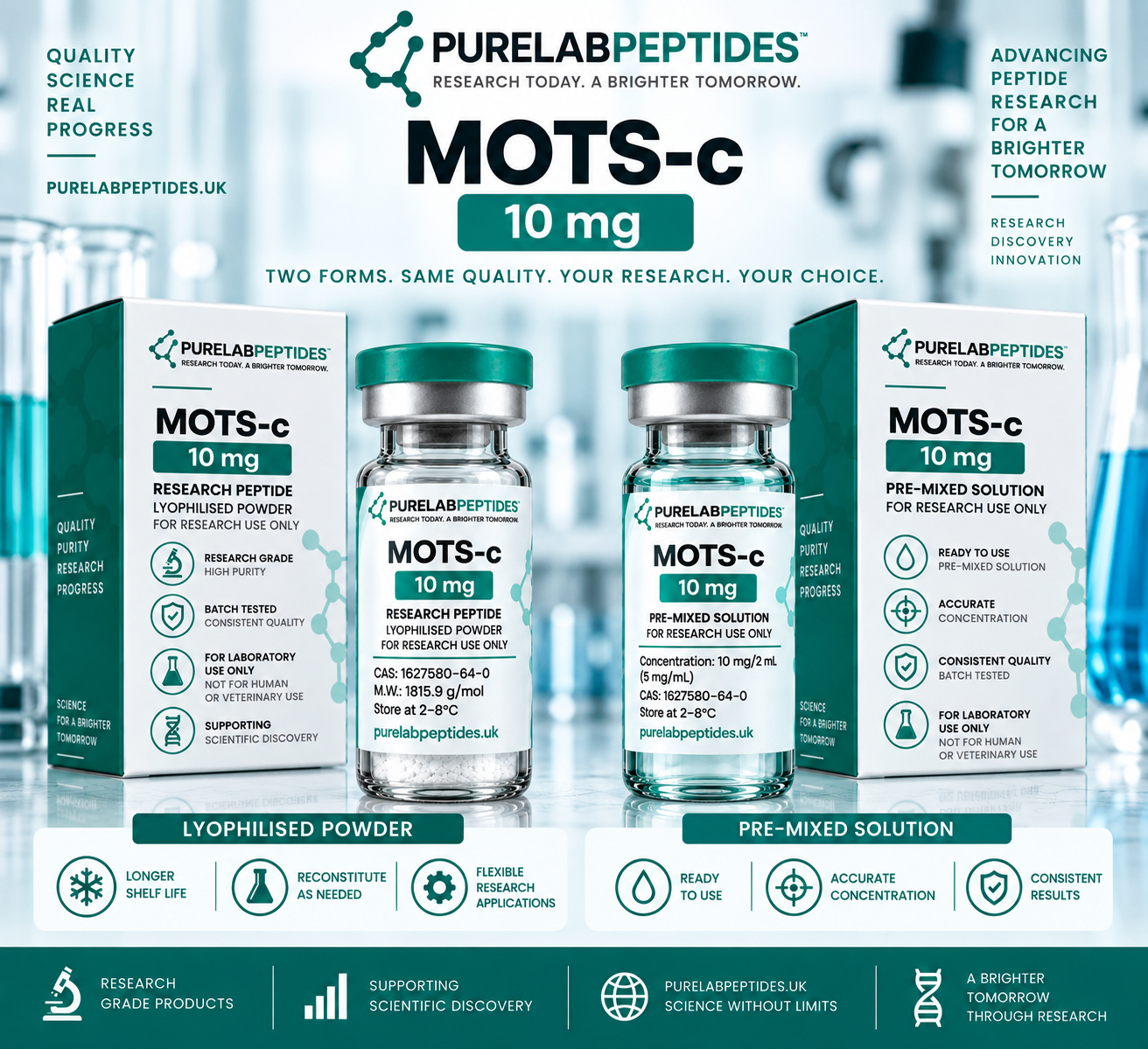
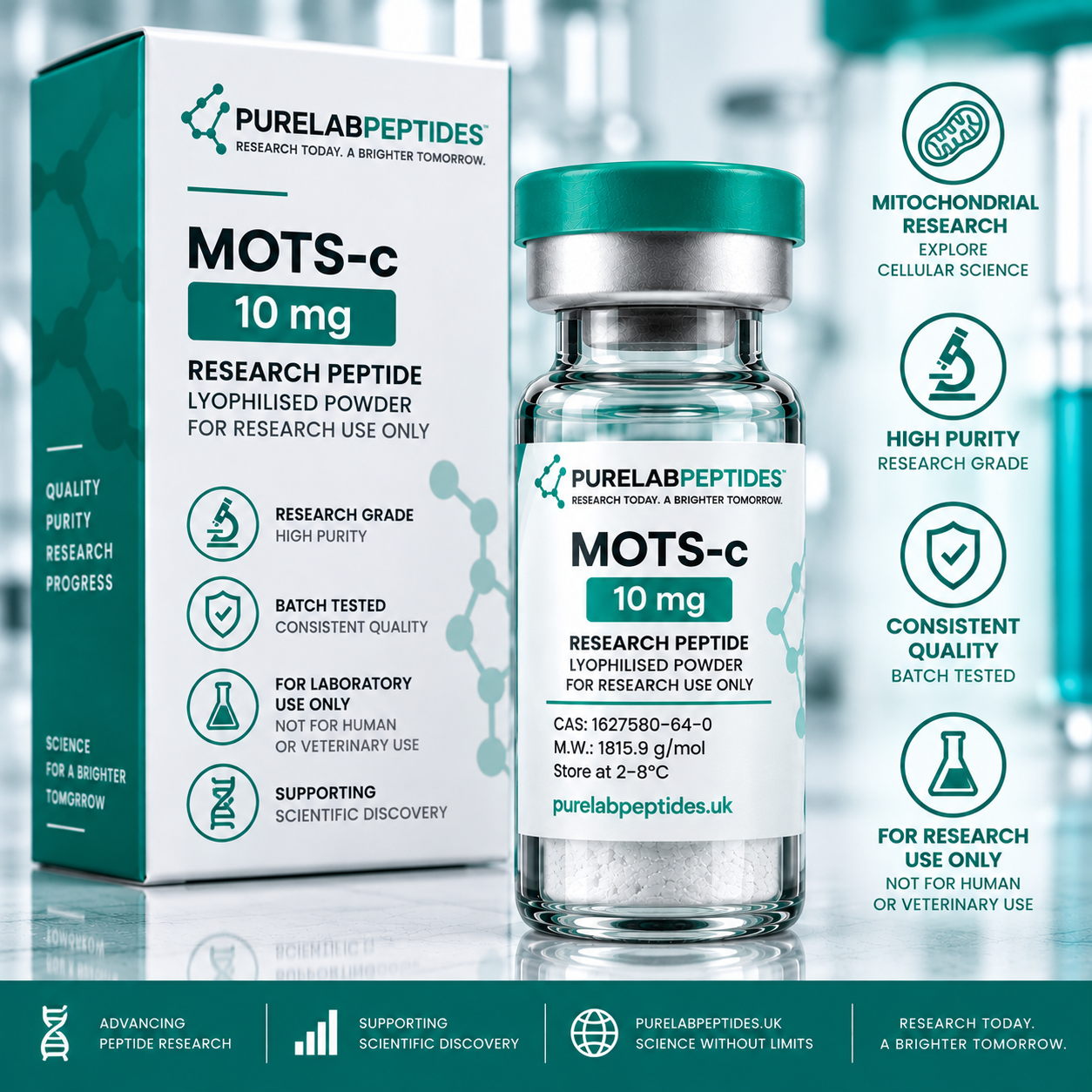
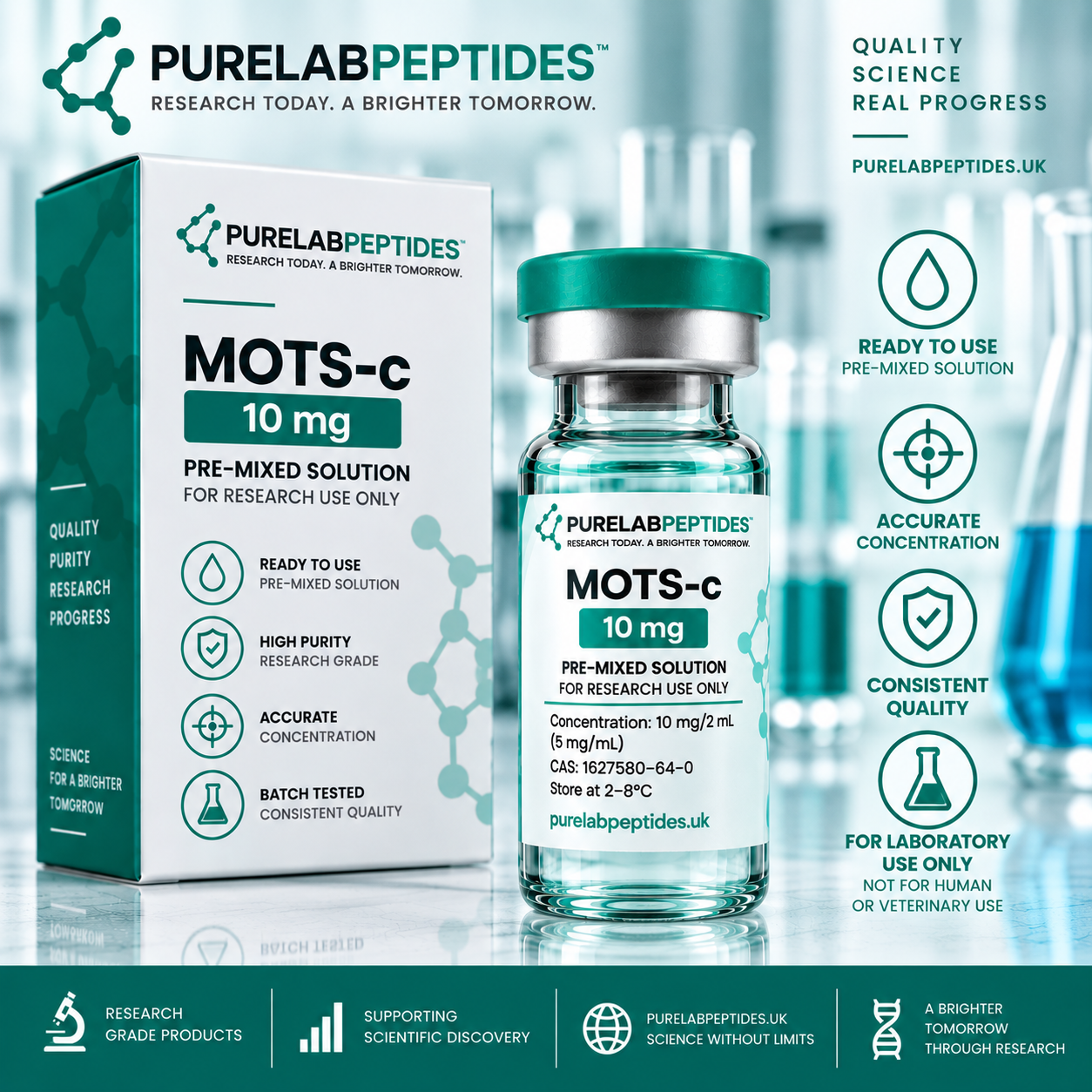
MOTS-c 10mg Research Peptide from PureLabPeptides.uk is a mitochondrial-derived peptide supplied for controlled laboratory, biochemical and analytical investigation. This 16-amino-acid research peptide provides an interesting model for studies involving mitochondrial signalling, cellular stress responses, metabolic pathways and molecular biology. For research use only. Not for human or veterinary consumption.

MOTS-c 10mg from PureLabPeptides.uk is a research peptide intended specifically for controlled laboratory, analytical and scientific investigation. MOTS-c 10mg Research Peptide
MOTS-c belongs to an intriguing class of molecules known as mitochondrial-derived peptides. Unlike most peptides whose genetic information originates from nuclear DNA, MOTS–c is associated with a short open reading frame located within the mitochondrial 12S ribosomal RNA region.
This unusual origin has made MOTS-c an important subject within emerging mitochondrial biology.
Researchers have investigated the molecule in experimental systems examining mitochondrial communication, metabolic regulation, cellular stress responses and interactions between mitochondrial and nuclear signalling.
PureLabPeptides.uk supplies MOTS-c 10mg strictly as a research-use-only material. It is not supplied as a medicine, dietary supplement, weight-management product, performance enhancer or product intended for self-administration.
MOTS-c stands for Mitochondrial Open Reading Frame of the 12S rRNA Type-c.
It is a mitochondrial-derived peptide consisting of 16 amino acids.
Mitochondria are widely recognised for their role in cellular energy production, but modern research has demonstrated that these organelles can also participate in signalling processes.
The discovery of mitochondrial-derived peptides has therefore expanded scientific understanding of communication between mitochondria and other parts of the cell. MOTS-c 10mg Research Peptide
MOTS-c represents one of the best-known examples within this developing research area.
Its mitochondrial origin and relatively short amino-acid sequence make it particularly interesting for scientists investigating cellular communication and metabolic biology.
MOTS-c has attracted scientific attention because experimental research suggests that mitochondrial-derived peptides may function as signalling molecules.
Researchers may investigate how MOTS-c responds to different experimental environments and how the molecule interacts with cellular pathways under controlled conditions. MOTS-c 10mg Research Peptide
Potential research areas include:
These areas describe scientific research questions and should not be interpreted as established therapeutic applications.
Mitochondria contain their own genetic material, separate from the DNA located within the cell nucleus.
Historically, mitochondrial DNA was understood primarily in terms of genes involved in mitochondrial function.
Research into short open reading frames has expanded this picture by identifying small biologically active peptides encoded within mitochondrial genetic regions. MOTS-c 10mg Research Peptide
MOTS-c is encoded within the mitochondrial 12S rRNA region and has become an important experimental example of mitochondrial-derived signalling.
Researchers can use the molecule to investigate how mitochondrial signals may communicate information concerning cellular conditions to other cellular systems. MOTS-c 10mg Research Peptide
This emerging field provides opportunities for understanding mitochondrial biology beyond conventional energy production.
One particularly interesting research area involves cellular responses to metabolic or environmental stress.
Experimental literature indicates that MOTS-c can relocate to the nucleus under certain stress conditions and participate in regulation of stress-responsive genes.
This provides researchers with an opportunity to examine communication between mitochondria and nuclear processes.
Laboratory experiments may investigate how different environmental conditions affect peptide localisation, molecular interactions or associated signalling pathways.
Such experiments should incorporate suitable controls and validated analytical techniques. MOTS-c 10mg Research Peptide
Findings from experimental systems should not automatically be extrapolated into claims concerning human health.
MOTS-c has also been investigated extensively within experimental metabolic research.
Early studies examined relationships between the peptide and cellular pathways involving metabolic homeostasis, including research concerning the folate-purine pathway and AMPK activation.
These observations have generated continuing scientific interest. MOTS-c 10mg Research Peptide
Researchers may use MOTS-c in suitable experimental models to examine metabolic signalling, cellular responses to changing energy conditions and interactions between mitochondrial signalling and other biochemical pathways.
Importantly, evidence from cells or animal models does not establish that externally administered MOTS-c provides equivalent effects in humans. MOTS–c 10mg Research Peptide
PureLabPeptides MOTS-c is supplied in a convenient 10mg research format.
This provides laboratories with a defined quantity for experimental planning, sample preparation and appropriately designed comparative studies.
Researchers remain responsible for determining suitable experimental concentrations based on their validated protocols and analytical requirements. MOTS-c 10mg Research Peptide
The 10mg designation describes the amount of research material supplied and must not be interpreted as a human dose.
PureLabPeptides.uk does not provide human administration or dosing instructions for MOTS-c.
MOTS-c may be incorporated into a variety of appropriately designed laboratory investigations.
Researchers might evaluate molecular identity, peptide stability or behaviour under different experimental conditions.
Comparative studies may investigate samples exposed to different temperatures, concentrations, cellular environments or biochemical conditions. MOTS-c 10mg Research Peptide
Scientists may also examine interactions involving signalling pathways identified within existing experimental literature.
Appropriate research design depends on the hypothesis being investigated, equipment available and validated procedures used by the laboratory.
Detailed documentation of experimental conditions is important for reproducibility.
Reproducibility is fundamental to scientific investigation.
When working with experimental peptides, researchers should carefully control variables including material identity, storage, preparation procedures, experimental concentration and environmental conditions.
Researchers should maintain comprehensive records throughout each experiment. MOTS-c 10mg Research Peptide
Where product-specific analytical documentation is available, laboratories should review that information before beginning their investigation.
Researchers may also conduct independent characterization when required by their institution or experimental protocol.
Research specifications should never be interpreted as evidence of pharmaceutical approval.
MOTS-c research material should be handled according to the product-specific storage information supplied with it.
Peptides can be sensitive to environmental conditions, making appropriate laboratory storage important.
Researchers should minimise unnecessary exposure to moisture, unsuitable temperatures and other conditions that could affect experimental integrity.
Samples should be clearly identified and protected against contamination.
Preparation procedures should be established according to validated laboratory protocols rather than information intended for pharmaceutical administration.
Research materials should also be stored securely so that they cannot be mistaken for medicines or consumer products.
MOTS-c is frequently discussed online in connection with metabolism, exercise, ageing and body composition.
However, proposed applications based on experimental findings should not be presented as established human benefits.
Human safety information for administered MOTS-c remains limited.
PureLabPeptides therefore supplies MOTS-c 10mg exclusively as an experimental research material.
It is not intended for human or veterinary consumption, self-administration, diagnosis, treatment, weight management, athletic enhancement or prevention of disease.
Researchers should evaluate published literature critically and comply with applicable institutional requirements.
PureLabPeptides.uk provides experimental peptide materials for researchers seeking clearly identified products for controlled scientific investigation.
MOTS-c 10mg offers a practical research format for laboratories investigating mitochondrial-derived peptides and related molecular pathways.
Clear product identification and responsible research-only positioning are especially important for experimental molecules without established clinical applications.
Researchers should review current product specifications and available analytical information before purchasing.
Researchers can order MOTS-c 10mg Research Peptide directly from PureLabPeptides.uk for legitimate laboratory, biochemical and scientific investigation.
Its unusual mitochondrial origin makes MOTS-c particularly interesting for experimental studies involving mitochondrial communication, cellular signalling and metabolic biology.
Before ordering, laboratories should determine whether the product specifications are appropriate for their intended research protocol.
PureLabPeptides MOTS-c 10mg is supplied strictly for laboratory research. Not for human or veterinary consumption.
MOTS-c is a 16-amino-acid mitochondrial-derived peptide. PureLabPeptides supplies it in a 10mg format specifically for controlled scientific and laboratory research.
MOTS-c stands for Mitochondrial Open Reading Frame of the 12S rRNA Type-c, reflecting the mitochondrial genetic region associated with the peptide.
MOTS-c consists of 16 amino acids, making it a relatively short mitochondrial-derived peptide.
Its mitochondrial origin makes MOTS-c particularly interesting for research concerning mitochondrial signalling, cellular stress responses, metabolic pathways and communication between mitochondria and the nucleus.
The 10mg designation refers to the stated quantity of research material supplied. It does not represent or imply a recommended human dose.
No. MOTS-c 10mg from PureLabPeptides.uk is supplied exclusively for laboratory research and is not intended for human or veterinary consumption or self-administration.
Metabolic signalling is an established area of experimental MOTS-c investigation. Researchers should interpret findings according to the limitations of the particular cellular, biochemical or animal model being studied.
No such claim should be made for this research product. Experimental studies have generated interest in metabolic and ageing-related pathways, but these findings do not establish PureLabPeptides MOTS-c as an approved or clinically proven treatment.
Researchers should follow the specific storage instructions accompanying the product and maintain suitable laboratory conditions designed to protect peptide stability and experimental integrity.
Researchers can order MOTS-c 10mg Research Peptide through PureLabPeptides.uk for legitimate laboratory and scientific investigation, subject to availability and applicable requirements.
| Form | Pre-Mixed, Vial |
|---|
Reviews
There are no reviews yet.